Categories
lawlibrary Legal Technology

Online Databases in the Limelight – VerdictSearch

Blog PhotoOnline databases can be invaluable, time-saving  tools to any legal researcher as they provide organized access to a wide array of legal resources as well as sophisticated search tools.  Many online databases, including fee-based databases, are available at the Law Library, free of charge, to library patrons.  Each Tuesday of this month, this blog will highlight one of the many databases available at the Law Library.

Are you looking for case valuation assistance?  Then look no further because the Law Library subscribes to VerdictSearch, an online database that assists with verdict and settlement research.  VerdictSearch at the Law Library provides users with access to federal and state cases from Maryland, Virginia and Washington D.C.  Users can search by specific terms as well as by type of injury (e.g., arm, brain, cancer), award (e.g., decision in favor of defendant, settlement, mediated settlement) and case (e.g., appeals, business law, civil practice).  Users can further refine their searches by plaintiff type (e.g., age, gender) and date range.  These searches may assist you with your trial research and strategy development.  VerdictSearch’s document delivery includes printing and email (PDF and Word).

Law Library patrons may use VerdictSearch in the library’s computer room free of charge.  If you have any questions regarding how to use VerdictSearch, please come to the Law Library’s service desk.

For more information about understanding legal research, including the difference between primary and secondary legal resources, check out these research guides.

*Note that VerdictSearch does offer a national database as well as practice area-specific databases.  The Library subscribes only to the Maryland, Virginia and Washington D.C. databases as these jurisdictions are the most relevant for the Law Library’s patrons.

Categories
lawlibrary Legal Technology

Online Databases in the Limelight – HeinOnline

Computer Room Photo
Access to HeinOnline is available in our computer room.

Online databases can be invaluable, time-saving  tools to any legal researcher as they provide organized access to a wide array of legal resources as well as sophisticated search tools.  Many online databases, including fee-based databases, are available at the Law Library, free of charge, to library patrons.  Each Tuesday of this month, this blog will highlight one of the many databases available at the Law Library.

Last week, this blog published a post about the Westlaw and Lexis databases available at the Law Library. This week, we would like to introduce you to another great database, HeinOnline. HeinOnline is the largest, image-based legal research database with full-text and page images of law review articles, treatises and primary sources of law. HeinOnline users can search for specific resources or browse one of the database’s many collections. For example, you can browse the Law Journal Library collection and see a listing of a specific Law Review’s articles, organized chronologically. Library patrons can access HeinOnline in the library’s computer room.

There is overlap between the resources available on HeinOnline and the resources available on the Westlaw and Lexis. However, there are two big reasons why users may prefer to use HeinOnline over Westlaw and Lexis. First, HeinOnline is an image-based database. This means that users can see page images of documents, including graphics, which match the print versions of the resources. Second, HeinOnline has a greater focus on retrospective historical coverage, meaning that users will be able to find older documents that may be unavailable in the other databases. For example, are you interested in railroad case law from the 1800s?  You can find many cases in HeinOnline’s Early American Case Law collection.

For more information about understanding legal research, including the difference between primary and secondary legal resources, check out these research guides.

Categories
lawlibrary

Legal Research in the Blogosphere – Law Review Commons

Legal research can be challenging, even for experienced attorneys; however, there are many resources available to assist both attorneys and non-attorneys with their legal research needs.  The Legal Research in the Blogosphere series will share blog posts and online sites that legal researchers may find useful.

The Law Review Commons (http://lawreviewcommons.com/) is a free, online collection of law reviews and legal journals.  (A law review is a scholarly journal focused on legal issues, which is most commonly published through a law school or a bar association.)  Users can both search and browse the collection of current and archival content.  Check out the Law Review Commons and let us know what you think!

The Law Sites blog (http://www.lawsitesblog.com/) provides a short review fo the Law Review Commons at http://www.lawsitesblog.com/2014/11/largest-free-collection-law-reviews-web.html.

Categories
lawlibrary

Legal Research in the Blogosphere

Legal research can be challenging, even for experienced attorneys; however, there are many resources available to assist both attorneys and non-attorneys with their legal research needs.  The Legal Research in the Blogosphere series will share blog posts and online sites that legal researchers may find useful.
 

We would like to share a great post on the Ms. JD blog (http://ms-jd.org/) about legal research strategy, which is available at http://ms-jd.org/blog/article/research-makeover-strategy-in-legal-research-seeing-your-research-through-f.  

Targeted to attorneys, the post lays out a three-step process for legal research: (1) strategize, (2) dive-in and (3) knowing when to stop.  The post also provides some tips about how to keep your research organized.  Check out the post, and let us know your thoughts!

Categories
lawlibrary Legal Technology

Online Databases in the Limelight – Westlaw & Lexis

photo 1
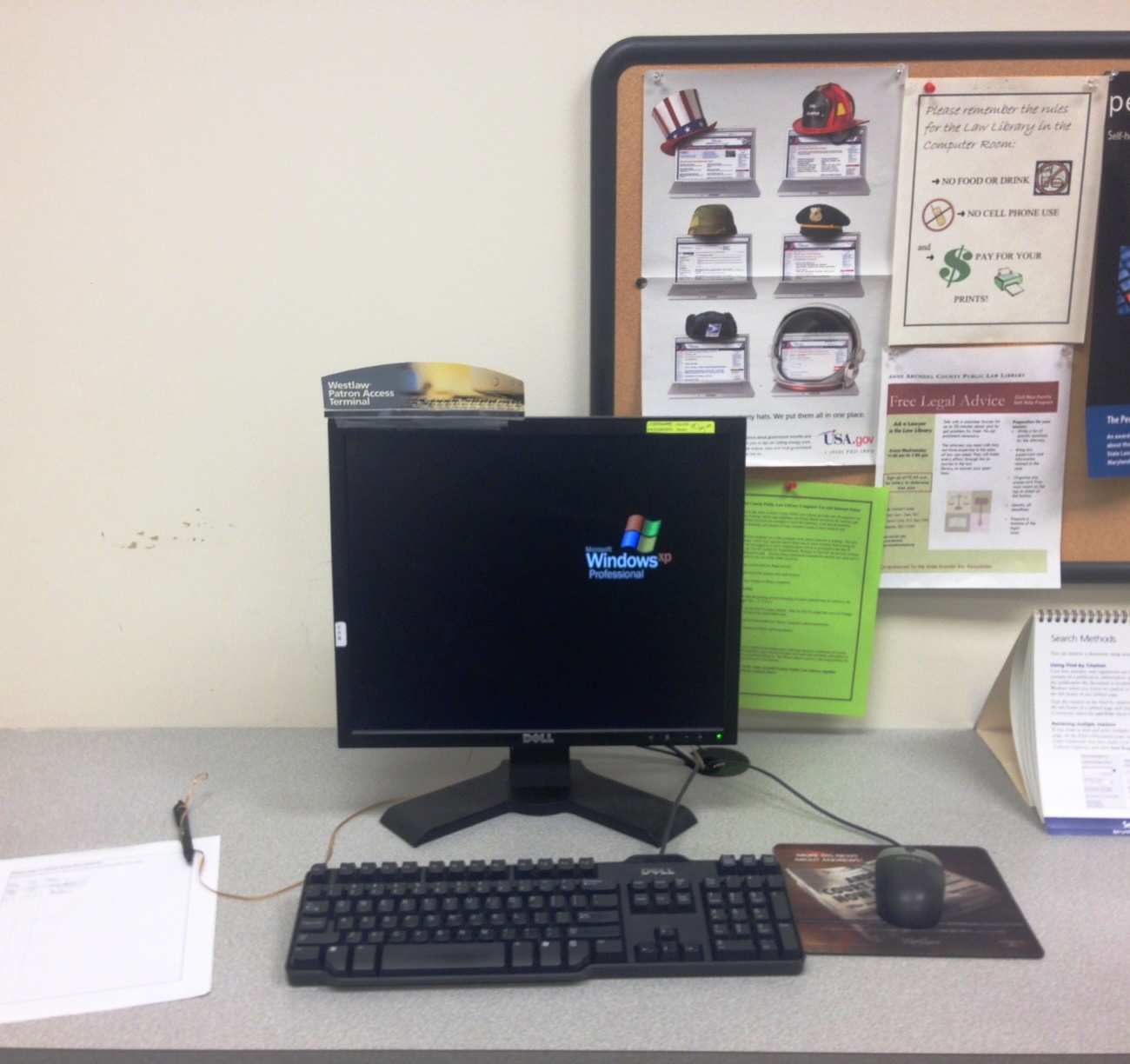
Here is one of two computers in our computer room that prioritizes Westlaw access.

Online databases can be invaluable, time-saving tools to any legal researcher as they provide organized access to a wide array of legal resources as well as sophisticated search tools. Many online databases, including fee-based databases, are available at the Law Library, free of charge, to library patrons. Each Tuesday of this month, this blog will highlight one of the many databases available at the Law Library.

Westlaw (www.westlaw.com) and Lexis (www.lexis.com) are two of the biggest players in the world of legal publishing and online legal research. These two legal services providers offer searchable databases with access to a wide array of primary resources, such as federal and state statutes, federal and state regulations and case law, as well as secondary resources, such as encyclopedias, treatises, journal articles and form books.*

There is a myriad of tools, resources and services available through both Westlaw and Lexis. One of the most popular services provided through Westlaw and Lexis is the online case citator service provided by each database (KeyCite for Westlaw and Shepard’s Case Citations for Lexis). These case citators identify all published cases and other sources that cite (e.g., refer to) the case being reviewed by the legal researcher and provide additional information, such as the reason why the later case cited the case at hand. This is important information to have as later cases can affect the value of the case at hand or later cases may better address the matter being researched. In addition, both databases provide document delivery services (e.g., email, PDF downloads, RTF downloads) so that users can access certain resources after the online session has concluded.

Access to these two databases can be very expensive, but the Law Library maintains subscriptions to both databases so that library patrons can access the databases free of charge. Law Library patrons can directly access these databases in the Law Library’s computer room. For those of you who are new to Westlaw and Lexis, the Law Library is available to assist you in learning how to use both databases and identifying the resources available through the databases. For those of you who have used Westlaw and Lexis in the past, the Law Library can assist you with searching more effectively. Please drop by the Law Library’s service desk, and we will help you get started.

 *For more information about understanding legal research, including the difference between primary and secondary legal resources, check out these research guides.

Categories
lawlibrary

ADR Collection Available in the Law Library

The following books were donated to the law library by the Office of Case Management so that they would be more accessible to those who might benefit from them.  They are shelved with the library’s self-help collection located in the aisle that leads to the Family Law Self-Help Center. They were purchased with support money from the Maryland Judiciary’s Mediation & Conflict Resolution Office. 

  • Principles of Alternative Dispute Resolution 2nd ed. / Stephen J. Ware (West, 2007).  (ADR KF 9084 .W7 2007)        
  • Renegotiating Family Relationships: Divorce, Child Custody, and Mediation 2nd ed. / Robert E. Emery (Guilford Press, 2012).  (ADR HQ 834 .E48 2012) 
  • Alternative Dispute Resolution: A Conflict Diagnosis Approach / Laurie S. Coltri (Prentice Hall, 2010).  (ADR K 2390 .C655 2010) 
  • Dispute Resolution: Negotiation, Mediation, Arbitration, and Other Processes 6th ed. / Stephen B. Goldberg &  Frank E.A. Sander (Wolters Kluwer Law & Business, 2012).  (ADR KF 9084 .G65 2012) 
  • Family Mediation: Contemporary Issues / Howard H. Irving & Michael Benjamin (Sage Publications, 1995).  (ADR HQ 10.5 .N7 I78 1995) 
  • A Guide to Divorce Mediation: How to Reach a Fair, Legal Settlement at a Fraction of the Cost / Gary J. Friedman & Jack Himmelstein (Workman Pub., 1993).  (ADR KF 535 .Z9 F68 1993)Mediation: Principles and Practice / Kimberlee K. Kovach (West, 2004).  (ADR KF 9084 .K68 2004)The Foreclosure Mediation Training Guide / Victoria Ring ( Graphico Pub., 2007).  (ADR KF 697 .F6 R56 2007) 
  • The Mediation Process: Practical Strategies for Resolving Conflict 3rd ed. / Christopher W. Moore (Jossey-Bass, 2003).  (ADR HM 1126 .M667 2003) 
  • The Handbook of Family Dispute Resolution: Mediation Theory and Practice / Alison Taylor (Jossey-Bass, 2002).  (ADR HQ 10 .T28 2002) 
  • Essentials of Alternative Dispute Resolution 2nd ed. / Susan R. Patterson & D. Grant Seabolt, Jr. (Pearson Publications Co., 2001).  (ADR KF 9084 .P47 2001) 
  • Stop Fighting Over the Kids : Resolving Day-To-Day Custody Conflict in Divorce Situations 1st ed. / Mike Mastracci (Saint Gabriel’s Press, 2009).  (ADR HQ 834 .M7 2009) 
  • The Practice of Mediation: A Video-Integrated Text 2nd ed. / Douglas N. Frenkel & James H. Stark (Wolters Kluwer Law & Business, 2012).  (ADR KF 9084 .F746 2012) 
  • Foreclosure Nation: Mortgaging the American Dream / Shari Olefson (Prometheus Books, 2009).  (ADR HD 255 .O44 2009) 
  • Help! I’m facing Foreclosure: What Are My Options? / William Tyler (PublishAmerica, 2009).  (ADR KF 697 .F6 .T4 2009)
  • Coping with the Foreclosure Crisis : State and Local Efforts to Combat Foreclosures in Prince George’s County, Maryland (Government Printing Office , 2009).  (ADR KF 697 .F6 .S6 2009) 

Other titles in the law library shelved with the general collection include:

  • Mediation: A Handbook for Maryland Lawyers / Honorable Daniel E. Klein, Honorable Kaye A. Allison & Perry F. Sekus, (MICPEL, 1999).  (KFM1760.3.K54 1999) 
  • How Arbitration Works 6th ed. / Alan Miles Ruben, ed. (American Bar Association, Committee on ADR in Labor & Employment Law, The Bureau of National Affairs, Inc., Washington, D.C., 2003).  (KF3424.E53 2003) 
  • How Arbitration Works 6th ed.: 2010 Cumulative Supplement / Kenneth May, ed. (American Bar Association, Committee on ADR in Labor & Employment Law, 2010).  (KF3424.E53 2010) 
  • The Alternative Dispute Resolution Practice Guide / Betty J. Roth & Randall W. Wulff (West, 1997.)  (KF9084.A93 1997) 
  • The Law of Alternative Dispute Resolution / Margaret Jasper (Dobbs Ferry, NY : Oceana 2000).  (KF9084.Z9 J37) 
  • Mediation in a Nut Shell 2nd ed. / Kimberlee K. Kovach (West, 2010).  (KF9084.K68 2010) 
  • Mediation: Law, Policy & Practice / Sarah R. Cole & Craig A. McEwen (West, 2012).  (KF9084.M44 2012) 

 There is also an AACPLL Wiki page, ADR -Alternative Dispute Resolution, with additionlal information.

Categories
lawlibrary

WestlawNext Patron Access

Have you tried WestlawNext Patron Access?

This new interface, WestlawNext, is now accessible in the law library’s computer room. WestlawNext is in addition to the “old” Westlaw, now referred to as Westlaw Classic, you may be accustomed to. One big difference that will be appreciated by library users is the ability to download and email results. These features are only available with Next, printing is the still the only option for the Classic version.

With WestlawNext you do not have to begin your research session by choosing a database to search. Instead, you need only type your search terms in the search box at the top of the page. This has a more Google like feel to it. However, you can still use the old Boolean terms and connectors in the search box and you can still select the database in which you would like to search. If you don’t though, your results will be presented to you in an organized manner. In the middle of the results screen will be the Overview. The Overview displays the results by document type displaying the most relevant within each category. Listed first will be cases, followed by statutes, regulations, secondary sources and more. On the left of the screen all of the categories will be listed with the number of results for each showing in parens. As you might guess, the number of results can be quite large, just like a Google search. This is where the ability to “filter” comes in. Once one of the categories of results or even “all results” is chosen, boxes will appear below the results on the left that allow the narrowing of the search. You could search within the results by typing in a search term such as “Maryland” or any combination of terms and connectors.

What if you just want to find a case or use Keycite, the citator? To search for a specific case, you would just enter the citation or case name in that same search box. A bar showing Keycite results will display automatically across the top of displayed documents once it is viewed.

Westlaw and WestlawNext Content

Both Westlaw Classic and WestlawNext have access to Maryland’s cases, code, regulation, Attorney General Opinions and some secondary sources such as the MLE and Maryland form books.

This is in addition to access to all state and federal cases and statutes, too. The general secondary sources include ALR, Black’s, the encyclopedias AmJur and CJS, and the Restatements and Principles of the Law. Titles of interest to litigators are the AmJur Proof of Facts, AmJur Trials and Causes of Action. The law library has a number of form books published by West. These sets along with many other titles not available in the library can be searched through the Form Finder on Westlaw and WestlawNext.

Next time you are in the law library, give WestlawNext a try at the computers labeled with a Westlaw sign. We will be happy to help you with your research using Next or the Westlaw Classic. You can also find out more through the online tutorials available on those Westlaw computers.

Categories
lawlibrary

Try Sailor at the Anne Arundel County Public Library for Access to Journal Articles and Non-Legal Information

The Anne Arundel County Public Library is a good resource for those times when your research requires non-legal information.  Through the AACPL website you can access Sailor.  As explained on the website: “Sailor is a service of Maryland’s public libraries that provides broadband Internet access for public libraries, schools and local government in Maryland, and an extensive collection of research databases for the use of Maryland public library customers.”

The Research Databases “button” provides access to a number resources  that might be of interest to legal researchers. Links and the database descriptions from Sailor follow:

Business Source Premier  for “business related newspapers and journals. Non-journal content includes company profiles, country reports, industry reports, market research reports, and SWOT analyses.”

MasterFile  for “a wide variety of journal articles, magazine articles, primary source documents, reference book entries and images.”

Regional Business News   where you can “search articles from Crain CommunicationsBusiness PhiladelphiaDaily Record (Baltimore Edition), New York Observer andWashington Times.”

Science Reference Center   where you can “search science oriented reference sources, science journals, biographies, and science related animations, videos, and images.”

In order to access you may have to enter the number on your library card or choose your library system from a drop-down menu.

Please remember that when you need non-legal information for your research you can use your public library right from your desk.

Categories
lawlibrary Maryland Law Self Represented

Self Help Guide for the Maryland Court of Appeals

The Maryland Court of Special Appeals has published “A Guide for Self-Representation: Maryland Court of Special Appeals.”  The library has added copies as part of the library collection (KFM1755.G85 2012) and has copies available for distribution.  The manual is also available online: http://mdcourts.gov/cosappeals/pdfs/cosaguideselfrepresentation.pdf

Categories
lawlibrary

FDsys : The Source for Free Online Government Information

Starting today, March 16, 2012, FDsys is the site for online official  and authentic federal government information.  FDsys is replacing the former GPO Access site which is has been archived and is no longer online.

Today the Budget for Fiscal Year 2013 is featured on the home page.  However, you can find information from all branches of the federal government including the Code of Federal Regulations, the United States Code, Congressional Reports,  and U.S. Court Opinions.  To get a good picture of all that can be found here, it is a good idea to use the “Browse Collections” feature.

An important feature as mentioned above is that you can find authenticated information.  For example, if you look at a section (Sec. 502.5 of  Title 12) of the CFR you will see a certificate of authenticity stating that what you are seeing is “Authenticated U.S. Government Information.”  Authenticated information lets the reader know that they are looking at the real thing.  This important feature is not found on many other government websites.  Hopefully other government entities will follow this example for online government information.