The Ask A Lawyer In The Library program is a civil, non-family law, self-help program sponsored by The Anne Arundel Bar Association and the Maryland Volunteer Lawyers Service. Every Wednesday, from 11:00 a.m. to 1:00 p.m., you can talk with a volunteer attorney for up to 20 minutes. No appointment is necessary, but sign-up is required at the law library’s information desk. Sign-up begins at 10:45 a.m., and time slots are determined by a lottery. For more information, please see http://circuitcourt.org/legal-help/lawyer-in-the-library.
On Wednesday, June 24, 2015, the Law Library hosted another successful Ask A Lawyer In The Library program. Thank you Michael Marinello and Megan Cooper from the Kagan Law Group, for volunteering and providing this service to the public. Seven people took part in the program and were able to speak with an attorney to request assistance with restitution, eviction, contracts, wrongful termination, estate and mandamus orders. The next program date is Wednesday, July 1, 2015.
Print copies of the article are available in the Law Library!
Law libraries provide essential services to self-represented litigants. To highlight the work that law libraries do to promote access to justice as well as available opportunities to expand services, your friendly Law Library Intern and Law Library Director, together with Sara Galligan of the Ramsey County Law Library, authored an article for the 2015 edition of Trends in State Courts. Published by the National Center for State Courts, Trends in State Courts is an annual, peer-reviewed publication targeted to the state court community to showcase court innovations, initiatives, policies and programs.
The 2015 Edition of Trends in State Courts is available in print and electronic format. Check out our article on page 77! Print copies of the article are available in the Law Library.
If you are interested in learning more about how law libraries can service self-represented litigants and promote access to justice, please contact us!
The Ask A Lawyer In The Library program is a civil, non-family law, self-help program sponsored by The Anne Arundel Bar Association and the Maryland Volunteer Lawyers Service. Every Wednesday, from 11:00 a.m. to 1:00 p.m., you can talk with a volunteer attorney for up to 20 minutes. No appointment is necessary, but sign-up is required at the law library’s information desk. Sign-up begins at 10:45 a.m., and time slots are determined by a lottery. For more information, please seehttp://circuitcourt.org/legal-help/lawyer-in-the-library.
On Wednesday, June 10, 2015, the Law Library hosted another successful Ask A Lawyer In The Library program. Thank you, Jonathan Pasterick of Hillman Brown & Darrow, P.A., for volunteering and providing this service to the public. Five people took part in the program and were able to speak with the attorney to request assistance with issues regarding contracts, homeowner association repairs, judgments, and deeds. The next program date is Wednesday, June 24, 2015.
Legal research can be challenging, even for experienced attorneys; however, there are many resources available to assist both attorneys and non-attorneys with their legal research needs. The Legal Research in the Blogosphere series will share blog posts and online sites that legal researchers may find useful.
In Custodia Legis (“in the custody of the law”) is the blog of the Law Librarians of Congress. The blog’s posts cover a wide array of U.S. and foreign legal topics, including legal trends, developments and issues. In addition, the blog is a great resource to learn more about Congress.gov, which is the official federal website for U.S. federal legislative information. Below, please find a sampling of posts that caught our attention.
In 2012, the Limited License Legal Technician (LLLT) Rule became effective in Washington State. The rule’s purpose is to meet the unmet legal needs of the public through expanding the availability and affordability of quality legal assistance, thus the rule “authorize[s] certain persons to render limited legal assistance or advice in approved practice areas of law.” Pursuant to actions by the LLLT Board, which was established by the Washington State Supreme Court to administer the LLLT program, the first practice area is domestic relations. This means that in the domestic relations practice area, limited license legal technicians who have passed the licensing examination (this includes a subject area and professional responsibility exam) and fulfilled other licensing requirements will be able to provide litigants with legal advice and assistance.
This month, seven people passed Washington State’s first exam for limited license legal technicians to practice in domestic relations. There are additional steps remaining, such as 3,000 hours of supervised experience, but Washington State’s first successful candidates are on their way to being able to provide certain legal advice and assistance in domestic relations matters.
Washington State is the first and only state thus far to allow limited license legal technicians, but it is under consideration or discussion in other states, such as California, Oregon and New York. The American Bar Association’s Commission on the Future of Legal Services is also reviewing limited license legal technicians. Check out this report by the ABA Task Force on the Future of Legal Education, which includes a recommendation for the adoption of “new or improved frameworks for licensing or otherwise authorizing providers of legal and related services”, which should include “licensing persons other than holders of a J.D. to deliver limited legal services” in order to expand access to justice. However, the future of limited license legal technicians in the United States remains unclear.
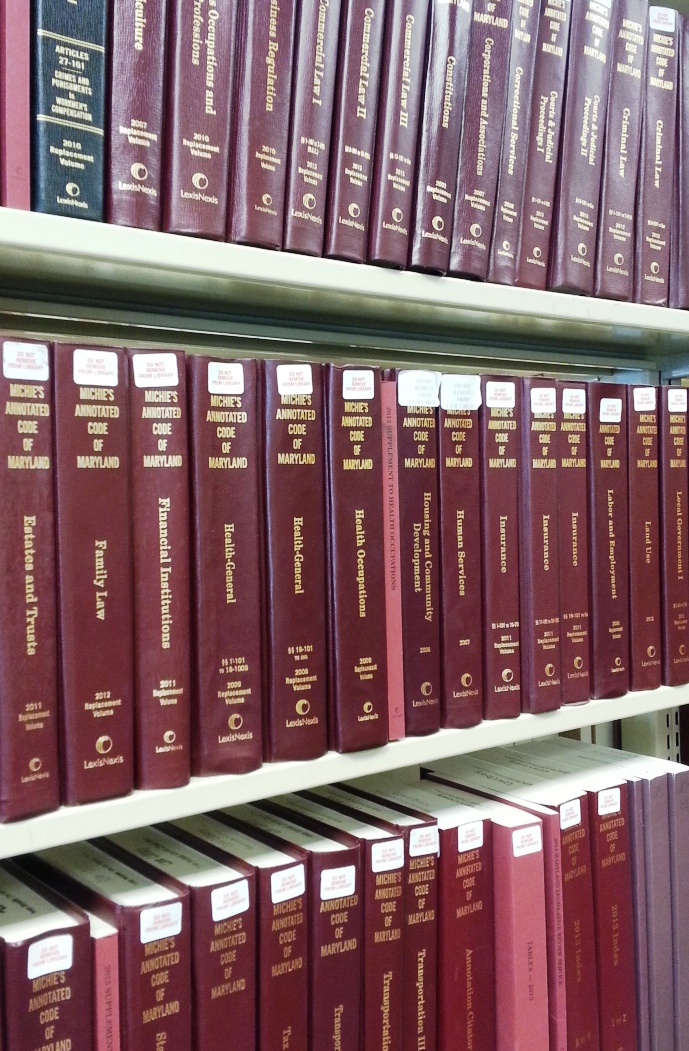
Here are print copies of the Annotated Code of Maryland.
In connection with the Law Library’s celebration of Law Day, we will be publishing a series of eight posts that focus on the basics of the Maryland court system and legal research.
For the Law Library’s legal researchers, the main goal is to find the “law” that will solve his or her legal problem or answer a specific legal question. The legal researchers are looking for relevant primary authorities, which are the binding laws for their case. These primary authorities come from several different sources, and you must read all of the primary sources of law together in reaching your legal conclusion.
Before we start discussing primary legal sources, a research tip is to start with secondary legal resources because these secondary resources have already done a lot of the work for you by reviewing and summarizing the relevant primary legal sources. These secondary legal resources, such as books, articles, formbooks and websites, are often more user-friendly than primary legal sources and can provide summaries of the law, explanations of the law and, most importantly, citations to the relevant primary sources.
Returning to primary legal sources, the main sources of primary law are statutes, regulations, and case law, which this post will briefly describe below.
Statutes. Most people probably think of statutes when they are thinking about the “law”. Statutes are the laws passed by legislatures (for example, the Maryland General Assembly and the United States Congress). Statutes are generally organized by subject in a set called a “code”. For example, you can find the statutes relating to divorce in the Family Law Article of the Maryland Code.
The Law Library’s collection includes The United States Code Annotated, Michie’s Annotated Code of Maryland and West’s Annotated Code of Maryland. You can also access these statutes and statutes from other jurisdictions through our online legal databases.
Regulations. Regulations are perhaps the least well-known of primary legal sources. Regulations are made by executive agencies (for example, the Federal Aviation Agency in the United States Executive Branch and the Maryland Department of Transportation). These agencies derive their rule-making power from statutes passed by the appropriate legislature, granting them those powers. These statutes set forth the subjects and limits of the agency’s rule making powers. So, it is important to read the regulations in conjunction with the relevant authorizing statutes. In Maryland, regulations are printed in the Code of Maryland Administrative Regulations (COMAR). Federal regulations are printed in the Code of Federal Regulations (CFR).
The Law Library’s collection includes COMAR as well as a subscription to the Maryland Register (the Maryland Register is the supplement service for COMAR that is published every two weeks). In addition, the Law Library’s collection also includes the Code of Federal Regulations and Federal Register. Drop by the Law Library, and we will show you how to use these resources!
Case Law. Case law is the law made by judges (usually at the appellate level). Judges write opinions, which are written explanations that justify a court’s decision and usually includes a statement of facts and the law. Navigating case law is a bit more difficult than navigating statutes and regulations, but equally important because case law can be binding legal authority. Stay tuned because this blog will be posting an article later this month on the topic of case law and opinions.
In the Law Library, you can find case law in print and electronic formats. In print, the cases are published in serials called reporters, which publish the cases in rough chronological order. The Law Library’s collection include Maryland Reports (cases from Maryland Court of Appeals) and Maryland Appellate Reports (cases from the Maryland Court of Special Appeals) as well as certain regional and federal reporters. You can also access the cases online through the Law Library’s subscriptions to online legal databases.
In addition, don’t forget Court Rules, which set out the procedures that you will need to follow. These procedures will vary from court to court and govern things like time limits, service, formats before, during and after a trial.
The Law Library’s collection includes the Annotated Maryland Rules and the Maryland Rules Commentary as well as resources related to the Federal Rules of Procedure.
This post is intended to provided a brief overview only. For additional information, the Maryland People’s Law Library is a great resource for learning more about legal research and how to get started in the Maryland court system. Check out these articles on the Maryland People’s Law Library.
The Basics of Finding the Law – This article provides an overview of where to find the “law”. Read the article about Understanding Legal Research first.
Finding and Using Secondary Sources – Secondary sources, such as articles, encyclopedia, and form books can be very helpful and, for most legal researchers, reading secondary sources is the best place to start. This article provides guidance in locating useful secondary resources.
Research Guides – The Maryland People’s Law Library research guides based on subject area (for example, Adoption, Bankruptcy, Divorce, Immigration, Workplace Safety)
Evaluating Legal Websites – There is a lot of information available online, but not everything is trustworthy. This article provides some helpful tips to help you decide whether you should rely on what you found on a website. In addition, you can always contact us here at the Law Library.
Getting Help from Law Librarians – The Law Library is always happy to assist you with your legal research, but the process can be very complicated, and there are certain things that the librarians cannot do, such as provide legal advice (because we are not attorneys). This article will help you get the most out of your relationship and interactions with the law librarian.
Stay tuned for the next post in our Law Day Series, which will provide an overview of case law research in Maryland.
The Ask A Lawyer In The Library program is a civil, non-family law, self-help program sponsored by The Anne Arundel Bar Association and the Maryland Volunteer Lawyers Service. Every Wednesday, from 11:00 a.m. to 1:00 p.m., you can talk with a volunteer attorney for up to 20 minutes. No appointment is necessary, but sign-up is required at the law library’s information desk. Sign-up begins at 10:45 a.m., and time slots are determined by a lottery. For more information, please seehttp://circuitcourt.org/legal-help/lawyer-in-the-library.
On Wednesday, June 10, 2015, the Law Library hosted another successful Ask A Lawyer In The Library program. Thank you, Chris Boucher, for volunteering and providing this service to the public. Six people took part in the program and were able to speak with the attorney to request assistance with issues regarding contracts, property, estates and foreclosure. The next program date is Wednesday, June 17, 2015.
Do you have a criminal law matter? Criminal Law matters are best addressed by the Office of the Public Defender. Information about the Office of the Public Defender is available at http://www.opd.state.md.us/.
The BARBRI Group conducted an annual survey of law students, professors, and practitioners to assess perceptions regarding recent law graduates’ readiness to practice law. While 76% of 3Ls felt that were practice-ready, only 56% of practicing attorneys who work with recent graduates felt that the recent graduates were ready to practice. The survey report is available here.
In light of the survey findings, we would like to share a list of titles available at the Law Library that can assist with developing a new attorney’s career and practice.
The Legal Career Guide: From Law Student to Lawyer by Gary A. Munneke and Ellen Wayne
Nonlegal Careers for Lawyers by by Gary A. Munneke, William D. Henslee and Ellen Wayne
Anatomy of a Trial: A Primer for Young Lawyers by Mark Paul Sandler
Lawyers and the American Dream by Stuart M. Speiser
You Raised Us – Now Work with Us: Millennials, Career Success, and Building Strong Workplace Teams by Lauren Stiller Rikleen
The Millennial Lawyer: Making the Most of Generational Differences in the Firm by Ursula Furi-Perry
Handling Cases Series
Handling Accident Cases by Albert Averbach
Handling Child Custody, Abuse, and Adoption Cases by Ann M. Haralambie
Handling Criminal Appeals by Jonathan M. Purver
Handling Drinking and Drive Cases in Maryland by Patrick E. Maher et al.
Handling Federal Estate and Gift Taxes by Myron Kove
Handling Federal Tort Claims: Administrative and Judicial Remedies by Lester Jayson
Handling Juvenile Delinquency Cases by F. Lee Bailey
Handling Narcotic and Drug Cases by F. Lee Bailey
Handling Social Security Disability Cases by Elliott D. Andalman et al.
In addition, the survey report found that, when forced to choose, both practicing attorneys and law school faculty ranked writing as the most important skill for recent law school graduates. The Law Library has many titles available for both new and experienced attorneys who wish to improve their legal writing. Check out these titles.
Legal Writing in a Nutshell by Lynn Bahrych
The Grammar and Writing Handbook for Lawyers by Lenne Eidson Espenschied
A Dictionary of Modern Legal Usage by Brian A. Garner
The Elements of Legal Style by Brian A. Garner
The Winning Brief: 100 Tips for Persuasive Briefing in Trial and Appellate by Brian A. Garner
Judicial Opinion Writing Handbook by Joyce J. George
The Lawyer’s Guide to Writing Well by Tom Goldstein and Jethro K. Lieberman
The Scrivener: A Primer on Legal Writing by Thomas R. Haggard
The Modern Rules of Style by Paul Marx
Preparing Legal Documents Nonlawyers Can Read and Understand by Wayne Scheiss
Plain English for Lawyers by Richard C. Plain
This is just a small sampling of the titles available at the Law Library. If you have a specific area of focus, please let us know, and we will assist you in finding relevant resources!
The Ask A Lawyer In The Library program is a civil, non-family law, self-help program sponsored by The Anne Arundel Bar Association and the Maryland Volunteer Lawyers Service. Every Wednesday, from 11:00 a.m. to 1:00 p.m., you can talk with a volunteer attorney for up to 20 minutes. No appointment is necessary, but sign-up is required at the law library’s information desk. Sign-up begins at 10:45 a.m., and time slots are determined by a lottery. For more information, please seehttp://circuitcourt.org/legal-help/lawyer-in-the-library.
On Wednesday, June 3, 2015, the Law Library hosted another successful Ask A Lawyer In The Library program. Thank you, Jack Paltell of Bell, Ragland, Gauges & Paltell, for volunteering and providing this service to the public. Six people took part in the program and were able to speak with the attorney to request assistance with issues regarding probate, business, employment termination, contracts and due process.
Do you have a criminal law matter? Criminal Law matters are best addressed by the Office of the Public Defender. Information about the Office of the Public Defender is available at http://www.opd.state.md.us/.
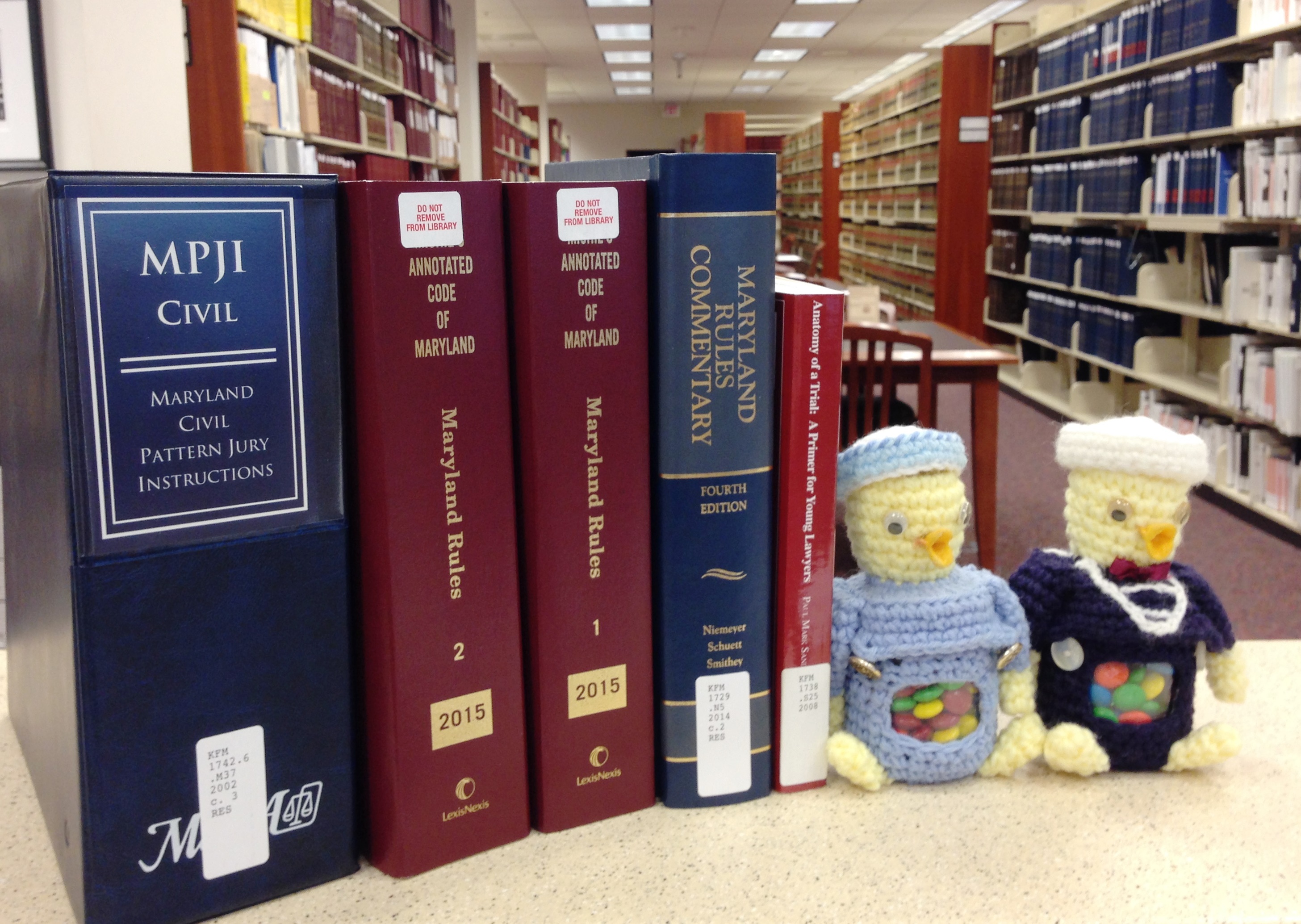
The Daily Record published “A lawyer’s reader’s digest”, which presents a list of six titles that are “practice-changing” books that “will inevitably make your job easier and you more efficient.” You can check out the article here.
The recommended books are as follows, and all but the last title is available at the Law Library!
The Maryland Rules Commentary
The Maryland Rules
Maryland Civil Pattern Jury Instructions
Pattern Examinations of Witnesses for the Maryland Lawyer
Anatomy of a Trial: A Primer for Young Lawyers
Bargaining for Advantage: Negotiation Strategies for Reasonable People
 The Ask A Lawyer In The Library program is a civil, non-family law, self-help program sponsored by The Anne Arundel Bar Association and the Maryland Volunteer Lawyers Service. Every Wednesday, from 11:00 a.m. to 1:00 p.m., you can talk with a volunteer attorney for up to 20 minutes. No appointment is necessary, but sign-up is required at the law library’s information desk. Sign-up begins at 10:45 a.m., and time slots are determined by a lottery. For more information, please see http://circuitcourt.org/legal-help/lawyer-in-the-library.
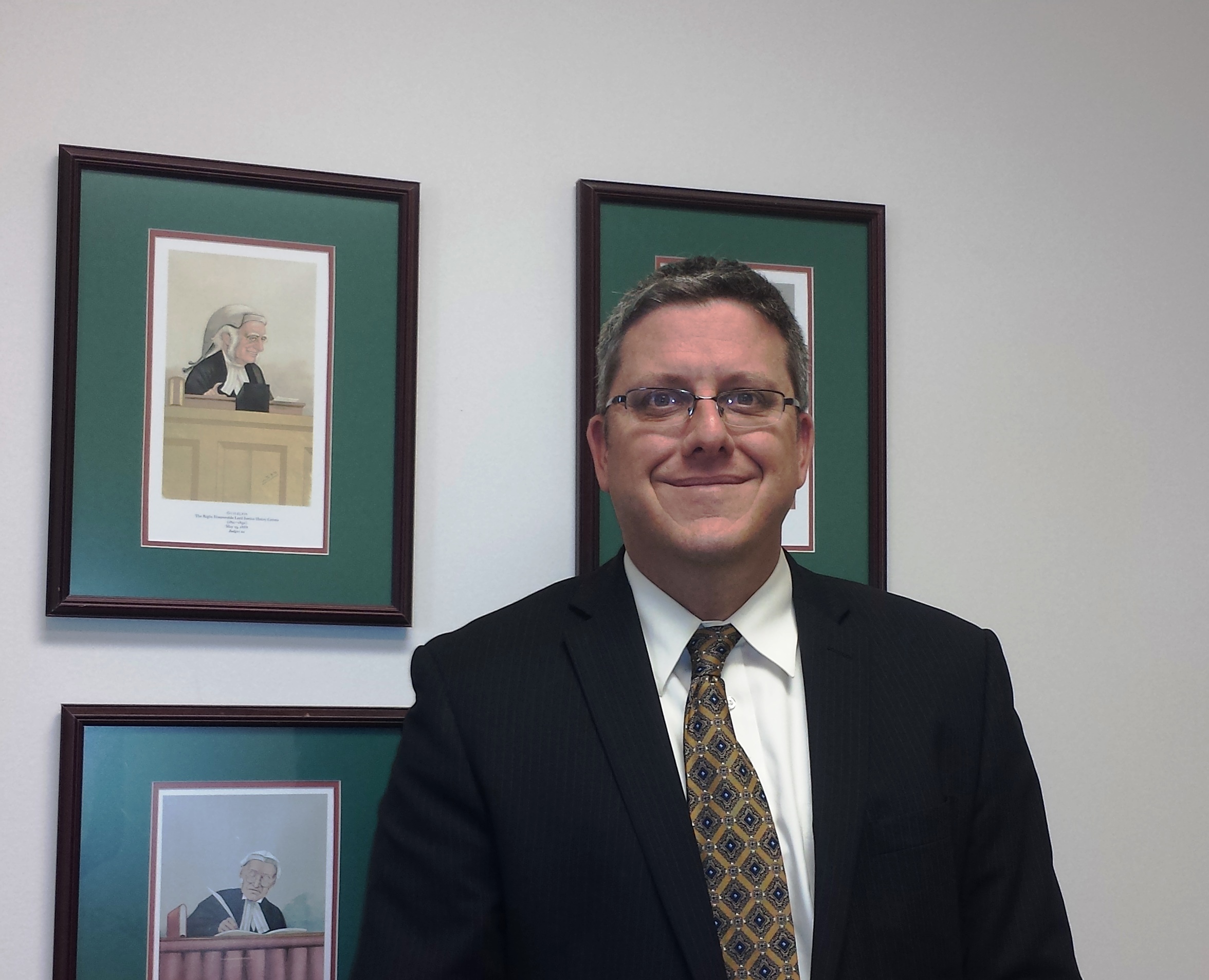
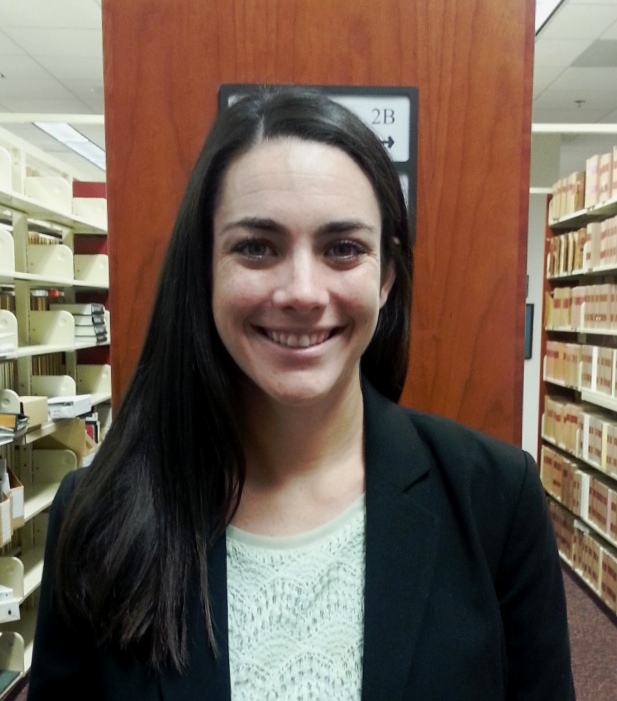 On Wednesday, June 24, 2015, the Law Library hosted another successful Ask A Lawyer In The Library program. Thank you Michael Marinello and Megan Cooper from the Kagan Law Group, for volunteering and providing this service to the public. Seven people took part in the program and were able to speak with an attorney to request assistance with restitution, eviction, contracts, wrongful termination, estate and mandamus orders. The next program date is Wednesday, July 1, 2015.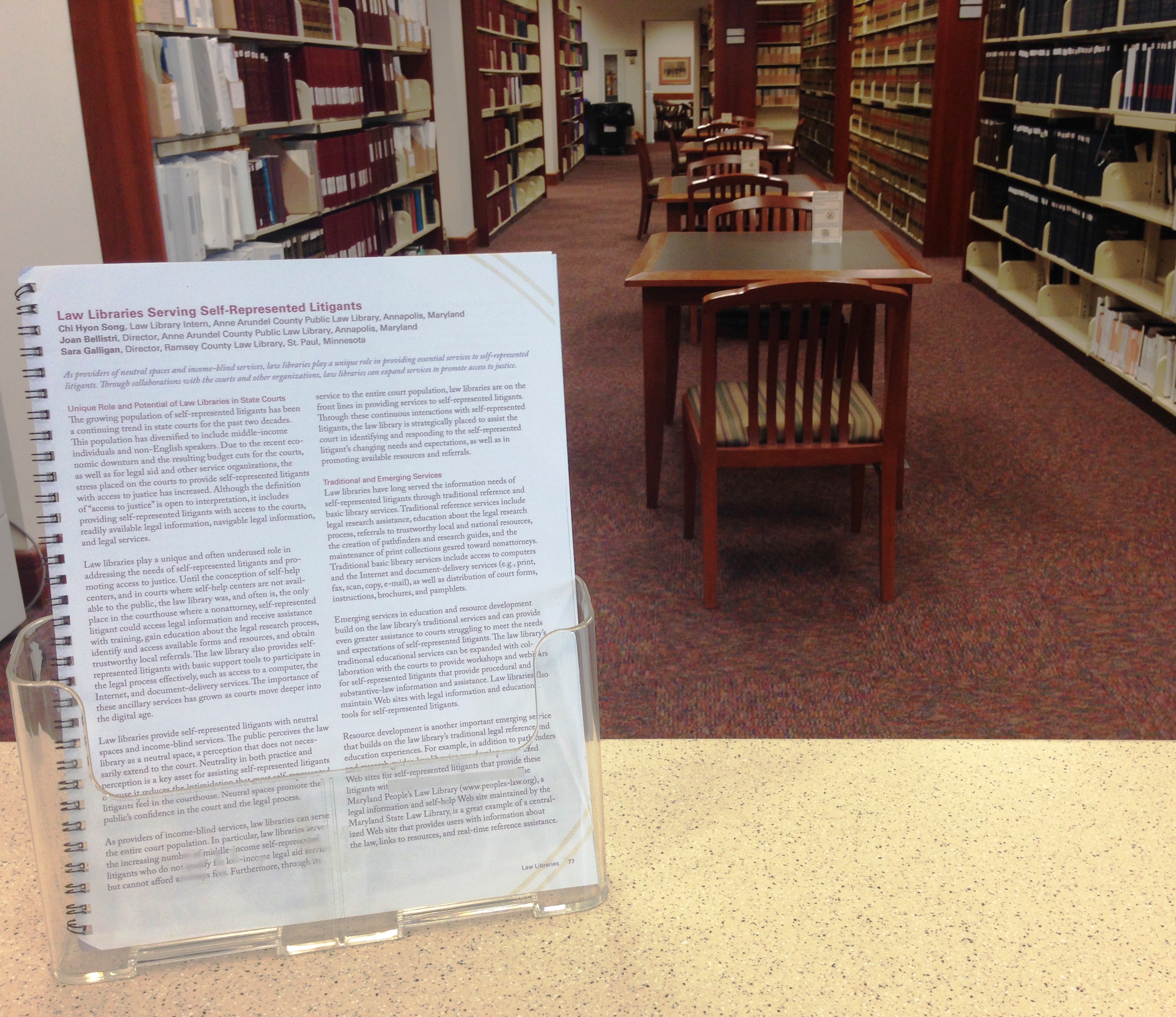


 AACPLL Blog: Law Library News