Categories
lawlibrary

Law Day Series – The Maryland Court System

In connection with the Law Library’s celebration of Law Day, we will be publishing a series of eight posts this month that focus on the basics of the Maryland court system and legal research.

The Maryland court system has four levels.

  • Two trial courts – District Court (34 locations) and Circuit Court (24 locations)
  • Two appellate courts – Court of Special Appeals and Court of Appeals

The District Courts are the trial courts where most Marylanders interact with the Maryland Court System. There are 34 District Court locations statewide with jurisdiction over various matters such as landlord-tenant cases, motor vehicle violations, and certain criminal matters. The court has exclusive jurisdiction for claims under $5,000, but shares jurisdiction for claims above $5,000 but less than $30,000 with the Circuit Court. There is also shared jurisdiction with the Circuit Court for certain criminal cases. Judges, not juries, make all of the District Court decisions because there are no jury trials in District Court. You can learn more about the District Court here.

The Circuit Courts are the trial courts for generally more serious criminal cases and major civil cases. Trials can be decided by jury or by a judge in the Circuit Court. The types of cases heard in Circuit Court include family law cases (e.g., divorce, custody), civil matters for claims above $30,000 and juvenile matters. There are 24 circuit court locations, one in each county in Maryland and the City of Baltimore. The Circuit Courts are organized into eight judicial circuits. The Circuit Court for Anne Arundel County, which is where the Law Library is located, is part of the 5th Circuit. You can learn more about the Circuit Courts here.

The Court of Special Appeals is the second highest court in Maryland and the intermediate appellate court. This means that the Court of Special Appeals hears any prior reviewable judgment, decree, order or other action of the District Court, Circuit Court and Orphans’ Court. Unlike the District Courts and the Circuit Courts, there is only one Court of Special Appeals, which is located in Annapolis, Maryland. The Court of Special Appeals has fifteen judges who normally decide cases in panels of three, but, in certain situations, all fifteen judges will decide a single case (sit en banc). You can learn more about the Court of Special Appeals here.

The Court of Appeals is the highest court in Maryland (often called the Supreme Court in other states and in the Federal court system). The seven judges who sit on the Court of Appeals review and select the cases that they will hear, and the seven judges hear the cases together. This selection process by the Court of Appeals means that the court does not automatically hear every case that is reviewable. Instead, the court generally selects those cases that have legal significance for the state. However, the Court of Appeals must hear all reviewable cases involving the death penalty, legislative redistricting, removal of certain officers, and certifications of questions of law. The Court of Appeals hears oral arguments in cases four days per month from September through June of each year. You can see their calendar here. Similar to the Court of Special Appeals, there is only one Court of Appeals, which is located in Annapolis, Maryland. You can learn more about the Court of Appeals here.

Note that the Federal courts located in Maryland are not part of the Maryland court system. If you want to learn more about the Federal courts in Maryland, check out the U.S. Courts’ website. The key difference between the Federal courts and the Maryland courts is that the Federal courts are authorized by the U.S. Constitution and mainly deal with federal laws (e.g., the laws that have been enacted by the U.S. Congress) whereas the Maryland courts are authorized by the Maryland Constitution and mainly deal with state and local laws.

To learn more, the Maryland Judiciary provides a detailed description of the Maryland court system at http://www.courts.state.md.us/publications/pdfs/mdjudicialsystem.pdf (en Español). In addition, you can check out these videos.

Stay tuned for the next post in our Law Day Series, which provide information about the Maryland Orphans’ Court.


 

Categories
Holiday lawlibrary

World Press Freedom Day

FullSizeRender (1)
The newest editions of the Law Library’s newspaper subscriptions are available to the public in our main entry hallway.

“Every year, May 3rd is a date which celebrates the fundamental principles of press freedom; to evaluate press freedom around the world, to defend the media from attacks on their independence and to pay tribute to journalists who have lost their lives in the exercise of their profession.”*

The UN General Assembly proclaimed May 3rd as World Press Freedom Day in 1993. This year’s themes are Independent and Quality Media, Gender and Media and Digital Safety for Journalists and their Sources. To learn more about World Press Freedom Day, check out the United Nations Educational, Scientific and Cultural Organization’s page at http://www.unesco.org/new/en/world-press-freedom-day.

Did you know that the Law Library maintains subscriptions to the print editions of the following newspapers?

  • The Baltimore Sun
  • The Washington Post

  • The Capital

  • The Daily Record

  • The National Law Journal

Access to additional newspapers and periodicals are available through the Law Library’s subscriptions to various online legal databases. Come visit us at the Law Library to learn more!

*http://www.unesco.org/new/en/unesco/events/prizes-and-celebrations/celebrations/international-days/world-press-freedom-day-2015/about-world-press-freedom-day/

Categories
Holiday lawlibrary

Law Day Series – Today is Law Day!

LawDay_FINAL_Logo-NEWIn connection with the Law Library’s celebration of Law Day, we will be publishing a series of eight posts this month that focus on the basics of the Maryland court system and legal research.

What is Law Day? Each year, on May 1st, we celebrate the rule of law and the role of the law and legal processes, including the court system, in promoting democracy and freedom through our celebration of Law Day. First envisioned by the American Bar Association (ABA)’s then-president, Charles S. Rhyne, in 1957, National Law Day was established as a day of national dedication to the principles of government under law by former U.S. President Dwight D. Eisenhower in 1958, and May 1st was designated as the official date of celebration by a joint resolution of Congress in 1961.

2015 Theme. This year’s theme is “Magna Carta: Symbol of Freedom Under Law”. The Magna Carta (the “Great Charter”), issued 800 years ago by King John of England at Runnymede, a meadow located along the River Thames near modern day Windsor, England, has withstood the test of time and continues to symbolize liberty and the rule of law, especially the ideal that no one, not even a king, is above the rule of law. While the Magna Carta addresses the specific issues faced by King John and the English barons from the thirteenth century, its underlying principles of liberty and the rule of law for all people remains as an inspiration for freedom and liberty.

If you’re interested in learning more about Law Day and this year’s theme, check out the ABA’s 2015 Law Day page!

For those you interested in seeing the Magna Carta in person, check out this information about the traveling exhibit of Lincoln Cathedral’s 1215 manuscript of the Magna Carta at http://www.americanbar.org/groups/public_services/law_library_congress/magna_carta.html.


Stay tuned for the next post in our Law Day Series, which will provide an overview of the Maryland Court System.

Categories
lawlibrary Pro Bono Self Represented

Ask a Lawyer In the Library: Wednesday Wrap-up

FullSizeRender
Thank you Richard!

The Ask A Lawyer In The Library program is a civil, non-family law, self-help program sponsored by The Anne Arundel Bar Association and the Maryland Volunteer Lawyers Service. Every Wednesday, from 11:00 a.m. to 1:00 p.m., you can talk with a volunteer attorney for up to 20 minutes. No appointment is necessary, but sign-up is required at the law library’s information desk. Sign-up begins at 10:45 a.m., and time slots are determined by a lottery. For more information, please see http://circuitcourt.org/legal-help/lawyer-in-the-library.

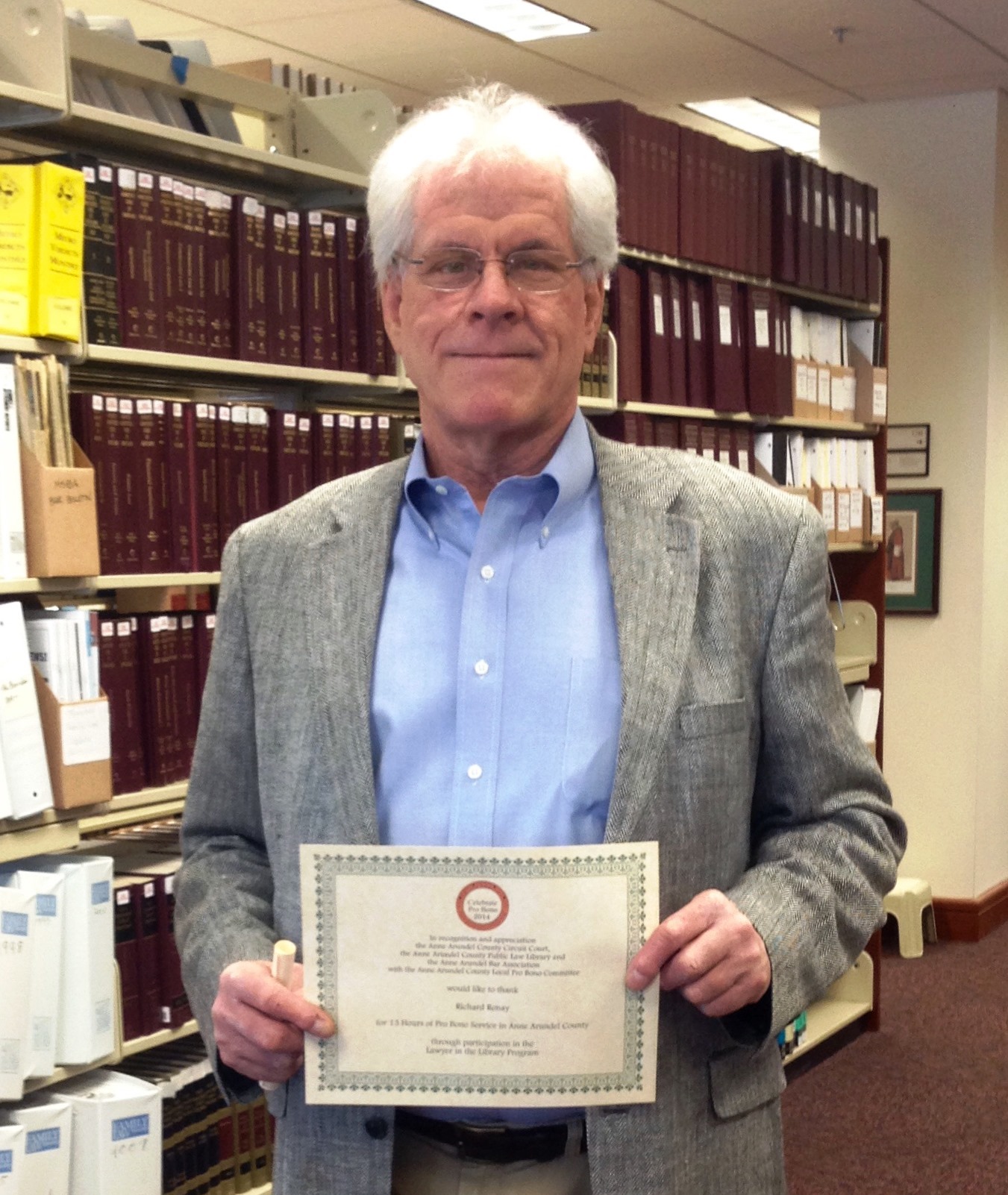
On Wednesday, April 29, 2015, the Law Library hosted another successful Ask A Lawyer In The Library program. Thank you Richard Ronay, of the Law Office of J. Richard Ronay, for volunteering and providing this service to the public. Three people took part in the program and were able to speak with the attorney to request assistance with contract issues, neighbor dispute and estate administration issues. The next program date is Wednesday, May 6, 2015.

Do you have a criminal law matter? Criminal Law matters are best addressed by the Office of the Public Defender. Information about the Office of the Public Defender is available at http://www.opd.state.md.us/.

More information about the program is available at http://circuitcourt.org/legal-help/lawyer-in-the-library. The Ask A Lawyer In The Law Library program is a limited legal advice service. The program is not a substitute for representation. If you need an attorney to represent you, you can contact the Anne Arundel Bar Association’s Lawyer Referral and Information Service.
 
Categories
lawlibrary

Legal Research in the Blogosphere – Copyright Blogs

Untitled drawing (4)Legal research can be challenging, even for experienced attorneys; however, there are many resources available to assist both attorneys and non-attorneys with their legal research needs.  The Legal Research in the Blogosphere series will share blog posts and online sites that legal researchers may find useful.

Copyright issues have always been topics of debate. With the constantly changing ways in which we create, share, access, obtain and save information and resources, copyright issues will likely remain a hot topic debate for years to come. If you want to learn more, check out these blogs about copyright issues and hot topics in copyright law.

Also, check out our earlier posts about copyright.gov and copyright law resources available in the Law Library!


Categories
lawlibrary Pro Bono Self Represented

Copyright Resources Available at the Library

Untitled drawing (2)Last week, we celebrated World Book and Copyright Day! So, what better time than now to learn about the copyright resources available at the Law Library. Call numbers, when available, are included in parenthesis.

Check out these resources, which are available for your review at the Law Library!

If you are interested in going to source, check out these resources!

Are you more interested in “how-to” resources? Then check out these titles.

If you are looking for additional resources, the Law Library also provides users with access to LexisNexis, Westlaw and other online legal databases. Drop by the Law Library, and we can help get you started.

*If you prefer print resources, the Law Library has print copies available.

Categories
lawlibrary

Copyright Fun

Untitled drawing (3)Yesterday, we published a post detailing many of the resources
available through the U.S. Copyright Office’s website, www.copyright.gov. My favorite section of the website is the Copyright Lore section, which is a collection of fun facts related to the Copyright Office and its mission.

For example, did you know…

  • that the Copyright Card Catalog is housed in the world’s biggest card catalog. This catalog has 25,675 drawers with 45 millions cards. These 45 millions cards, if stacked, exceeds 2,000 miles in length.
  • that there have only been 12 Registers of Copyright since the inception of the Copyright Office?
  • that the Copyright Office issued a copyright registration for the “Statue of American Independence”, the original name of the Statue of Liberty” on August 31, 1876, ten years before the Statue of Liberty was erected in the New York Harbor?

If you are interested in learning about the history and important dates in copyright history, check out the website’s Copyright Timeline that starts with the 1710 enactment of the Statute of Anne in Great Britain and continues to the 2011 appointment of the Register of Copyrights.

For teachers, the Library of Congress website provides information about copyright and primary sources and an interactive program called “Taking the Mystery Out of Copyright” that includes information about the national and state education standards that the interactive program meets.

Next week, we will publish a post detailing the copyright law related resources available at the Law Library.


Categories
lawlibrary

World Book and Copyright Day!

Untitled drawing (1)Today is the United Nations Educational, Scientific and Cultural Organization (UNESCO) World Book and Copyright Day. “This is a day to celebrate books as the embodiment of human creativity and the desire to share ideas and knowledge, to inspire understanding and tolerance.”* In honor of World Book and Copyright Day, the Law Library will publish a series of four posts this week and next week related to copyright law. Today’s post topic is the website for the United States Copyright Office, which can be accessed at www.copyright.gov.

Created by Congress in 1897, the Copyright Office is a department of the Library of Congress that administers the copyright registration system, provides basic copyright information services to the public and administers statutory licenses that manage and disperse certain monies to copyright owners. The Register of Copyrights, a position also created in 1897, is the director of the Copyright Office and works under the direction of the Librarian of Congress to carry out the Copyright Office’s legal and policy functions.

The Copyright Office’s website provides a wealth of information and resources for those interested in learning about copyright law and related policy issues, registering a copyright, recording a document or searching the Copyright Office’s records.

 The website’s main page highlights the following “How Do I…?” sections.

 The website is also a good source of research materials.

  • You can learn more about the law and policies regarding copyrights and other intellectual property law through access to the applicable U.S. Code provisions and regulations. There’s also a wealth of related information, such as historical documents, Congressional hearings, testimonies and past and open rulemaking proceedings.
  • Factsheets, such as factsheets on fees assessed by the Copyright Office, and Forms are available on the website.
  • You can access recent annual reports and policy studies. For example, you can read “Copyright and the Music Marketplace”, a study by the U.S. Copyright Office detailing the existing music licensing framework and providing recommendations for changes to the system. Links found on the webpage can lead you to related materials as well as any public comments.
  • You can keep up with the Copyright Office’s current events through Federal Register Notices, NewsNet and Press Releases.
  • You can access and download the full version of the Compendium of U.S. Copyright Office Practices, which is the administrative manual of the Register of Copyrights that provides the Copyright Office with instruction regarding their statutory duties and provides copyright applicants, practitioners and other members of the public with guidance regarding institutional practices. 

If you have questions about how to use the resources available on www.copyright.gov, online tutorials are available that can guide your through completing your electronic copyright registration and searching the Copyright Office Catalog.** In addition, there are Frequently Asked Questions pages that addresses many topics of interest, such as how to register a work, privacy questions, use questions, information about the services available at the Copyright Office and mandatory deposits.


*Message dated April 23, 2014, from Irina Bokova, Director-General of UNESCO, available at http://unesdoc.unesco.org/images/0022/002273/227351e.pdf.

**You may need access to PowerPoint or a PowerPoint reader to access these tutorials.


Categories
lawlibrary Pro Bono Self Represented

Ask a Lawyer In the Library: Wednesday Wrap-up

photo (2)
Thank you Joe!

The Ask A Lawyer In The Library program is a civil, non-family law, self-help program sponsored by The Anne Arundel Bar Association and the Maryland Volunteer Lawyers Service. Every Wednesday, from 11:00 a.m. to 1:00 p.m., you can talk with a volunteer attorney for up to 20 minutes. No appointment is necessary, but sign-up is required at the law library’s information desk. Sign-up begins at 10:45 a.m., and time slots are determined by a lottery. For more information, please see http://circuitcourt.org/legal-help/lawyer-in-the-library.

On Wednesday, April 22, 2015, the Law Library hosted another successful Ask A Lawyer In The Library program. Thank you, Joe Gormley from Gormley Jarashow Bowman LLC, for volunteering and providing this service to the public. Three people took part in the program and were able to speak with the attorney to request assistance with issues regarding court procedure, debt collection and small claims. The next program date is Wednesday, April 29, 2015.

Do you have a criminal law matter? Criminal Law matters are best addressed by the Office of the Public Defender. Information about the Office of the Public Defender is available at http://www.opd.state.md.us/.

More information about the program is available at http://circuitcourt.org/legal-help/lawyer-in-the-library. The Ask A Lawyer In The Law Library program is a limited legal advice service. The program is not a substitute for representation. If you need an attorney to represent you, you can contact the Anne Arundel Bar Association’s Lawyer Referral and Information Service.
 
Categories
lawlibrary Pro Bono Self Represented

JustAdvice – Expungement

UPDATE: The JustAdvice Clinic has completed its spring session and is CLOSED until this fall. Stay tuned for updates!

Expungement was one of the most asked about issues during last month’s Homeless Resource Day, and it remains hot topic at the local, state and national levels. Check out this article on the Wall Street Journal Blog.

If you are looking for brief advice and assistance on how to expunge your criminal record, law students from the University of Maryland Francis King Carey School of Law may be able to assist you through the JustAdvice Clinic, a project of the University of Maryland Francis King Carey School of Law Clinical Program. JustAdvice has provided over 2,600 Maryland residents with low-cost legal consultations since June 2009.

Appointments are highly encouraged. Walk-ins are welcome, but note that walk-ins will not be accepted in the final hour of the session. For example, if the session ends at 3:00 p.m., a walk-in must arrive prior to 2:00 p.m. To make an appointment and for information about upcoming session dates, times and locations, check out JustAdvice’s website at http://justadviceclinic.org/. You can also contact them via telephone at 410-929-4809 or email at JustAdvice@law.umaryland.edu.

Don’t forget that you will need to bring a copy of your Criminal Justice Information System (CJIS) Report to your session with the JustAdvice law student.*

 For more information about expungement and other resources and referrals, check out our wiki page on expungement or contact us!

*Information about how to obtain a Criminal Justice Information System Report is available here.