Jack Paltell, Steve Migdal, and William Moomau were the “Lawyers in the Library” this month providing legal assistance with such issues as deeds, eviction, debt collection, contracts and homeowner associations.
“Ask a Lawyer in the Library” is held every Wednesday of the month from 11:00 a.m. – 1:00 p.m. and on the third Wednesday from 4:30 p.m. – 6:30 p.m. (The evening program will not be held this summer and will resume in September.) You can talk with a volunteer lawyer for at least 20 minutes about your civil, non-family legal problem for free. All sessions are now conducted over Zoom or by phone.
This program is sponsored by Anne Arundel County Local Pro Bono Committee, Maryland Volunteer Lawyers Service, and the Anne Arundel Bar Association. It is hosted by the Anne Arundel County Public Library.
Register online here or call the law library for help. Once you have registered, you will be sent a link to an intake sheet. Instructions for meeting with the attorney will be sent once the intake is competed.
Frequently, patrons ask us if we have official court forms to file for their specific situations. The courts have their own official forms (People’s Law Library lists some of the most frequently used), but more often, people ask for official forms that do not exist.
Fortunately, the library has a wide variety of sample procedure and legal forms that are free to be copied and modified. Procedure forms are for court filings, while those commonly called “legal forms,” most of which are not standardized, are used for all other legal affairs, such as wills, leases, and contracts.
Non-standardized procedure forms can include very general templates, such as blank petitions and blank motions; they can also be more specific (but still general enough to copy), such as motions for summary judgments and counterclaims for bringing in a new party.
Form books and form sets are good sources for all kinds of sample forms and templates. Some are available online through Westlaw or Lexis, others are exclusively in print, available here inside the library. When there is no sample form specific enough to cover a situation, they can be modified.
Form Books and Individual Samples
In addition to forms from Westlaw and Lexis, the Library has a variety of form books in print and has made available additional sample procedure forms for Maryland courts. Below, I have listed them by jurisdiction and subject area, and have also included the Library’s recommended form sets from Lexis and Westlaw.
Maryland
Practice and Procedure Sample Forms
Maryland practice forms (MSBA)
Call Number: KFM1738.A65 M3 2009
Also on Lexis and Westlaw
Maryland civil procedure forms: Maryland practice series (George W. Liebmann)
Call Number: KFM1730.A65 L5
Also on Westlaw
Forms from Maryland civil procedure forms (Robert Dale Klein)
Call Number: KFM1730.A65 K64 2000
Also on Lexis
Practice manual for the Maryland lawyer
Call Number: KFM1730.A65 P7 2019
Also on Lexis and Westlaw
Maryland litigation forms and analysis /by Gary I. Strausberg, general editor
Call Number: KFM1730.A65 M372 1998
Also on Westlaw
Family Law Sample Forms
Maryland family law form finder
On Westlaw
Maryland divorce and separation law / editors, John J. Condliffe, Esq. & Debra B. Cruz, Esq.
See “Marital Settlement Agreements” chapter for sample agreement.
Call Number: RES KFM1300.M37 2019
Also on Lexis and Westlaw
Maryland domestic relations forms: with practice commentary / Ann M. Turnbull, Joseph J. Wase
Call Number: RES KFM1294.A65 T8
Also on Lexis
Forms from Maryland domestic relations forms
On Lexis
Premarital and domestic partnership agreements (MSBA)
On Lexis and Westlaw
Maryland family and juvenile law : practice manual and forms
Call Number: RES KFM1294.R44 2001
Marital settlement agreement – form / Thomas C. Ries, Richard B. Jacobs
Call Number: KFM1300.M34 2009
Maryland family law forms / [Constance K. Putzel, Shelley L. Rothschild … et al.]
Call Number: KFM1294.M37 2011
A practice guide to family law
Call Number: RES KFM1294.P88 1999
Collection of family law forms. Sample forms on this page include several types of answer templates, consent forms, interrogatories, and motions. There are also links to official court forms.
Real Estate
Forms from Maryland real estate forms
On Lexis
Maryland real estate forms: practice / Russell R. Reno, Jr., Wilbur E. (Pete) Simmons, Jr., Kevin L. Shepherd ; contributing editor, Michael S. Kosmas
Call Number: RES KFM1326.A65 R46 2005
Also on Lexis
Maryland estate planning, will drafting, and estate administration forms: practice
Call Number: KFM1340.A65 B37 1995
Also on Lexis
Probate forms in Maryland : annotated, including pleading, guardian and ward, actions at law and in equity relating to administration and forms of wills / by Philip L. Sykes
Call Number: KFM1344.A65 S9
Contest of wills in Maryland with complete forms / by Philip L. Sykes
Call Number: KFM1344.5 .C6 S9
Maryland estate planning, wills and trusts library : forms and practice manual
Call Number: KFM1340.A65 G88 1998
Maryland estate planning form finder
On Westlaw
Business and Commercial
Maryland corporation law and practice : with forms / by Herbert M. Brune
Call Number: KFM1413.B7 1953
Maryland limited liability company forms and practice manual
Call Number: KFM1407.5 .A65 M37 1999
Maryland secured transactions under revised article 9 of the Uniform Commercial Code : forms and practice manual
Call Number: KFM1375.W58 2000
Criminal
Maryland criminal procedure forms and analysis
Call Number: KFM1775.A65 S653
Employment
Maryland employment law : forms and practice manual / Carla N. Murphy, editor ; Sharon A. Snyder, editor
Call Number: KFM1534.M87
Intellectual Property
Maryland intellectual property and technology transactions : forms and practice manual / William S. Galkin
Call Number: KFM1530.G35 2008
Technology
Maryland technology transactions: the Venable practice and forms manual
Call Number: KFM1530.M37 2002
Practice of Law
Legal representation and fee agreements for the Maryland Lawyer: forms and comments
Call Number: KFM1277.5 .F4 B36 2009
Also on Lexis and Westlaw
Federal Titles
On Lexis and Westlaw
Nichols cyclopedia of federal procedure forms
On Westlaw
Federal procedural forms
On Westlaw
Bender’s federal practice forms
On Lexis
Non-Jurisdictional
Print Titles
Family law arbitration : practice, procedure, and forms / Carolyn Moran Zack
Call Number: KF505.5 .Z33 2020
Forms, checklists, and procedures for the family lawyer / Mark A. Chinn
Call Number: KF505.C478 2021
The law of crimes and criminal procedure, including forms and precedents
Call Number: KF9219.H6 1904
On Westlaw
American jurisprudence pleading & practice forms annotated
American jurisprudence legal forms 2d
Lane’s Goldstein litigation forms
Fletcher corporation forms annotated
McGaffey legal forms with tax analysis / Jere D. McGaffey
Handbook of Personal Injury Forms and Litigation Materials
On Lexis
Rabkin & Johnson current legal forms with tax analysis / Jacob Rabkin and Mark H. Johnson ; revision author, Volume 1, Stephen E. Pigott
Murphy’s will clauses : annotations and forms with tax effects / Joseph H. Murphy, assisted by Beverly Massy Stowell Rounds, updates by John H. Skarbnik
Page on the law of wills : including probate, will contests, evidence, taxation, conflicts, estate planning, forms, and statutes relating to wills
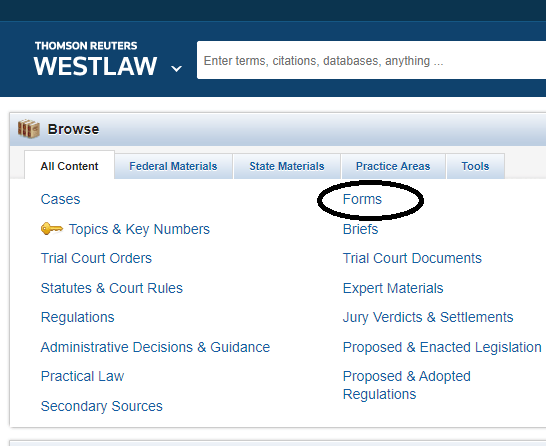
Westlaw’s Form Finder is a convenient way to search for samples. To get there from the main screen, click on “Forms” in the “All Content” tab (Figure 1).
Figure 1
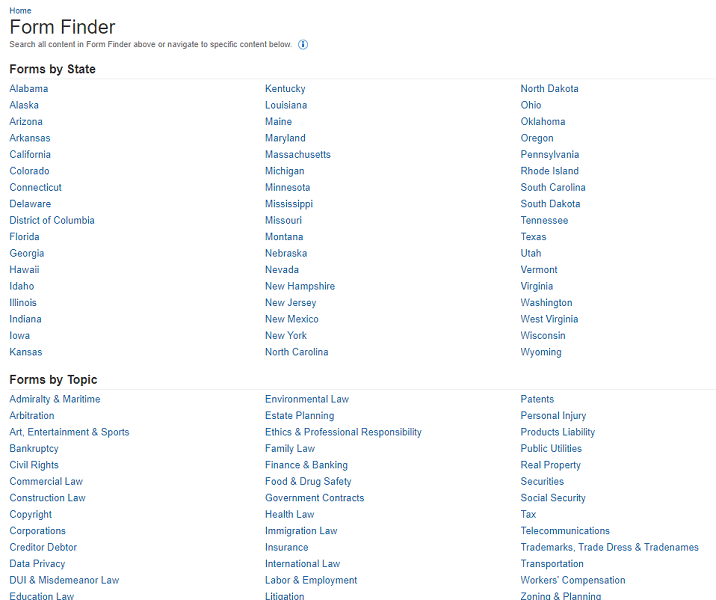
Once you are on the “Form Finder” screen, you can choose to search for forms by state, by topic (Figure 2), or by publication name.
Figure 2
Once in the search screen, fill in the search fields and press enter.
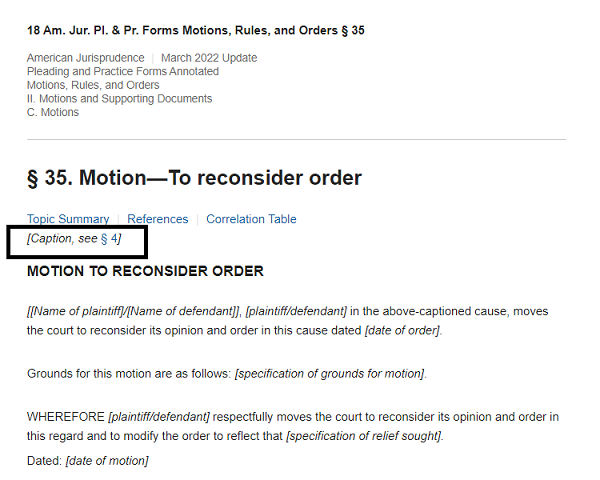
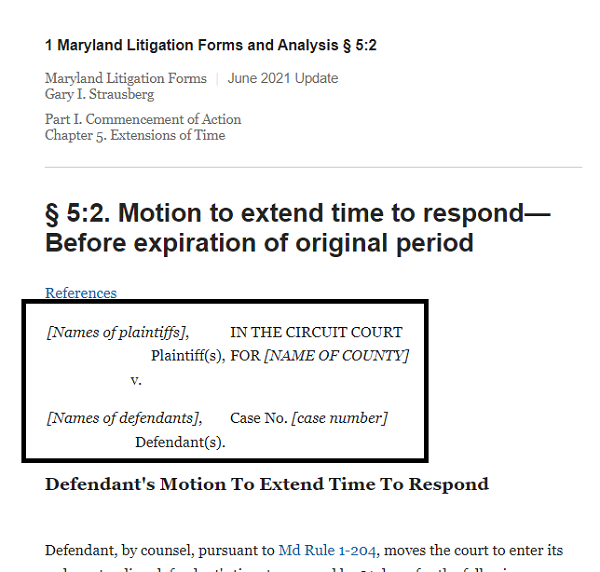
Some forms, like those in American Jurisprudence Pleading & Practice Forms Annotated, link to captions (Figure 3). A caption is a header in which you would fill in information about the court, the plaintiff, and the defendant if applicable (Figure 4).
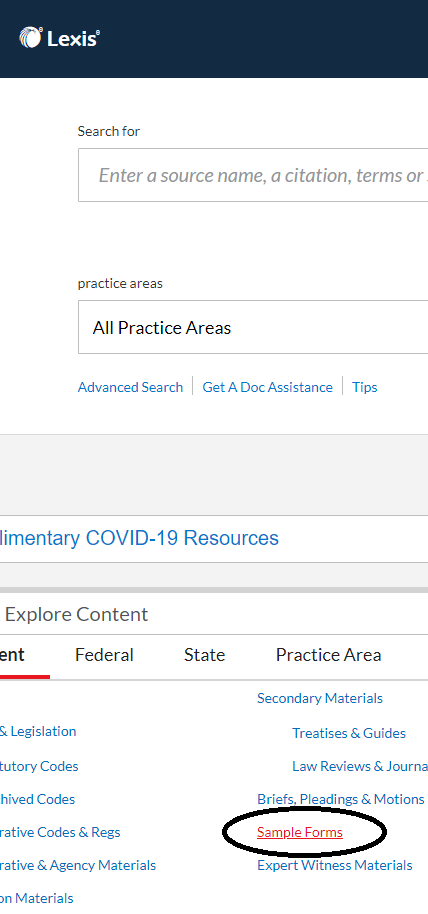
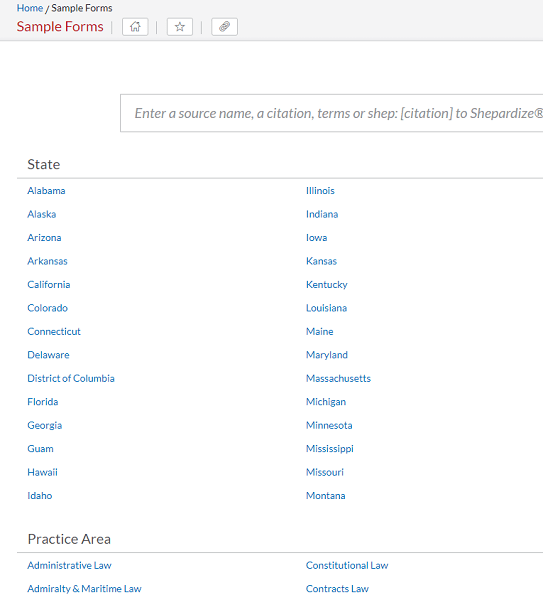
From Lexis’s main screen, click “Sample Forms” under the “Content” tab (Figure 5), which will send you to the Sample Forms page. There, you can choose to search by state or practice area (Figure 6). On the next screen, you can search all forms under the heading you chose or add the second state or practice area filter to make your search more precise. More precise is not always better, however, because you could filter out relevant results.
Figure 5Figure 6
Unfortunately, there is no federal option listed with all the state options on the sample forms page.
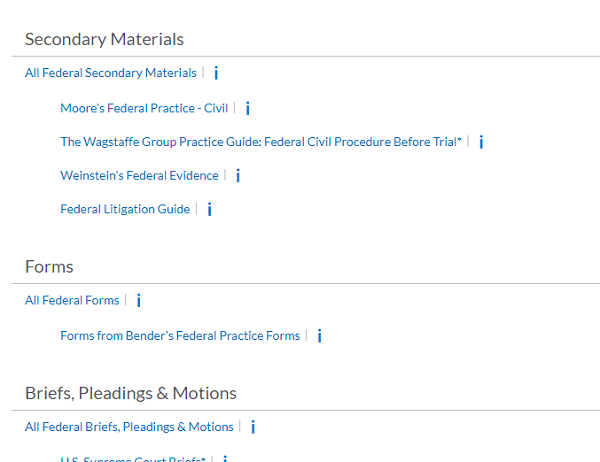
To search for sample forms for federal courts, on the home screen click on “Federal” under “Explore Content,” then click on “All Federal” in the second section (Figure 7) (Be careful not to click “All Federal Cases”).
Figure 7
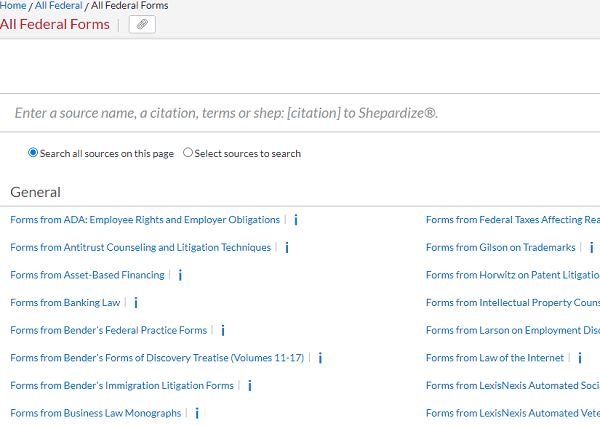
On the “All Federal” page, you can then scroll down to “Forms” and click “All Federal Forms” (Figure 8)
Figure 8
There you can choose to search all the federal form books or search an individual title (Figure 9).
The Ask a Lawyer in the Library Program welcomed Jennifer Jones and William Moomau as the newest pro bono volunteers this spring. They joined Steve Migdal, Jack Paltell, Richard Ronay, Carole Brown and Saul McCormick in assisting 20 people with a variety of legal issues in April and March. Issues included landlord/tenant, contracts, wills and estates, consumer debt and property disputes with neighbors.
“Ask a Lawyer in the Library” is held every Wednesday of the month from 11:00 a.m. – 1:00 p.m. and on the third Wednesday from 4:30 p.m. – 6:30 p.m. You can talk with a volunteer lawyer for at least 20 minutes about your civil, non-family legal problem for free. All sessions are now conducted over Zoom or by phone.
This program is sponsored by Anne Arundel County Local Pro Bono Committee, Maryland Volunteer Lawyers Service, and the Anne Arundel Bar Association. It is hosted by the Anne Arundel County Public Library.
Register online here or call the law library for help. Once you have registered, you will be sent a link to an intake sheet. Instructions for meeting with the attorney will be sent once the intake is competed.
Tax filings are due in less than a month, and like many, you have probably been putting them off. Fortunately, there are online tools and helpful information available through our library for those who just need the tools and forms to get them done, learn more specific aspects about tax filing, or become more proficient in tax law.
Steve Migdal, Jessica Corace and Jack Paltell were the Lawyers in the Library this month. These volunteer attorneys helped 8 people with their legal questions. Issues included personal injury, breach of contract, return of stolen goods and estate administration.
“Ask a Lawyer in the Library” is held every Wednesday of the month from 11:00 a.m. – 1:00 p.m. and on the third Wednesday from 4:30 p.m. – 6:30 p.m. You can talk with a volunteer lawyer for at least 20 minutes about your civil, non-family legal problem for free. All sessions are now conducted over Zoom or by phone.
This program is sponsored by Anne Arundel County Local Pro Bono Committee, Maryland Volunteer Lawyers Service, and the Anne Arundel Bar Association. It is hosted by the Anne Arundel County Public Library.
Register online here or call the law library for help. Once you have registered, you will be sent a link to an intake sheet. Instructions for meeting with the attorney will be sent once the intake is competed.
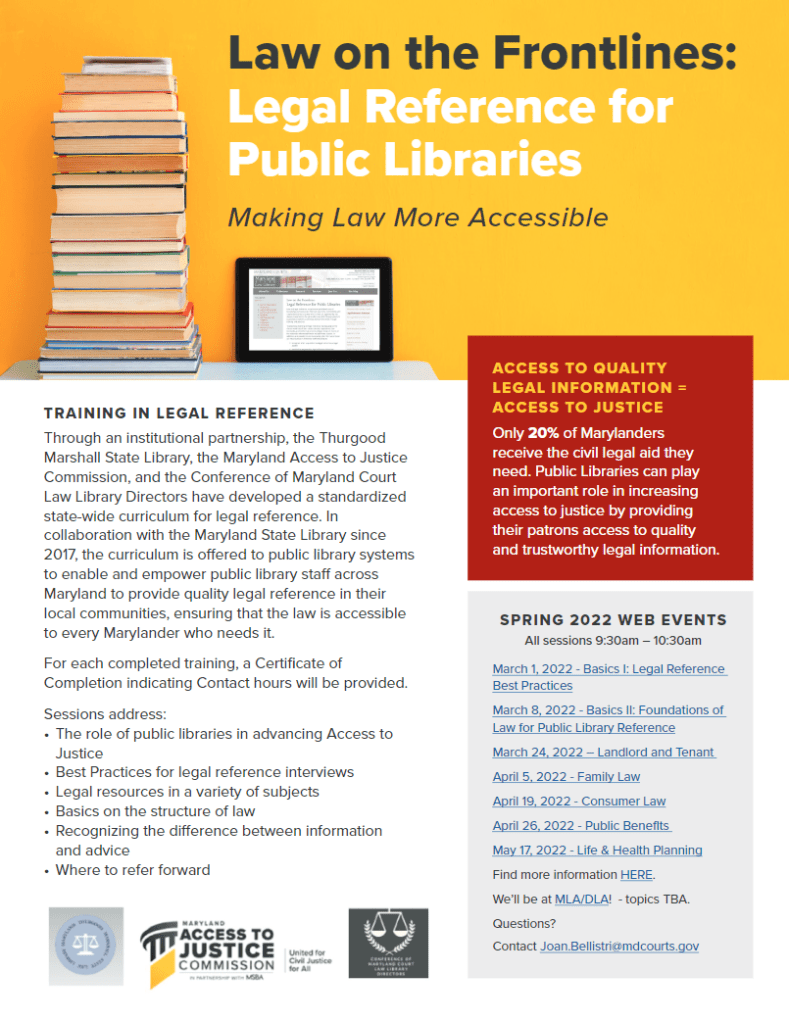
This training begins on March 1, 2022. Sessions will cover the basics and then concentrate on subject specific issues. You can register for all sessions or pick the ones you want. Register here.
A Guide to the History of Slavery in Maryland has been added as an e-resource to the library’s collection. Per the introduction, this publication “provides a brief, but comprehensive, overview of the history of slavery in the state. Built upon the most recent scholarship, this guide offers teachers and students a starting point from which to begin their own exploration of an institution, that, in so many ways, has shaped the modern world.”
The 2020 version of the book is available online, free of charge, via the Maryland State Archives. The book is available for checkout at the Anne Arundel Public Library. It can be purchased from the Maryland State Archives, Amazon, or other local booksellers.
Also of interest is the Maryland State Archives Presents: Legacy of Slavery in Maryland. This website provides access to “case studies” such as Stories of Flight or Blacks in Annapolis, interactive maps allows research by name or place and resources include the Guide to African American Families and Census Data.
The Law Library and Family Court Help Center in the Anne Arundel County Circuit Court is closed today, February 21, 2022 for the Presidents’ Day holiday. The Law Library will reopen tomorrow, Tuesday, February 22, 2022. Except on Court Holidays, the Library is open Monday through Friday, from 8:30 a.m. until 4:30 p.m.
Find out more about this holiday at the website of the National Archives. I was surprised to find out that “contrary to popular belief, neither Congress nor the President has ever stipulated that the name of the holiday observed as Washington’s Birthday be changed to “President’s Day.”
Most non-lawyers would probably agree that legal writing is difficult and hard to understand. Latin, French, Old English and Anglo-Norman terms abound, as do double negatives and coupled synonyms (like “null and void”). This jargon is strewn across lengthy, complex sentences that may need to be read several times – with a legal dictionary – to understand, if at all.
While frustrating, there are reasons for the strangeness of legalese. It should not allow any ambiguity, which means the language needs to be as precise and accurate as possible, to the point where specialized terms and lengthy, comprehensive text are sometimes necessary. Everyday speech evolves all the time and can cause disagreements, while the constancy – hence antiqueness – of legal language is intended to prevent these disagreements.
A great number of people and organizations say yes, hence the passage of the Plain Writing Act of 2010. This act requires all federal agencies publish their documents in plain language. While legal language is intended to minimize ambiguity, it is probably safe to say that most people skip reading lengthy and incomprehensible legal documents. When is the last time you checked “accept” for an online agreement without taking the time to scroll through the small print? These poorly understood contracts can enable unpleasant surprises down the road and cause the very disputes they are meant to prevent.
That said, writing clearly, plainly, and accurately in a way most people can understand is hard. In writing this blog post, I could not make its readability go below an 11th grade level, according to Microsoft Word’s readability statistics (here’s how to find that function). There are information hubs, guidelines, tools, and samples to help with this, however.
Steve Migdal, Jack Paltell and Leonard Englander were the Lawyers in the Library for January. They assisted twelve people with issues such as wills and estates, landlord tenant problems, neighbor issues, expungement of a protective order and an automobile accident.
“Ask a Lawyer in the Library” is held every Wednesday of the month from 11:00 a.m. – 1:00 p.m. and on the third Wednesday from 4:30 p.m. – 6:30 p.m. You can talk with a volunteer lawyer for at least 20 minutes about your civil, non-family legal problem for free. All sessions are now conducted over Zoom or by phone.
This program is sponsored by Anne Arundel County Local Pro Bono Committee, Maryland Volunteer Lawyers Service, and the Anne Arundel Bar Association. It is hosted by the Anne Arundel County Public Library.
Register online here or call the law library for help. Once you have registered, you will be sent a link to an intake sheet. Instructions for meeting with the attorney will be sent once the intake is competed.