Categories
lawlibrary Maryland Law

New Maryland Laws Take Effect on October 1, 2015 – Spotlight on Marijuana and Marijuana Paraphernalia

New Maryland laws take effect on October 1, 2015!  We will be publishing a series of posts highlighting a few of the newly enacted laws.  This series is just a small sampling of the new laws enacted by the 2015 Legislative Session.  To read about more laws resulting from the 2015 session, see the 90 Day Report – A Review of the 2015 Session published by the Department of Legislative Services (DLS) of the General Assembly of Maryland. For a full listing of new laws effective October 1, 2015, check out this publication from DLS.

Senate Bill 456 (Chapter 351) – A court must “dismiss a criminal charge, in a prosecution for possession of marijuana or for possession of paraphernalia related to marijuana, if the court finds that a person used or possessed marijuana or marijuana paraphernalia because of a medical necessity.” You can learn more about this new law, including its legislative history, here.

Don’t forget, bills that are passed by the Maryland General Assembly do not always become Maryland Law. For example, Senate Bill 517, which calls for, among other things, the repeal of “the criminal prohibition on possession of marijuana-related paraphernalia and eliminates any penalty”, was vetoed by the Governor on policy grounds. Since this veto occurred after the Maryland Legislature adjourned, an override vote will not occur until the next legislative session commences. To learn more about the Maryland legislative process, check out this blog post on statutes.

In addition, the 2014 Legislative Session made changes to Maryland laws related to marijuana. Check out our 2014 post to learn more!
Note that all quotations, unless noted otherwise, are attributable to the 90 Day Report – A Review of the 2015 Session published by the Department of Legislative Services of the General Assembly of Maryland, which is available online at http://mgaleg.maryland.gov/Pubs/LegisLegal/2015rs-90-day-report.pdf.

Categories
lawlibrary Maryland Law

New Maryland Laws Take Effect on October 1, 2015 – Spotlight on Shielding

New Maryland laws take effect on October 1, 2015!  We will be publishing a series of posts highlighting a few of the newly enacted laws.  This series is just a small sampling of the new laws enacted by the 2015 Legislative Session.  To read about more laws resulting from the 2015 session, see the 90 Day Report – A Review of the 2015 Session published by the Department of Legislative Services (DLS) of the General Assembly of Maryland. For a full listing of new laws effective October 1, 2015, check out this publication from DLS.

Maryland Second Chance Act of 2015 – House Bill 244 (Chapter 0313) – This new law authorizes “a person to petition the court to shield court records and police records relating to shieldable convictions no earlier than 3 years after the person satisfies the sentence or sentences imposed for all convictions for which shielding is requested”, however, “if a person is convicted of a new crime during a specified time period, the original conviction or convictions are not eligible for shielding unless the new conviction becomes eligible for shielding.” You can learn more about this new law, including its legislative history, here.

What is shielding? Shielding means making “a court record and police record relating to a conviction of a crime inaccessible by members of the public. Also, the Maryland Judiciary Case Search may not in any way refer to the existence of specific records shielded in accordance with the bill.”

What’s the difference between shielding and expungement? When a record has been expunged, it has been totally deleted from the court system and other places where the record is held, such as the Police Department, Archives, and State’s Attorney’s office. However, when a record is shielded, it means that the public cannot view the record; however, the record still exists.

To learn more about public access to court records, check out these Maryland Judiciary Publications. Don’t forget, the Law Library is always available to assist your with your legal research, including locating referrals.

Note that all quotations, unless noted otherwise, are attributable to the 90 Day Report – A Review of the 2015 Session published by the Department of Legislative Services of the General Assembly of Maryland, which is available online at http://mgaleg.maryland.gov/Pubs/LegisLegal/2015rs-90-day-report.pdf.

Categories
lawlibrary Maryland Law

New Maryland Laws Take Effect on October 1, 2015 – Spotlight on Expungement

Laws of MDNew Maryland laws take effect on October 1, 2015!  We will be publishing a series of posts highlighting a few of the newly enacted laws.  This series is just a small sampling of the new laws enacted by the 2015 Legislative Session.  To read about more laws resulting from the 2015 session, see the 90 Day Report – A Review of the 2015 Session published by the Department of Legislative Services (DLS) of the General Assembly of Maryland. For a full listing of new laws effective October 1, 2015, check out this publication from DLS.

Senate Bill 651 (Chapter 0374) /House Bill 124 – Eligibility for expungement has been expanded to include “persons convicted of a crime where the act on which the conviction was based is no longer a crime.” You can learn more about this new law, including its legislative history, here.

House Bill 304 (Chapter 0314)- Eligibility for expungement generally does not include a petition based on the entry of probation before judgment, “except a probation before judgment for a crime where the act on which the conviction is based is no longer a crime, and the person is a defendant in a pending criminal proceeding or was convicted of a crime other than a minor traffic violation or a crime where the act on which the conviction is based is no longer a crime within three years after the entry of the probation before judgment.” You can learn more about this new law, including its legislative history, here.

House Bill 131 (Chapter 0069) – For criminal charges that were transferred to juvenile court, the petition for expungement must be filed in the court of original jurisdiction where the order for transfer was entered. You can learn more about this new law, including its legislative history, here.

To learn more about expungement and expungement resources, check out these articles on the Maryland People’s Law Library, our wiki page and our past blog post! In addition, the Maryland Courts website includes information on how to expunge your records.

Note that all quotations, unless noted otherwise, are attributable to the 90 Day Report – A Review of the 2015 Session published by the Department of Legislative Services of the General Assembly of Maryland, which is available online at http://mgaleg.maryland.gov/Pubs/LegisLegal/2015rs-90-day-report.pdf.

Categories
Attorney Training lawlibrary

Google Scholar for Case Law Research

The Law Library provides its users with free access to various online legal databases. However, library users must use these resources in-person at the Law Library. For those of you who would like to conduct legal research at home, one free option is Google Scholar.

To learn how to research cases on Google Scholar, check out these resources, which provide overviews of basic and advanced legal research features on Google Scholar.

Although Google Scholar can be a good resource, there are limitations, such as the reliability of case citations, access to statutes and regulations, and time delays in the availability of recent cases.  

For more information about case law research generally, check out our earlier blog post. In addition, contact us at the Law Library, and we can assist you with your case law research!

Categories
Attorney Training lawlibrary

Farewell, Westlaw Classic

Westlaw Classic is coming to an end, and all Westlaw users will be migrated to WestlawNext. At the Law Library, the sunset date is September 10, 2015. Starting on that date, anyone who attempts to access Westlaw Classic at the Law Library or the Circuit Courthouse will be automatically redirected to WestlawNext at http://next.westlaw.com.

If you are new to WestlawNext, there are self-paced training options available online. These self-paced training programs include general guides that provide an overview of WestlawNext, searching on WestlawNext and browsing on WestlawNext. Advanced, targeted trainings, such as form finder training, are also available. In addition, the Law Library is available to assist you with your online WestlawNext research.
If you want to learn more about WestlawNext or online legal databases, check out our blog posts here.

Categories
lawlibrary Pro Bono Self Represented

Foreclosure Clinic Wrap-Up

mvls-logoLast week, the Law Library hosted its second Foreclosure Clinic. Thank you, Lonni Summers, Susan Mays, Diane Wessel, and the Maryland Volunteer Lawyers Service (MVLS) for providing this much-needed service to Maryland’s self-represented litigants.

The next clinic date is scheduled for Wednesday, September 16, 2015 from 1:00 p.m. to 3:00 p.m. individuals are served on a first-come, first-served basis. Consultations are usually twenty minutes. Please sign up, in-person, at the Law Library’s main service desk on September 16, 2015.

We recommend that you prepare for your meeting with the attorney. Here are a few suggestions.

  • Bring all your paperwork or other information related to the foreclosure.
  • Write a list of specific questions.Organize your paperwork from most recent on top to oldest on bottom.
  • Write a list of specific questions.
  • Prepare a timeline of your matter, including any deadlines.

If you need assistance prior to September 16, 2015, check out these resources.

  • Civil Justice – Civil Justice provides Marylanders with foreclosure assistance. Check out their website or call them at 410-706-0174 for more information.
  • Foreclosure Mediation Brief Advice Project – This is a free clinic open to homeowners facing foreclosure without legal representation. For information about the Foreclosure Mediation Brief Advice project, check out our blog post from earlier this year.
  • Maryland Volunteer Lawyers Service (MVLS) – MVLS may be able to represent you in your foreclosure matter. Call MVLS at 410-547-6537 for more information.

You can find a list of additional assistance resources at the People’s Law Library.

Categories
lawlibrary

New Materials Alert!

The Law Library is constantly striving to develop its collection to meet the needs of and challenges faced by its user communities. Check out these new materials, which have been recently added to the Law Library’ collection!


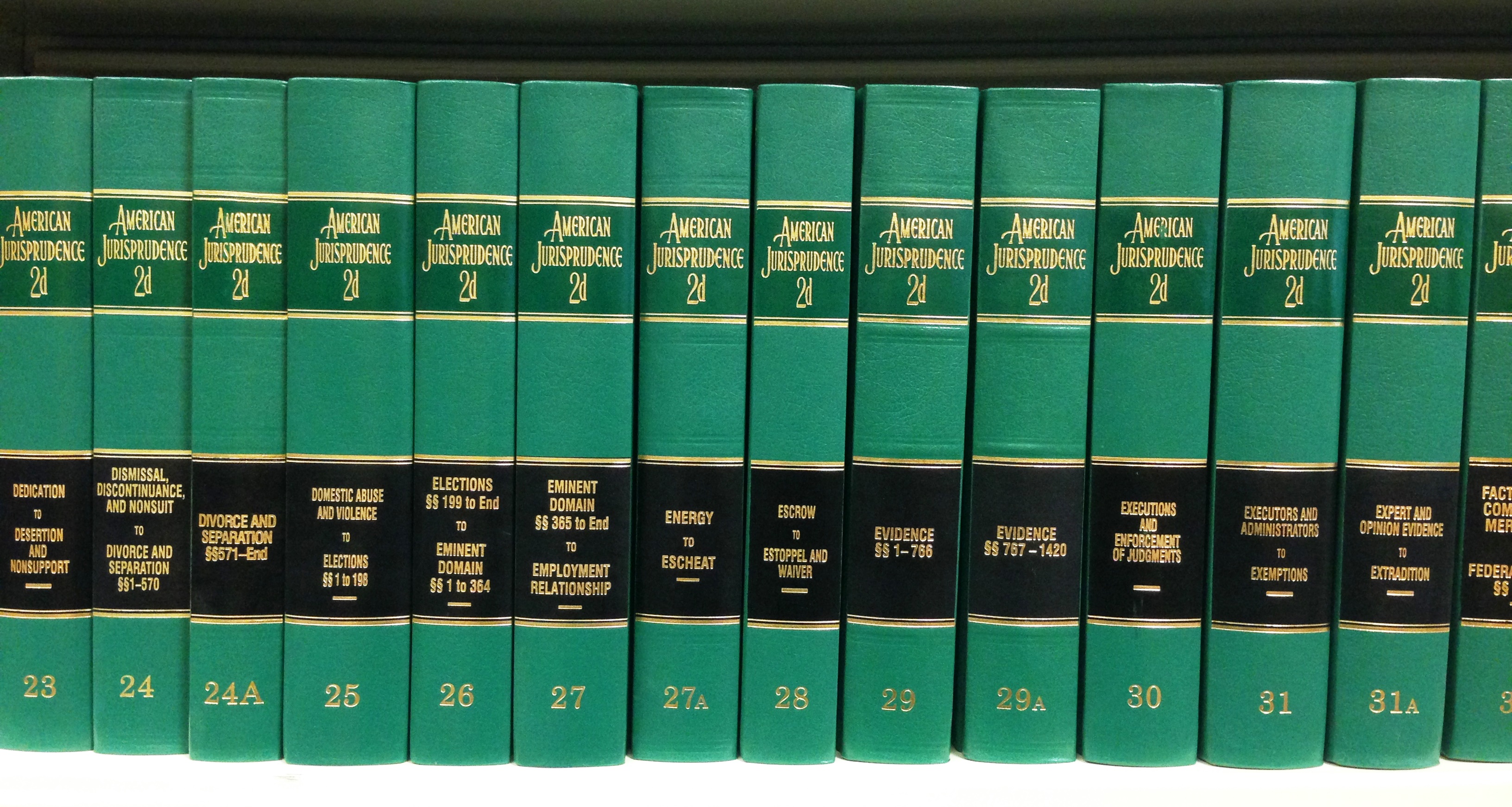
IMG_1550American Jurisprudence, 2d
 – The Law Library has updated its print copies of American Jurisprudence, 2d, one of the most widely used legal encyclopedias. This secondary resource provides users with a comprehensive set of articles on a wide range of legal topics, organized in alphabetical order by topic. American Jurisprudence is a fantastic starting point for legal research as it provides general introductions to a vast array of legal topics as well as citations for other useful materials, including relevant primary materials such as cases and statutes.


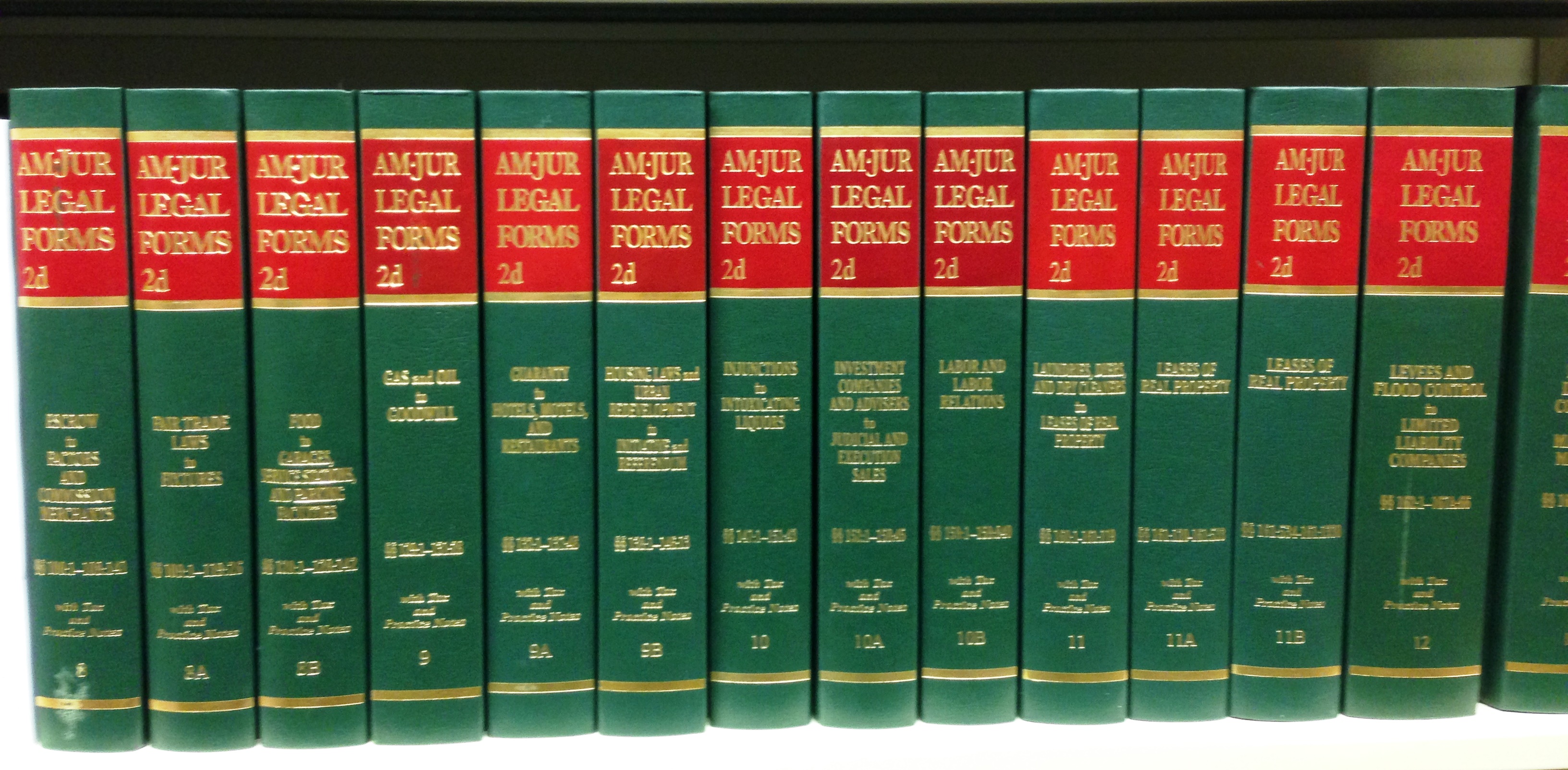
IMG_1551American Jurisprudence Legal Forms
The Law Library has updated its print copies of American Jurisprudence Legal Forms, which can provide law library users with access to sample forms with practice notes, research references checklists and related subject guides, all organized by subject matter. You can review and copy forms related to a wide array of substantive law, including business organizations, commercial transactions, real estate, commercial transactions, estate planning and workers’ compensation.

In addition, you can access both resources through our subscription to Westlaw, which includes document delivery services (e.g., print, email, download). Please stop by the Law Library’s main service desk for assistance in locating these new materials as well as legal research instruction to increase your research efficiency and success!

Categories
lawlibrary

Law Day – Office of Administrative Hearings

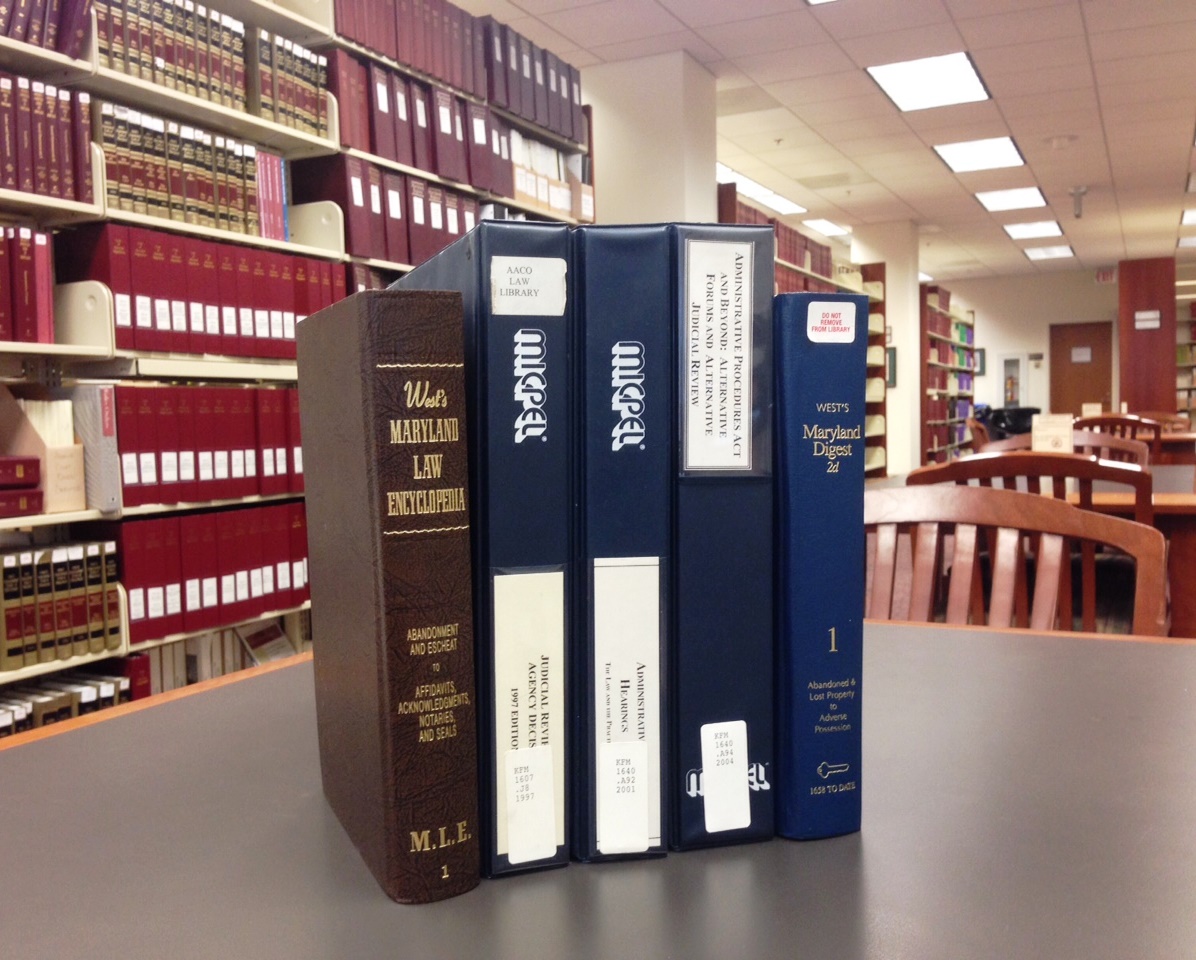
IMG_1553
Here are some of the resources available at the Law Library!

In connection with the Law Library’s celebration of Law Day, we will be publishing a series of eight posts that focus on the basics of the Maryland court system and legal research.

The Office of Administrative Hearings (OAH) was created in 1990 through the Administrative Procedure Act, which provides for the resolution of contested agency actions through an impartial administrative hearing process. This means that Marylanders may contest actions of Maryland state agencies through OAH. In Maryland, administrative agencies may include “any agency, board, department, district, commission, authority, commissioner, official, the Maryland Tax Court, or other unit of the State or of a political subdivision of the State and the Client Protection Fund of the Bar of Maryland.”* Examples of Maryland agencies include the Motor Vehicle Administration, Workers’ Compensation Commission and Maryland Insurance Administration. The hearing process is overseen by an Administrative Law Judge, who is an attorney trained to hear these types of matters and is independent from the Maryland agencies. To learn more about OAH and the administrative hearing process, check out this FAQ page.

OAH Library – At OAH’s main office in Hunt Valley, Maryland, the OAH has a library that is open to the public. The library’s collection includes OAH decisions, published state agency policies and other materials. Please note that in order to see an OAH decision, library users must first make a written public information request and receive approval for that request before visiting the library. For more information, please see the library’s website. Note that some decisions may not be available because they may contain confidential or privileged information.

Appealing an Administrative Decision – If you are looking to appeal an administrative decision, read this article published on the People’s Law Library, which provides an overview of the process for appealing an administrative decision. In addition, check out the Law Library’s Administrative Appeals wiki page, which includes links to useful resources and a sample form with a guide. If you have more questions, please contact us!

Foreclosure Mediation – The Administrative Law Judges at OAH also conduct mediations referred to the OAH by the Circuit Court pursuant to Maryland’s Foreclosure Mediation Law.  If you want to learn more about foreclosure mediation provided by OAH, check out this page.
*Maryland Rule 2-701.


Additional Law Library Resources
– Check out these materials, which are available at the Law Library.

  • West’s Maryland Digest 2d, 1 Md. D. 2d., Administrative Law, Key Numbers 651-821
  • West’s Maryland Law Encyclopedia, 1 M. L. E., Administrative Law and Procedure §§ 64-82
  • Maryland Civil Procedure Forms 3rd ed. / Robert D. Klein (LEXIS, 2000) –  Title 7- Chapter 200
  • Practice Manual for the Maryland Lawyer 4th ed.  / Jack L. B. Gohn, Esq. (MSBA, 2012) – §2- Chapter 8: “Challenges to Agency Action”.
  • Principles and Practice of Maryland Administrative Law / Arnold Rochvarg, M. (Carolina Academic Press, 2011)
  • Pleading Causes of Action in Maryland 5th ed. / Paul Mark Sandler & James K. Archibald  (MSBA, 2013)
  • Appellate Practice for the Maryland Lawyer: State and Federal 3rd ed. / Paul Mark Sandler & Andrew D. Levy, eds. (MICPEL, 2007) – Chapter 22: “Appeals From Administrative Agencies” by Honorable Paul W. Grimm & Robert B. Levin
  • Judicial Review of Agency Decisions / Alan M. Wilner, (MICPEL, 1997)
Categories
lawlibrary Maryland Law

Maryland Attorney General Opinions

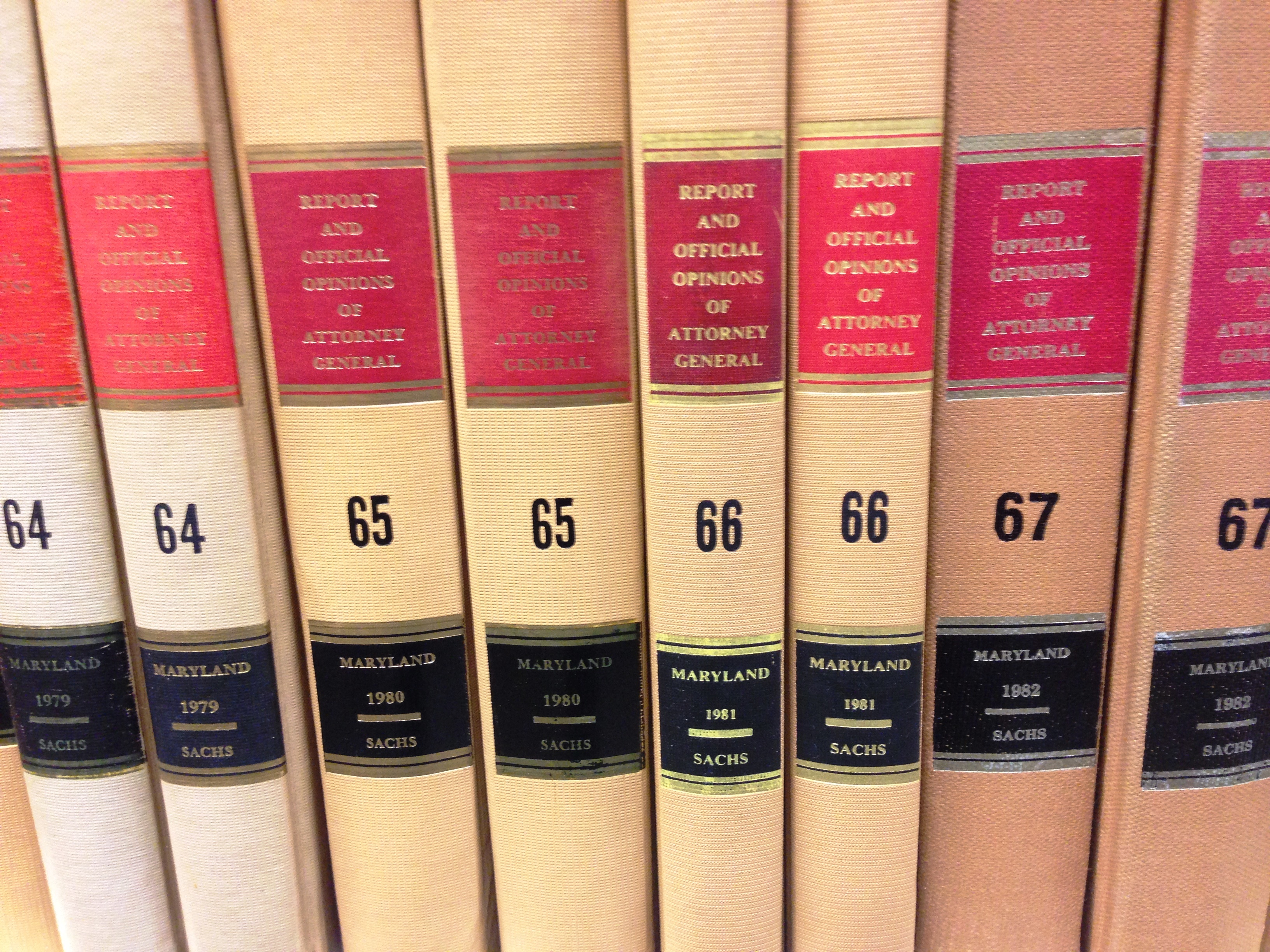
IMG_1511The Attorney General is Maryland’s chief legal officer and is elected by Marylanders every four years. The Attorney General’s Office is in charge of Maryland’s legal business, including acting as a legal advisor to the State of Maryland. To learn more about the Office of the Maryland Attorney General, check out their website.

In its role as a legal advisor to the State of Maryland, when requested by the Maryland General Assembly, the Governor, the Comptroller, the Treasurer or any State’s Attorney, the Attorney General provides a formal opinion, which is a written response to specific legal questions raised by Maryland’s government officials. The legal questions can range from the construction of statute, interpretation of case law or requests for legal counsel. Often, these opinions deal with a significant legal question involving Maryland law.

Private individuals cannot request a formal Opinion of the Attorney General. However, it is a possible that an Opinion of the Attorney General addresses a legal issue that is directly related to your matter. In that scenario, a Maryland court may consider an Opinion of the Attorney General, but the Opinion is not binding authority for Maryland Courts.

You can find Opinions of the Attorney General, from 1993 to the present, online at the Maryland Attorney General’s website. The Law Library’s collection include hardbound volumes of the Opinions of the Attorney General from 1917 to 2011. You can also access Maryland Attorney General Opinions through the Law Library’s subscriptions to Westlaw (coverage from 1977 to the present) and LexisNexis (coverage from 1970 to the present).

Note that Opinions of the Attorney General are formal opinions, which should be distinguished from other written documents from the Office of the Attorney General, such as letters to state agencies and memoranda of law. In order to be a formal Opinion of the Attorney General, the document must have gone through a specified review process and adopted by the Attorney General of Maryland. More information is available here.

Categories
lawlibrary Maryland Law

Law Day – Statutes

In connection with the Law Library’s celebration of Law Day, we will be publishing a series of eight posts that focus on the basics of the Maryland court system and legal research.

Statutes are the laws passed by legislative bodies and probably what most people visualize when they think about the law. Statutes are generally organized by subject in a set called a “code”. For example, you would generally find statutes about divorce laws in Maryland under the Family Law Article (subject) in the Code of Maryland (code). Don’t forget, statutes are only one of the three main sources of primary law (statutes, regulations and case law), and your legal research may not be complete if you only focus on relevant statutes.

Federal Statutes. The U.S. Congress is the U.S. federal government’s legislative body and derives its power to make laws from the United States Constitution. The U.S. Congress consists of two chambers: the House of Representatives and the Senate. Members of Congress are directly elected by citizens of the United States. To learn more about the federal legislative process, check out this article, “How Our Laws Are Made”, available on Congress.gov.

Current U.S. statutes are organized by subject matter in the current U.S. Code, which is available online here. In addition, check out our earlier blog post here about Congress.gov, the official federal website for federal legislative information. Congress.gov is a great resources that provides members of the public with access to current and historic legislative information, including bill status, bill summaries and committee reports.

The Law Library’s print collection includes the West’s United States Code Annotated. (The annotations included in the print books by the editors include references to relevant cases, law review articles and other resources that may provide the legal researcher with useful research and related primary sources.) You can also read the annotated code in electronic format through the Law Library’s subscriptions to WestlawNext and LexisNexis.

Maryland Statutes. Maryland’s legislative body is the Maryland General Assembly, which is comprised of two chambers: the State Senate and the House of Delegates. The Maryland General Assembly meets for 90 calendar days each year, beginning on the second Wednesday of January, and special sessions may be called by the Governor or a petition by a majority of each house. More information about the Maryland legislative process is available here. Current Maryland statutes are organized by article (subject) in the Code of Maryland and available online here.

The Law Library’s print collection includes current and superseded copies of Michie’s Annotated Code of Maryland West’s Annotated Code of Maryland. (The annotations included in the print books by the editors include references to relevant cases, law review articles and other resources that may provide the legal researcher with useful research and related primary sources.) In addition, you can read the current annotated code in electronic format through the Law Library’s subscriptions to WestlawNext and LexisNexis.

Local Ordinances and Resolutions. Don’t forget local ordinances and resolutions! For example, if you live in Annapolis, your legal statutory research may need to include the Anne Arundel County Code as well as the Code of the City of Annapolis.

The legislative body for Anne Arundel County is the County Council, whose members are elected. The Anne Arundel County Council generally holds legislative session on the first and third Mondays of each month (excluding August) in Annapolis, Maryland and all sessions are open to the public. For more information, check out the County Council’s website. For those you who cannot attend the sessions in person, you may be able to view live webcasts.

The Annapolis City Council is the legislative body for the city of Annapolis, and its members include the Mayor of Annapolis and eight Aldermen and Alderwomen. Information regarding the City Council’s regular meetings, public access to agendas and television schedules are available here.

The Law Library’s print collection includes current and superseded copies of the Anne Arundel County Code and the Code of the City of Annapolis. In addition, the Law Library’s collection includes copies of the Anne Arundel County Council’s Proposed Bills, Final Bills, Resolutions and Schedules.

Stay tuned for the next post in our Law Day Series, which will provide an overview of the Maryland Office of Administrative Hearings.