Legal research can be challenging, even for experienced attorneys; however, there are many resources available to assist both attorneys and non-attorneys with their legal research needs. The Legal Research in the Blogosphere series will share blog posts and online sites that legal researchers may find useful.
Copyright issues are hot topics in the legal and library worlds. Rachel Englander, one of the Communications Chairs for the Law Library Association of Maryland (LLAM) is writing an ongoing series of blog posts for the LLAM blog dealing with copyrights. Check out her posts, which discuss copyright generally, licensing rights, and Digital Rights Management (DRM).
Legal research can be challenging, even for experienced attorneys; however, there are many resources available to assist both attorneys and non-attorneys with their legal research needs. The Legal Research in the Blogosphere series will share blog posts and online sites that legal researchers may find useful.
Scotusblog was founded in 2002 by the wife and husband team of Amy Howe and Tom Goldstein. Currently, the blog has over twenty writers who publish posts on issues closely related to the Supreme Court, such as posts on every merits case before the Supreme Court (prior to argument, after argument and after decision). This can be a great resource for those legal researchers interested in following the Supreme Court’s current events.
For non-attorney readers, the blog publishes “Plain English” posts where cases are drafted in plain language. The blog also includes an introduction to Supreme Court procedure, a glossary of legal terms, and biographies of the Supreme Court Justices. For visual learners, the blog has a multimedia library with videos of interviews with the Supreme Court Justices, news footage, presentations, and other resources. You can read about the blog’s vision here.
Please note that the blog is not the official website for the Supreme Court. The official Supreme Court website is available at http://www.supremecourt.gov/default.aspx. On the Supreme Court’s website you will also find a wealth of information, including biographies of the Supreme Court Justices, opinions, calendars for oral arguments, Court Rules, and guidance for attorneys. If you are interested in learning more about the Supreme Court and Supreme Court practice, please stop by the Law Library.
THOMAS is retiring! Launched in 1995 by the Library of Congress and named after Thomas Jefferson, one of the United States’s founding fathers, THOMAS is a great online database of federal legislative information. The specific date of THOMAS’s retirement has not yet been set, but expect THOMAS to retire after the 2015 fiscal year.
Introducing Congress.gov! Congress.gov is now the official website for federal legislative information and provides the public with access to both current and historic legislative information including bill summaries, bill status, presidential nominations, treaties, and committee reports. Note that the default search setting for Congress.gov is the current session of Congress. Common search options are available in a drop-down menu next to the main search box at the top of the webpage, and advanced search settings are available through the “Advanced” link to the right of the main search box. For more search tips, check out https://www.congress.gov/help/search-tips-overview.
Information is generally updated the morning after a session adjourns, and specific update schedules are available at https://www.congress.gov/about/coverage-dates. Every Monday, the website compiles a list of the top ten most-viewed bills from the previous week. This can be a great resource to quickly find a popular topic or get a sense of what is trending. Here are some highlights from the site.
You can save searches that you run on Congress.gov, but you will need to register with the website.
If you prefer THOMAS, until all data sets from THOMAS have been transferred to Congress.gov, you can still access THOMAS at http://thomas.loc.gov/home/thomas.php.
If you would like to learn more about Congress.gov or receive assistance in navigating the site, contact us at the Law Library, and we will be more than happy to assist you.
Legal research can be challenging, even for experienced attorneys; however, there are many resources available to assist both attorneys and non-attorneys with their legal research needs. The Legal Research in the Blogosphere series will share blog posts and online sites that legal researchers may find useful.
The American Bar Association (ABA) maintains a comprehensive directory of law blogs, which is available at http://www.abajournal.com/blawgs/. The blogs are organized by topic, author type, region, law school and courts. These blogs can be good resources for more specialized information as well as fun to read. In addition, the ABA maintains a blog “Hall of Fame” and annual rankings. Check them out to see if your favorite law blog made the list.
Each month, the AACPLL Blog will publish a post with helpful legal research tips. If you would like more information about any of the tips referenced in this post or series, please feel free to contact the Law Library!
January is one of the Law Library’s busiest months for updating resources, including updating pocket parts and filing supplemental pages. As you are conducting your legal research, it is essential that you make sure that your sources, both primary (e.g., code, regulations, case law) and secondary (e.g., treatises, form books) are up-to-date because the “law” is constantly changing. The onus is on the legal researcher to make sure their information is current.
Here are a few helpful tips for making sure that your resource is up-to-date.
Check the cover or title page to determine the publication date of the resource. The publication date will provide clues as to whether you should check to see if a later edition of the resource has been published.
Check the pocket part and take note of the date of the pocket part. Pocket parts are paper supplements that are generally located inside the back cover of a hardbound volume. If you are not sure if the pocket part is current, please drop by the service desk. The Law Library keeps track of its updates, and we can let you know if the pocket part is the most recent supplement available.
Check for any standalone supplements to the resource. When in doubt, ask us at the Law Library’s service desk, and we can confirm whether a volume has a standalone supplement.
Online does not necessarily mean current. Is the information posted on a reputable site? Check for a publication date or “last updated” date. When in doubt, ask!
Here are some great resources that provide an overview of the basics of legal research.
In addition, the following titles, which focus on providing a comprehensive overview of the legal research process and fundamentals, are available at the Law Library.
What is UELMA? UELMA (“yoo-el-mah”) is the Uniform Electronic Legal Material Act, a uniform law* that addresses the issues of trustworthiness and access raised by the increased electronic distribution of state primary legal materials through the provision of an “outcomes-based approach to the authentication and preservation of electronic legal material . . . to enable end-users to verify the trustworthiness of the legal material they are using and to provide a framework for states to preserve legal material in perpetuity in a manner that allows for permanent access.”** UELMA requires legal material that are only published in electronic form to be designated as official. Official information must then be (1) capable of authentication (i.e., the appointed government agency or official provides the user with a way to determine that the legal information is trustworthy as an accurate copy), (2) preserved (i.e., in print and/or electronic formats) and (3) permanently accessible to the public.
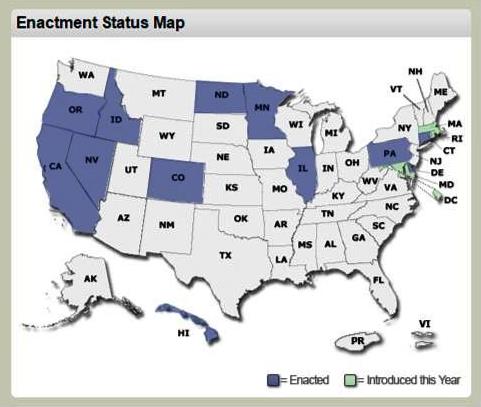
As of October 2014, the following twelve states have adopted the act: California, Colorado, Connecticut, Delaware, Hawaii, Idaho, Illinois, Minnesota, Nevada, North Dakota, Oregon and Pennsylvania. UELMA was introduced in the Maryland General Assembly in January 2014 (HB 46 / SB 275), but was withdrawn from further consideration in February 2014. The full text of UELMA is available at http://www.aallnet.org/Documents/Government-Relations/2011Oct-UniformElectronicLegalMaterialAct-Final.pdf. If you are interested in learning more about UELMA, check out the UELMA Resources page (http://www.aallnet.org/Documents/Government-Relations/UELMA), available on the American Association of Law Libraries’ website.
*In the United States, multiple legislative bodies may address the same area of law. The goal of uniform laws is to encourage uniformity throughout the United States by encouraging state legislatures to enact the same law. A uniform law is only a proposal until it is adopted by a legislative body.
**Prefatory Note of the Uniform Electronic Material Act.
Online databases can be invaluable, time-saving tools to any legal researcher as they provide organized access to a wide array of legal resources as well as sophisticated search functions. Many online databases, including fee-based databases, are available at the Law Library, free of charge, to library patrons.
Throughout the month of December 2014, this blog featured a series on online databases available at the Law Library for patrons’ use. The featured databases include Bloomberg BNA, HeinOnline, LexisNexis, VerdictSearch and Westlaw, which are all subscription-based databases that the Law Library offers to its patrons free of charge. However, this is just a small sampling of the legal databases that may be available for your use. If you are interested in learning more about online legal databases, including databases that are available without subscription, please contact us!
Many other law libraries also provide their library patrons with access to online legal databases free of charge. For other local access points to online legal databases, you can check out these libraries.
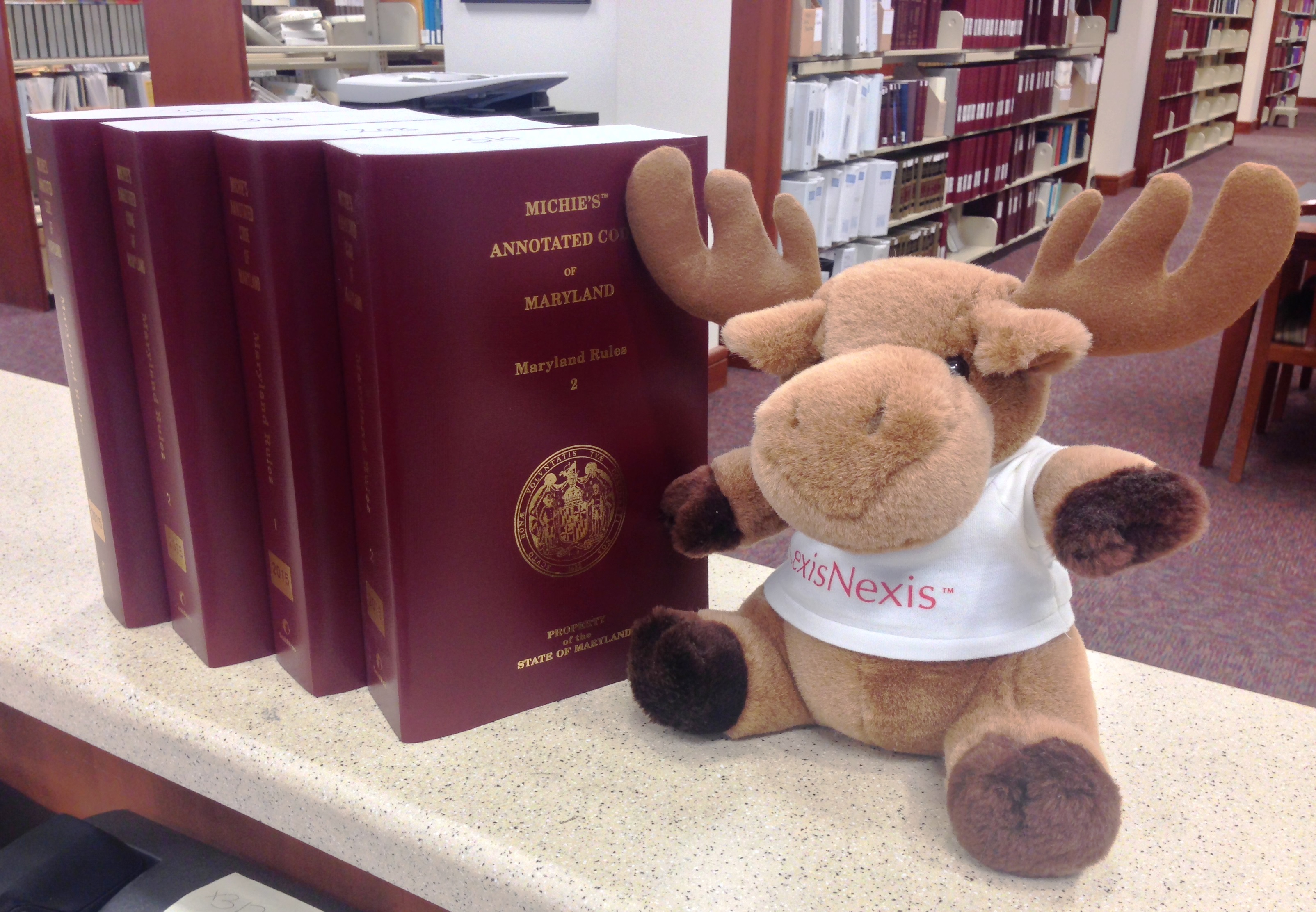
The 2015 Edition of Michie’s Maryland Court Rules is available at the Law Library! The 2015 edition includes amendments adopted through November 7, 2014. The Maryland Rules are the rules of practice and procedure followed by Maryland courts and apply to all Maryland courts unless noted otherwise. Annotation sources include Maryland case law, the Maryland Law Review, the University of Baltimore Law Review, the University of Baltimore Law Forum and Opinions of the Attorney General.
The current Maryland Code and Rules (without annotations) are available online, free of charge, through Lexis Nexis and Westlaw. In addition, you can access the annotated Maryland Code and Rules online in the Law Library’s computer room through the Law Library’s subscriptions to Lexis and Westlaw legal databases. If you are new to the Maryland Rules, the People’s Law Library has an online video tutorial on reading the Maryland Rules through Westlaw, which is available at http://www.screencast.com/t/My0FU44NZbwL.
The 2015 edition supersedes and replaces all previous editions and supplements. Note that the Law Library maintains copies of the superseded Maryland Rules in its collection, so if you ever need to reference the superseded rules, please drop by the Law Library’s service desk, and we can assist you in locating the appropriate rules.
If you have any questions or want to learn more, you can always reach us via email at lawlibrary@aacounty.org, via phone at (410) 222-1387 or via fax at (410) 268-9762.
Online databases can be invaluable, time-saving tools to any legal researcher as they provide organized access to a wide array of legal resources as well as sophisticated search tools. Many online databases, including fee-based databases, are available at the Law Library, free of charge, to library patrons. Each Tuesday of this month, this blog will highlight one of the many databases available at the Law Library.
The Law Library provides library patrons with free access to the Bloomberg BNA (Bureau of National Affairs) legal database. While there is a great deal of overlap between the resources available on Bloomberg BNA and Westlaw and LexisNexis, which we highlighted earlier this month, Bloomberg BNA materials are only available on Bloomberg BNA. These BNA materials include the following.
United States Law Week provides searchable access to Supreme Court opinions, Supreme Court Practice and Federal Appellate Practice.
Family Law Reporter provides a weekly roundup of family law developments and trends.
Criminal Law Reporter provides an overview of trends, development and issues in criminal law.
Lawyer’s Manual on Professional Conduct provides news and guidance regarding attorneys’ ethics and professional conduct.
Law Library patrons may access Bloomberg BNA’s database in the library’s computer room free of charge. If you have any questions regarding how to use the database, please come to the Law Library’s service desk.
For more information about understanding legal research, including the difference between primary and secondary legal resources, check out these research guides.

 AACPLL Blog: Law Library News