Categories
lawlibrary Maryland Law

New Maryland Laws Take Effect on October 1, 2015 – Spotlight on Marijuana and Marijuana Paraphernalia

New Maryland laws take effect on October 1, 2015!  We will be publishing a series of posts highlighting a few of the newly enacted laws.  This series is just a small sampling of the new laws enacted by the 2015 Legislative Session.  To read about more laws resulting from the 2015 session, see the 90 Day Report – A Review of the 2015 Session published by the Department of Legislative Services (DLS) of the General Assembly of Maryland. For a full listing of new laws effective October 1, 2015, check out this publication from DLS.

Senate Bill 456 (Chapter 351) – A court must “dismiss a criminal charge, in a prosecution for possession of marijuana or for possession of paraphernalia related to marijuana, if the court finds that a person used or possessed marijuana or marijuana paraphernalia because of a medical necessity.” You can learn more about this new law, including its legislative history, here.

Don’t forget, bills that are passed by the Maryland General Assembly do not always become Maryland Law. For example, Senate Bill 517, which calls for, among other things, the repeal of “the criminal prohibition on possession of marijuana-related paraphernalia and eliminates any penalty”, was vetoed by the Governor on policy grounds. Since this veto occurred after the Maryland Legislature adjourned, an override vote will not occur until the next legislative session commences. To learn more about the Maryland legislative process, check out this blog post on statutes.

In addition, the 2014 Legislative Session made changes to Maryland laws related to marijuana. Check out our 2014 post to learn more!
Note that all quotations, unless noted otherwise, are attributable to the 90 Day Report – A Review of the 2015 Session published by the Department of Legislative Services of the General Assembly of Maryland, which is available online at http://mgaleg.maryland.gov/Pubs/LegisLegal/2015rs-90-day-report.pdf.

Categories
lawlibrary Maryland Law

New Maryland Laws Take Effect on October 1, 2015 – Spotlight on Shielding

New Maryland laws take effect on October 1, 2015!  We will be publishing a series of posts highlighting a few of the newly enacted laws.  This series is just a small sampling of the new laws enacted by the 2015 Legislative Session.  To read about more laws resulting from the 2015 session, see the 90 Day Report – A Review of the 2015 Session published by the Department of Legislative Services (DLS) of the General Assembly of Maryland. For a full listing of new laws effective October 1, 2015, check out this publication from DLS.

Maryland Second Chance Act of 2015 – House Bill 244 (Chapter 0313) – This new law authorizes “a person to petition the court to shield court records and police records relating to shieldable convictions no earlier than 3 years after the person satisfies the sentence or sentences imposed for all convictions for which shielding is requested”, however, “if a person is convicted of a new crime during a specified time period, the original conviction or convictions are not eligible for shielding unless the new conviction becomes eligible for shielding.” You can learn more about this new law, including its legislative history, here.

What is shielding? Shielding means making “a court record and police record relating to a conviction of a crime inaccessible by members of the public. Also, the Maryland Judiciary Case Search may not in any way refer to the existence of specific records shielded in accordance with the bill.”

What’s the difference between shielding and expungement? When a record has been expunged, it has been totally deleted from the court system and other places where the record is held, such as the Police Department, Archives, and State’s Attorney’s office. However, when a record is shielded, it means that the public cannot view the record; however, the record still exists.

To learn more about public access to court records, check out these Maryland Judiciary Publications. Don’t forget, the Law Library is always available to assist your with your legal research, including locating referrals.

Note that all quotations, unless noted otherwise, are attributable to the 90 Day Report – A Review of the 2015 Session published by the Department of Legislative Services of the General Assembly of Maryland, which is available online at http://mgaleg.maryland.gov/Pubs/LegisLegal/2015rs-90-day-report.pdf.

Categories
lawlibrary Maryland Law

New Maryland Laws Take Effect on October 1, 2015 – Spotlight on Expungement

Laws of MDNew Maryland laws take effect on October 1, 2015!  We will be publishing a series of posts highlighting a few of the newly enacted laws.  This series is just a small sampling of the new laws enacted by the 2015 Legislative Session.  To read about more laws resulting from the 2015 session, see the 90 Day Report – A Review of the 2015 Session published by the Department of Legislative Services (DLS) of the General Assembly of Maryland. For a full listing of new laws effective October 1, 2015, check out this publication from DLS.

Senate Bill 651 (Chapter 0374) /House Bill 124 – Eligibility for expungement has been expanded to include “persons convicted of a crime where the act on which the conviction was based is no longer a crime.” You can learn more about this new law, including its legislative history, here.

House Bill 304 (Chapter 0314)- Eligibility for expungement generally does not include a petition based on the entry of probation before judgment, “except a probation before judgment for a crime where the act on which the conviction is based is no longer a crime, and the person is a defendant in a pending criminal proceeding or was convicted of a crime other than a minor traffic violation or a crime where the act on which the conviction is based is no longer a crime within three years after the entry of the probation before judgment.” You can learn more about this new law, including its legislative history, here.

House Bill 131 (Chapter 0069) – For criminal charges that were transferred to juvenile court, the petition for expungement must be filed in the court of original jurisdiction where the order for transfer was entered. You can learn more about this new law, including its legislative history, here.

To learn more about expungement and expungement resources, check out these articles on the Maryland People’s Law Library, our wiki page and our past blog post! In addition, the Maryland Courts website includes information on how to expunge your records.

Note that all quotations, unless noted otherwise, are attributable to the 90 Day Report – A Review of the 2015 Session published by the Department of Legislative Services of the General Assembly of Maryland, which is available online at http://mgaleg.maryland.gov/Pubs/LegisLegal/2015rs-90-day-report.pdf.

Categories
lawlibrary Maryland Law

Law Day – Statutes

In connection with the Law Library’s celebration of Law Day, we will be publishing a series of eight posts that focus on the basics of the Maryland court system and legal research.

Statutes are the laws passed by legislative bodies and probably what most people visualize when they think about the law. Statutes are generally organized by subject in a set called a “code”. For example, you would generally find statutes about divorce laws in Maryland under the Family Law Article (subject) in the Code of Maryland (code). Don’t forget, statutes are only one of the three main sources of primary law (statutes, regulations and case law), and your legal research may not be complete if you only focus on relevant statutes.

Federal Statutes. The U.S. Congress is the U.S. federal government’s legislative body and derives its power to make laws from the United States Constitution. The U.S. Congress consists of two chambers: the House of Representatives and the Senate. Members of Congress are directly elected by citizens of the United States. To learn more about the federal legislative process, check out this article, “How Our Laws Are Made”, available on Congress.gov.

Current U.S. statutes are organized by subject matter in the current U.S. Code, which is available online here. In addition, check out our earlier blog post here about Congress.gov, the official federal website for federal legislative information. Congress.gov is a great resources that provides members of the public with access to current and historic legislative information, including bill status, bill summaries and committee reports.

The Law Library’s print collection includes the West’s United States Code Annotated. (The annotations included in the print books by the editors include references to relevant cases, law review articles and other resources that may provide the legal researcher with useful research and related primary sources.) You can also read the annotated code in electronic format through the Law Library’s subscriptions to WestlawNext and LexisNexis.

Maryland Statutes. Maryland’s legislative body is the Maryland General Assembly, which is comprised of two chambers: the State Senate and the House of Delegates. The Maryland General Assembly meets for 90 calendar days each year, beginning on the second Wednesday of January, and special sessions may be called by the Governor or a petition by a majority of each house. More information about the Maryland legislative process is available here. Current Maryland statutes are organized by article (subject) in the Code of Maryland and available online here.

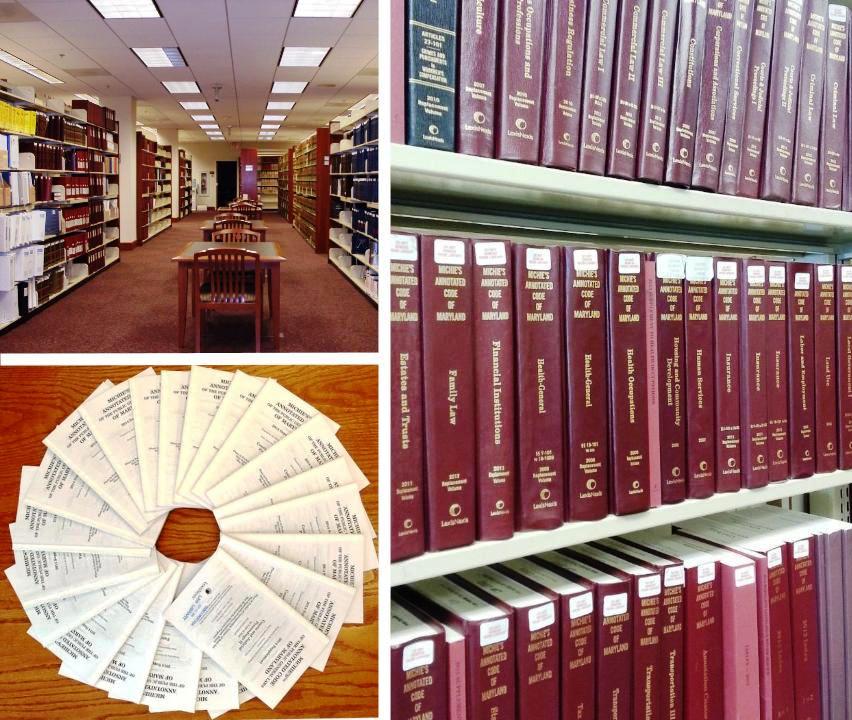
The Law Library’s print collection includes current and superseded copies of Michie’s Annotated Code of Maryland West’s Annotated Code of Maryland. (The annotations included in the print books by the editors include references to relevant cases, law review articles and other resources that may provide the legal researcher with useful research and related primary sources.) In addition, you can read the current annotated code in electronic format through the Law Library’s subscriptions to WestlawNext and LexisNexis.

Local Ordinances and Resolutions. Don’t forget local ordinances and resolutions! For example, if you live in Annapolis, your legal statutory research may need to include the Anne Arundel County Code as well as the Code of the City of Annapolis.

The legislative body for Anne Arundel County is the County Council, whose members are elected. The Anne Arundel County Council generally holds legislative session on the first and third Mondays of each month (excluding August) in Annapolis, Maryland and all sessions are open to the public. For more information, check out the County Council’s website. For those you who cannot attend the sessions in person, you may be able to view live webcasts.

The Annapolis City Council is the legislative body for the city of Annapolis, and its members include the Mayor of Annapolis and eight Aldermen and Alderwomen. Information regarding the City Council’s regular meetings, public access to agendas and television schedules are available here.

The Law Library’s print collection includes current and superseded copies of the Anne Arundel County Code and the Code of the City of Annapolis. In addition, the Law Library’s collection includes copies of the Anne Arundel County Council’s Proposed Bills, Final Bills, Resolutions and Schedules.

Stay tuned for the next post in our Law Day Series, which will provide an overview of the Maryland Office of Administrative Hearings.
Categories
lawlibrary Maryland Law

Upcoming Changes to Maryland Family Law – Divorce

On October 1, 2015, several changes to Maryland divorce law will go into effect.  These changes were passed in the 2015 Regular Session of the General Assembly of Maryland and approved by the Governor of Maryland.

Grounds for Divorce – Mutual Consent – Senate Bill 472 / House Bill 165 (Chapter 353) is, perhaps, the most sweeping of the new changes to Maryland’s divorce law because it provides for an absolute divorce on the grounds of mutual consent if certain conditions are met. These conditions include a requirement that the parties do not have any minor children in common and that the parties submit a written settlement agreement to the court that resolves certain specific issues, such as property and financial issues.

Grounds for Limited Divorce – House Bill 0165 (Chapter 0226) affects the conditions to determine separation for purposes of granting a limited divorce on a specific ground by repealing certain requirements dealing with the voluntary nature of the separation and reconciliation. Additional information, including the Fiscal and Policy Note, is available on the General Assembly’s website.

Residency Requirement – House Bill 1185 (Chapter 473) provides that, under certain circumstances, the period of time that an applicant for divorce must reside in the State of Maryland will be reduced from one year to six months. Additional information, including the Fiscal and Policy Note, is available on the General Assembly’s website.

If you are looking for more information about divorce and other family law matters, available resources include the following.

  • FLSHCThe Family Law Self Help Center provides self-represented litigants with legal information and forms for family law matters such as divorce, custody, visitation, child support and name changes. Located at the Law Library, the Family Law Self Help Center has walk-in hours and telephone hours (410-280-5374).
  • The Law Library’s wiki site includes pages dedicated to Family Law Resources, including referrals, forms and reference materials.
  • The Circuit Court of Anne Arundel County’s website includes a “Learn About” page addressing Family Law Cases.
  • The Maryland Courts’ website includes information about Family Law Matters, such as adoption, child custody, child support, divorce, marriage and name change.
  • The Maryland People’s Law Library has a page dedicated to Family Law Articles.

For more information or help getting started with your research, contact the Law Library!

Categories
lawlibrary Maryland Law UELMA

UELMA Update

An interior view of the State House dome.

Today, the Senate Judicial Proceedings Committee will have a hearing on the Maryland Uniform Legal Materials Act (UELMA, “yoo-el-mah”). This proposed law would require legal materials that are only published in electronic form to be designated as “official”. The law would then require “official” materials to be capable of authentication, preserved, and permanently accessible to the public.

Why is UELMA so important? Many state governments have moved to online only publication of legal information. Consumers of this information, which include students, attorneys, legislators, and librarians are increasingly accessing this information online. It is critical that there is a way for everyone to know that the electronic information is accurate. UELMA provides Maryland’s citizens with this assurance and ensures that the law in the digital age will be accessible, authenticated, and preserved.

For more background information, check out our blog post from January here. If you have any questions about UELMA or navigating the Maryland General Assembly’s website, please contact us at the Law Library!

*The Maryland Uniform Legal Materials Act, sponsored by Delegates Vitale, Ghrist, Glass, McComas, McConkey, McMillan, Metzgar, Saab, and B. Wilson, was introduced to the House of Delegates and first read on January 28, 2015.* The proposed act, sponsored by Senator Astle, was introduced to the Senate on February 6, 2015. The text of Senate Bill 611 is available here, and the text of House Bill 162 is available here. For those of you interested in tracking the progress of the proposed act through the Maryland General Assembly, check out these summary pages here and here.

Categories
lawlibrary

Check your pocket parts!

photo 1Each month, the AACPLL Blog will publish a post with helpful legal research tips.  If you would like more information about any of the tips referenced in this post or series, please feel free to contact the Law Library!

January is one of the Law Library’s busiest months for updating resources, including updating pocket parts and filing supplemental pages.  As you are conducting your legal research, it is essential that you make sure that your sources, both primary (e.g., code, regulations, case law) and secondary (e.g., treatises, form books) are up-to-date because the “law” is constantly changing.  The onus is on the legal researcher to make sure their information is current.

Here are a few helpful tips for making sure that your resource is up-to-date.

  • Check the cover or title page to determine the publication date of the resource.  The publication date will provide clues as to whether you should check to see if a later edition of the resource has been published.
  • Check the pocket part and take note of the date of the pocket part.  Pocket parts are paper supplements that are generally located inside the back cover of a hardbound volume.  If you are not sure if the pocket part is current, please drop by the service desk.  The Law Library keeps track of its updates, and we can let you know if the pocket part is the most recent supplement available.
  • Check for any standalone supplements to the resource.  When in doubt, ask us at the Law Library’s service desk, and we can confirm whether a volume has a standalone supplement.
  • Online does not necessarily mean current.  Is the information posted on a reputable site? Check for a publication date or “last updated” date.  When in doubt, ask!

Here are some great resources that provide an overview of the basics of legal research.

In addition, the following titles, which focus on providing a comprehensive overview of the legal research process and fundamentals, are available at the Law Library.

Categories
lawlibrary Maryland Law UELMA

An Introduction to UELMA

Untitled drawing (5)
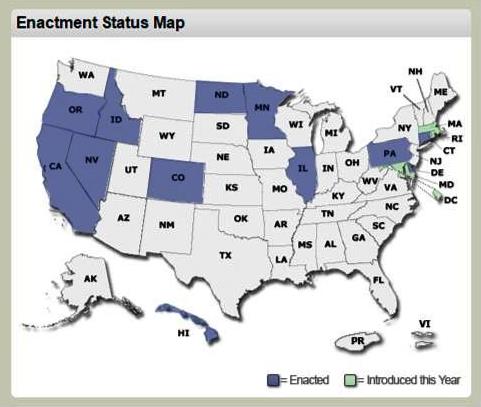
This Enactment Status Map as well as other resources are available at http://www.uniformlaws.org.

What is UELMA? UELMA (“yoo-el-mah”) is the Uniform Electronic Legal Material Act, a uniform law* that addresses the issues of trustworthiness and access raised by the increased electronic distribution of state primary legal materials through the provision of an “outcomes-based approach to the authentication and preservation of electronic legal material . . . to enable end-users to verify the trustworthiness of the legal material they are using and to provide a framework for states to preserve legal material in perpetuity in a manner that allows for permanent access.”**  UELMA requires legal material that are only published in electronic form to be designated as official.  Official information must then be (1) capable of authentication (i.e., the appointed government agency or official provides the user with a way to determine that the legal information is trustworthy as an accurate copy), (2) preserved (i.e., in print and/or electronic formats)  and (3) permanently accessible to the public.

As of October 2014, the following twelve states have adopted the act:  California, Colorado, Connecticut, Delaware, Hawaii, Idaho, Illinois, Minnesota, Nevada, North Dakota, Oregon and Pennsylvania.  UELMA was introduced in the Maryland General Assembly in January 2014 (HB 46 / SB 275), but was withdrawn from further consideration in February 2014.  The full text of UELMA is available at http://www.aallnet.org/Documents/Government-Relations/2011Oct-UniformElectronicLegalMaterialAct-Final.pdf. If you are interested in learning more about UELMA, check out the UELMA Resources page (http://www.aallnet.org/Documents/Government-Relations/UELMA), available on the American Association of Law Libraries’ website.

Why is UELMA important? UELMA will help ensure that online legal information deemed official will be publicly accessible, free and reliable.  This, in turn, will promote government transparency, promote acceptance by the courts of online legal sources and assist legal researchers.  For more reasons why UELMA is important, check out this article by Judy Janes, the director of the University of California, Davis, Mable Law Library – http://aallnet.org/mm/Publications/spectrum/Spectrum-Online/uelma.html.  Advocacy materials are available at http://www.aallnet.org/Documents/Government-Relations/UELMA.  UELMA supporters include the American Association of Law Libraries (http://www.aallnet.org/Documents/Government-Relations/UELMA/testimonychart.pdf)  and the American Bar Association (http://www.aallnet.org/Documents/Government-Relations/Formal-Statements/2012/lt013112ABA.pdf).

*In the United States, multiple legislative bodies may address the same area of law.  The goal of uniform laws is to encourage uniformity throughout the United States by encouraging state legislatures to enact the same law. A uniform law is only a proposal until it is adopted by a legislative body.

**Prefatory Note of the Uniform Electronic Material Act.

Categories
lawlibrary Maryland Law

New Maryland Laws Took Effect on January 1, 2015

Laws of MDHappy New Year!  New Maryland laws took effect on January 1, 2015, which impact laws relating to trusts (House Bill 83, Chapter 585), residential leases (Senate Bill 345 / Chapter 488 and House Bill 249, Chapter 489) and real estate appraisers (Senate Bill 1106, Chapter 79). These new laws represent just a small sampling of the new laws enacted by the 2014 Legislative Session.  To learn more about the laws resulting from the 2014 session, check out the 90 Day Report – A Review of the 2014 Session, which is published by the Department of Legislative Services of the General Assembly of Maryland.

If you have any questions or want to learn more, you can always reach us via email at lawlibrary@aacounty.org, via phone at (410) 222-1387 or via fax at (410) 268-9762.

Categories
Maryland Law

New Maryland Laws Take Effect on October 1, 2014 – Can’t Find What You’re Looking For?

Untitled drawingNew Maryland laws take effect on October 1, 2014!  We will be publishing a series of posts highlighting a few of the newly enacted laws.  Please note that this series is just a small sampling of the new laws enacted by the 2014 Legislative Session.  To read about more laws resulting from the 2014 session, see the 90 Day Report – A Review of the 2014 Session published by the Department of Legislative Services of the General Assembly of Maryland.

Was there a major issue from the 2014 session that was not covered in this series?  The 90 Day Report – A Review of the 2014 Session includes a hyperlinked list of Major Issues from 2014 such as Distracted Driving, Dog Owner Liability, Medical Marijuana, Minimum Wage, Estate Tax and Transgender Rights.  Also, note that some new laws from the 2014 session, such as Maryland Minimum Wage Act of 2014, are effective as of July 1, 2014.

Can’t find what you’re looking for?  The Department of Legislative Services of the General Assembly of Maryland publishes a Popular Terms List as a reference for current legislation that is often referred to by the public and media by certain popular terms.  Also, the Department of Legislative Services of the General Assembly of Maryland publishes compilations of executive orders.

Do you prefer paper sources?  The Law Library’s collection includes a copy of the 2014 Maryland Legislative Review Service, published by LexisNexis, which summarizes the 2014 Acts of the Maryland General Assembly Regular Session and organizes the 2014 Acts by topical headings.

Don’t forget – the Law Library is here if you have questions or would like additional information. Contact us!