ALA, the American Library Association of Libraries, “celebrates” Banned Books Week this week. The website states “it brings together the entire book community — librarians, booksellers, publishers, journalists, teachers, and readers of all types — in shared support of the freedom to seek and to express ideas, even those some consider unorthodox or unpopular.” Check out the lists of the top ten banned books over the years – you might be surprised.
Author: Joan Bellistri
Law Library Director for the Anne Arundel County Public Law Library

“Ask a Lawyer” is back in full force after the summer break. Ten attorneys assisted 37 people with contracts, court procedures, replevin, guardianship, appeals, estates and expungement in August.
In addition, the MVLS Foreclosure Clinic helped one person with foreclosure questions. The MVLS Brief Legal Advice Foreclosure Clinic is held on the 3rd Wednesday in the law library from 11:00 a.m. to 1:00 p.m. Questions about foreclosure are answered in the law library remotely by an MVLS attorney in Baltimore.

The Ask a Lawyer In the Library program is a civil, non-family law, self-help program sponsored by The Anne Arundel Bar Association and the Maryland Volunteer Lawyers Service. Every Wednesday, from 11:00 a.m. to 1:00 p.m., you can talk with a volunteer attorney for up to 20 minutes. No appointment is necessary, but sign-up is required at the law library’s information desk. Sign-up begins at 10:45 a.m., and time slots are determined by a lottery. In addition to the weekly program, the Ask A Lawyer In The Library program is held monthly at two Anne Arundel County Public Library branches: Glen Burnie Regional Library on the 3rd Wednesday (except in June and July) and Eastport-Annapolis Neck Community Library on the last Tuesday. For more information, please see http://circuitcourt.org/legal-help/lawyer-in-the-library.
Law Library Closed for Labor Day
The Law Library and the Anne Arundel County Circuit Court are closed today, September 3, 2018 for the Labor Day holiday. According to the U.S. Department of Labor, “Labor Day, the first Monday in September, is a creation of the labor movement and is dedicated to the social and economic achievements of American workers. It constitutes a yearly national tribute to the contributions workers have made to the strength, prosperity, and well-being of our country.” Read more on the DOL’s page, the History of Labor Day.
The Law Library will reopen tomorrow, Tuesday, September 4, 2018. A list of Court Holidays is available on the Circuit Court’s website at http://www.circuitcourt.org/court-holidays. Except on Court Holidays, the Library is open Monday through Friday, from 8:30 a.m. until 4:30 p.m.
The People’s Law Library of Maryland has a new look. We were accustomed to the look and feel of this important website since we use it many times everyday and so were a bit surprised to see the new design with Maryland colors pop-up on the screen.
People’s still provides the links we refer to everyday – the legal directory, the legal clinics listing, and, of course, all of the legal information on topics important to Maryland citizens.
The front page provides a link to the Maryland Courts Self-Help Center as well as the phone number where live assistance is available Monday through Friday from 8:30 a.m. until 8:00 p.m. (I appreciate the live chat button on every information page as it makes for easy referrals – to information and live assistance in one convenient place.)
The People’s Law Library of Maryland is an important tool that we use all of the time. It makes assisting those that call in or email with questions so much easier as long as they have a computer or smart phone. People’s articles can be a part of almost every reference response for non-attorney questions. We are fortunate to have such a great resource in Maryland.
Most new Maryland laws become effective October 1. However, there are still a number that have an effective date of July 1. Many of those laws concern alcoholic beverages but some of the other issues include:
- Pink hunting gear HB1118/CH180 SB341/CH181
- Regulation of online electioneering SB875/CH833 HB981/CH834 (See the July 3, 2018 Washington Post article “Maryland pioneers state regulation of online political advertising” for more information.)
- Sunscreen in schools HB427/CH33
A full list of laws with a July 1 effective date is here.
There were also a number of laws with a June 1 effective date which include the BUDGET RECONCILIATION AND FINANCING ACT OF 2018 SB187 /CH10. A full listing is here.
And just one bill became law on June 30, SB885/CH622. It alters the statutory formula that determines the compensation required to be paid to the Maryland Agricultural Land Preservation Fund on condemnation of land.
This excerpt from the 90 Day Report – A Review of the 2018 Session at E-8 provides a good discussion of the 2018 changes to the expungement law per HB382/CH686 and SB101/CH143:
Under the Criminal Procedure Article, a person who has been charged with the commission of a crime, including a crime under the Transportation Article for which a term of imprisonment may be imposed, or who has been charged with a civil offense or infraction, except a juvenile offense, as a substitute for a criminal charge may file a petition for expungement listing the relevant facts of a police record, court record, or other record maintained by the State or a political subdivision of the State, under various circumstances listed in the statute. House Bill 382 (passed) clarifies that a person may petition for expungement of any civil offense or infraction, except a juvenile offense. The bill repeals the requirement that the civil offense or infraction be a substitute for a criminal charge.
Chapter 515 of 2016, also known as the Justice Reinvestment Act, authorized the expungement of convictions for several specified offenses, the vast majority of which are misdemeanors. Expungements of these convictions are subject to specified procedures and waiting periods. Senate Bill 101 (passed) authorizes the expungement of a felony conviction for theft, possession with intent to distribute a controlled dangerous substance, and burglary. The bill specifies that a petition for expungement of a felony is subject to a waiting period of 15 years from when the person satisfies the sentence or sentences imposed for all convictions for which expungement is requested, including parole, probation, or mandatory supervision. For a further discussion of Senate Bill 101, see the subparts “Criminal Law” and “Public Safety” within this part of this 90 Day Report.
These changes will go into effect October 1, 2018.
To learn more about expungement and expungement resources, check out expungement on the Maryland People’s Law Library and our wiki page. In addition, the Maryland Courts website includes information on how to expunge your records and a video.
This excerpt from the 90 Day Report – A Review of the 2018 Session provides a good discussion of the 2018 changes to the divorce law concerning mutual consent.
Under current law, a court may grant an absolute divorce on the ground of mutual consent if (1) the parties do not have any minor children in common; (2) the parties execute and submit to the court a written settlement agreement signed by both parties that resolves all issues relating to alimony and the distribution of property, as specified; (3) neither party files a pleading to set aside the settlement agreement prior to the divorce hearing required under the Maryland Rules; and (4) both parties appear before the court at the absolute divorce hearing.
Senate Bill 96/CH849 (passed) repeals the requirement that both parties appear before the court in order to be granted an absolute divorce on the ground of mutual consent. Senate Bill 120/CH850 (passed) repeals the restriction that limits absolute divorces on the ground of mutual consent to parties without minor children in common. Instead, it requires the written settlement agreement submitted to the court to also resolve all issues relating to the care, custody, access, and support of minor or dependent children. The parties must attach to the settlement agreement a completed child support guidelines worksheet, if applicable. The bill also establishes that as a condition to granting an absolute divorce on the ground of mutual consent, the court must be satisfied that any terms of the settlement agreement relating to minor or dependent children are in the best interests of those children.
In regards to Twelve-month Separation , Oral Amendment to Divorce Application Statutory provisions set forth a process by which a court may grant a limited divorce, which does not sever the marriage but does grant the complaining party the right to live separate and apart from the other spouse. A limited divorce also can address issues of custody, visitation, child support, alimony, and use and possession of a family home. A court may grant an absolute divorce based on numerous specified grounds, including the ground of 12-month separation when the parties have lived separate and apart without cohabitation for 12 months without interruption before the filing of the application for divorce. House Bill 1368/CH782 (passed) authorizes an oral amendment to a previously filed application for a limited or absolute divorce, that is made by a party with the consent of the other party at a hearing on the merits in open court, to qualify as “the filing of the application for divorce” in statutory provisions regarding an absolute divorce on the ground of a 12-month separation.
These changes will go into effect October 1, 2018.
For assistance and more information on family matters please see the following:
- The Family Law Self Help Center provides self-represented litigants with legal information and forms for family law matters such as divorce, custody, visitation, child support and name changes. Located at the Law Library, the Family Law Self Help Center is open Monday through Friday from 8:30 a.m to 4:30 p.m. (but closes for lunch from 1:00 – 2:00).
- Maryland Courts Self-Help Center provides phone (410-260-1392) and live chat assistance Monday through Friday from 8:30 a.m. until 8:00 p.m.
- The Law Library’s wiki site includes pages dedicated to Family Law Resources, including referrals, forms and reference materials.
- The Circuit Court of Anne Arundel County’s website includes a “Learn About” page addressing Family Law Cases.
- The Maryland Courts’ website includes information about Family Law Issues, such as adoption, child custody, child support, divorce, marriage and name change.
- The Maryland People’s Law Library has many articles on family law topics.
For more information or help getting started with your research, contact the Law Library!

From the website of the Maryland State Commission on Criminal Sentencing Policy:
The MSCCSP released Version 10.0 of the Maryland Sentencing Guidelines Manual (MSGM). MSGM 10.0 includes revisions to the juvenile delinquency scoring component of the offender score approved by the MSCCSP and adopted in COMAR effective July 1, 2018. For additional details on the juvenile delinquency score revisions, see the June 2018 edition of the Guidelines E-News. In addition to the juvenile delinquency score revisions, the new manual includes updated sample cases, an updated offense table (Appendix A), and a revision to one of the victim information items that involves changing “Victim Non-participation” to “Victim participation” following feedback from practitioners to phrase the item in the affirmative. Finally, the updated offense table reflects minor edits and the addition of a previously unclassified offense (EC, § 10-439–Purchase, sell, transfer, or obtain stem cell material donated in accordance with EC, § 10-438 for financial gain or advantage).

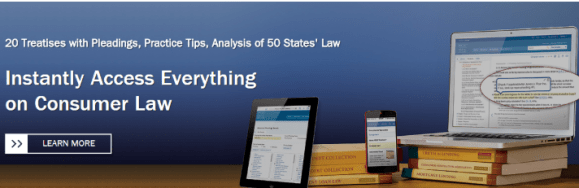
You may already know that the Law Library has an extensive collection of National Consumer Law Center titles on our shelves. But did you know the library also offers these same titles online?
Easily navigate a wealth of information regarding Debtor Rights, Credit and Banking, Consumer Litigation, and Deception and Warranties using the Law Library’s digital subscription. Enjoy the functionality of speedy, thorough searches for information, as well as the hassle-free ability to copy, paste, email, and share texts with the click of a mouse.
This digital subscription includes not only the standard 20 titles, but web links to primary sources, related court decisions, forms, links, and a plethora of other useful resources. The NCLC website also has free webinars, information on NCLC legal assistance programs, consulting services for attorneys and legislation/rulemakings on consumer topics.
Visit the Law Library to access these valuable information resources.
Thanks to our volunteer attorneys – Jonathan Pasterick of Hillman, Brown and Darrow, Carole Brown, Frank Lozupone of Gormley Jarashow Bowman and Richard Ronay – who assisted 22 people with issues such as divorce, health insurance, contracts, property disputes and guardianship.
In addition, the MVLS Foreclosure Clinic helped one person with foreclosure questions. The MVLS Brief Legal Advice Foreclosure Clinic is held on the 3rd Wednesday in the law library from 11:00 a.m. to 1:00 p.m.
The Ask a Lawyer In the Library program is a civil, non-family law, self-help program sponsored by The Anne Arundel Bar Association and the Maryland Volunteer Lawyers Service. Every Wednesday, from 11:00 a.m. to 1:00 p.m., you can talk with a volunteer attorney for up to 20 minutes. No appointment is necessary, but sign-up is required at the law library’s information desk. Sign-up begins at 10:45 a.m., and time slots are determined by a lottery. In addition to the weekly program, the Ask A Lawyer In The Library program is held monthly at two Anne Arundel County Public Library branches: Glen Burnie Regional Library on the 3rd Wednesday (except in June and July) and Eastport-Annapolis Neck Community Library on the last Tuesday. For more information, please see http://circuitcourt.org/legal-help/lawyer-in-the-library.
Do you have a family law matter? Family Law matters are best addressed by Family Law Self-Help Center which is located in the back of the law library.
Do you have a criminal case? The Office of the Public Defender provides legal services to eligible individuals.