Categories
lawlibrary Pro Bono

National Pro Bono Celebration has begun

pro bono banner

Maryland and Anne Arundel County have expanded the week-long celebration to the whole month of October.  On Wednesday, October 4, 2017, the Maryland Volunteer Lawyers Service held its Annual Awards Ceremony.  So nice to be in the room with so many who donate their time to help those in need of legal assistance.  The words of Chief Judge Barbera were inspiring as she highlighted the good that pro bono work provides to those in danger of losing their home or seeing their children.  Tom Mulinazzi whose firm, the Mulinazzi Law Office, was awarded the Law Firm of the Year for pro bono, put it nicely by saying that pro bono work is “an opportunity to be a hero.”

The next night, Thursday, October 5, the Anne Arundel Bar Association President’s Pro Bono Award was presented at the joint dinner of the James C. Cawood, Jr. Inns of Court and the AABA.  Steve Wrobel, AABA President, presented the award with Tasnima Apol, Chair of the Anne Arundel County Pro Bono Committee to Carole Brown, an attorney in a solo practice.  Carole’s nomination read as follows.

Since 2014, Carole has generously donated her time to take pro bono cases to represent numerous victims of domestic violence for the YWCA of Annapolis and Anne Arundel County. Carole greets every client with a smile and is kind, compassionate, and caring. Clients feel at ease and are comfortable with Carole’s easy manner. Whenever asked to help, Carole enthusiastically accepts difficult cases in which parties take extreme positions and emotions run high. Carole sets the example in Anne Arundel County of a zealous advocate who is committed to her clients’ best interests.

In addition, Carole has been a flexible volunteer for all of the Lawyer in the Library programs whether in the courthouse, Eastport or Glen Burnie.  Congratulations and thank you to Carole!

Categories
lawlibrary

Court Holiday – Library Closed

The Law Library is closed today, Monday, October 9, 2017, for the Columbus Day holiday.  The Law Library will reopen tomorrow, Tuesday, October 10, 2017.  A list of Court Holidays is available on the Circuit Court’s website at http://www.circuitcourt.org/court-holidays. Except on Court Holidays, the Library is open Monday through Friday, from 8:30 a.m. until 4:30 p.m.

Categories
lawlibrary

HeinOnline – Legal Classics Library

heinHein announced that “this month’s content release has brought our Legal Classics Library to a new milestone by surpassing 10,000 titles! This database contains works from some of the greatest minds in legal history and includes rare items that are found in only a handful of libraries around the world.”

You might think of HeinOnline as the source for law reviews and legal periodicals but the Legal Classics Library has saved many a trip elsewhere to find an older but still significant treatise  such as Underhill on Evidence or Blackstone’s Commentaries.

Categories
lawlibrary

Worth a read: The Education Gap In The Law

The Education Gap In The Law We need to elevate the average person’s knowledge for preventative legal checkups, but how? (By MARY E. JUETTEN Sep 26, 2017 in the Above the Law Blog)

This post mentioned how small businesses most often start out without any kind of legal advice and how 86% of low income people in need of legal assistance go without. Another issue discussed is that “people need to know that they have a problem that requires legal expertise to research or consult appropriate resources.”  Solutions suggested included  be public service announcements or even referrals by banks or insurance agents.

I have another idea: LIBRARIES!  Libraries are considered as reliable and trusted sources of information. Both public law libraries and public libraries are sources of the basic legal information and referrals needed for access to justice. The Maryland People’s Law Library and the AACPLL’s FAQs are perfect examples of online information. Both the Maryland State Law Library and the AACPLL are open to the public.

Categories
lawlibrary

First Monday in October – Supreme Court Preview

Monday, October 2, 2017, marks the beginning of a new term for the Supreme Court of the United States.  The court makes its calendars and lists available online.

Here are some links to summaries of the upcoming term:

SCOTUSblog  “ is devoted to comprehensively covering the U.S. Supreme Court without bias and according to the highest journalistic and legal ethical standards. The blog is provided as a public service.”  and they have published a list of upcoming cases.”

Oyez is “a free law project from Cornell’s Legal Information Institute (LII), Chicago-Kent College of Law and Justia.com, is a multimedia archive devoted to making the Supreme Court of the United States accessible to everyone. It is a complete and authoritative source for all of the Court’s audio since the installation of a recording system in October 1955.”   Their list and summary is here.

In the news:

Washington Post: https://www.washingtonpost.com/politics/courts_law/first-monday-in-october-new-supreme-court-term-begins/2017/10/02/0caf66c4-a742-11e7-9a98-07140d2eed02_story.html?utm_term=.415c9fb531cc

https://www.washingtonpost.com/politics/courts_law/2017/10/01/38d5bbc2-a521-11e7-b14f-f41773cd5a14_story.html?utm_term=.9d5499feff71

New York Times: https://www.nytimes.com/2017/10/01/us/politics/supreme-court-term-2017.html?ref=todayspaper

USA Today: https://www.usatoday.com/story/news/politics/2017/09/26/supreme-courts-top-cases-2017/698441001/ 

LA Times: http://www.latimes.com/politics/la-na-pol-court-cases-fall-2017-story.html

CSPAN video: https://www.c-span.org/video/?434059-1/supreme-court-term-preview 

In the law library we have online access to the Bloomberg BNA United States Law Week. Preview highlights of the upcoming term and reviews of last term are available.  This publication is a current awareness tool for following the Supreme Court and national case-law trends. There is an icon for access to this publication on all library computers.

Categories
lawlibrary Maryland Law

New Maryland Laws Take Effect on October 1, 2017 – Can’t Find What You’re Looking For?

lawsNew Maryland laws take effect on October 1, 2017! We published a series of posts highlighting a few of the newly enacted laws, but this is just a small sampling of the new laws enacted by the 2017 Legislative Session. The Department of Legislative Services (DLS) of the General Assembly of Maryland provides a full listing.

Was there a major issue from the 2017 session that was not covered in this series? The 90 Day Report – A Review of the 2017  Session, published by DLS, includes a hyperlinked list of Major Issues from 2017 such as the budget, education, public safety, taxes and voting rights.

Can’t find what you’re looking for?  DLS publishes a Popular Terms List as a reference for current legislation that is often referred to by the public and media by certain popular terms.

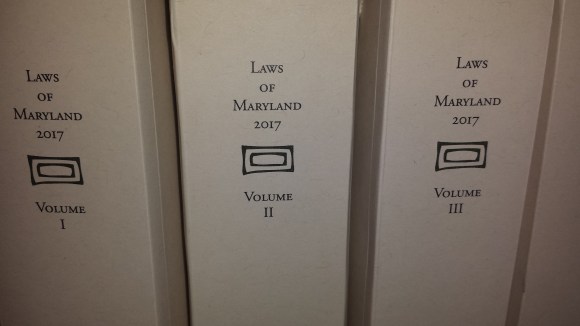
Do you prefer paper sources?  The Law Library’s collection includes the following resources:  the advance (paperback) Laws of Maryland, arranged in chapter number order with separate volumes for a Sponsor Index, the Final Status Report, and Committee Index; West’s Maryland Legislative Service with a list of sections affected; and  the 2017 Maryland Legislative Review Service, published by LexisNexis, which summarizes the 2017 Acts of the Maryland General Assembly Regular Session and organizes the 2017 Acts by topical headings. In addition, the Law Library’s Maryland collection includes print copies of the current Annotated Code of Maryland. The  2017 pocket parts should be coming soon.

Don’t forget – the Law Library is here if you have questions or would like additional information. Contact us!

Categories
lawlibrary Pro Bono Self Represented

Ask a Lawyer In the Library – Wednesday (and Tuesday) Wrap-Up

On Tuesday evening, September 26, three attorneys were available in the Eastport Annapolis-Neck Community Library for the Lawyer in the Library Program to provide free Legal Advice. Carole Brown, John Lynch of McNamee Hosea, and Jerry Williams of Patel and Williams were the Lawyers in the Library. And on Wednesday Paul Farmer of Gormley Jarashow Bowman was the Lawyer in the Law Library.


Six people people took part in the program and were able to speak with the attorneys to request assistance with issues such as foreclosure, buying a house, understanding a settlement agreement, and appeal of an arbitration.

Do you know that legal help is available from the Maryland Courts Self Help Center from 8:30 am until 8:00 pm during the week, Monday through Friday? This is a virtual service via phone (410-260-1392) or online chat.

The Ask A Lawyer In The Library program is a civil, non-family law, self-help program sponsored by The Anne Arundel Bar Association and the Maryland Volunteer Lawyers Service. Every Wednesday, from 11:00 a.m. to 1:00 p.m., you can talk with a volunteer attorney for up to 20 minutes. No appointment is necessary, but sign-up is required at the law library’s information desk. Sign-up begins at 10:45 a.m., and time slots are determined by a lottery.  On the 3rd Wednesday of the month the MVLS Brief Limited Advice Foreclosure Clinic is hosted by the library.  Participants are encouraged to register for the clinic by calling 410-547-6537, but pre-registration is not required. The Ask a Lawyer program is also held monthly in the evening at two Anne Arundel County Public Library locations – at the Glen Burnie Regional Library on the 3rd Wednesday of the month and at the  Eastport-Annapolis Neck Community Library on the last Tuesday of the month. For more information, please see http://circuitcourt.org/legal-help/lawyer-in-the-library.


Categories
lawlibrary Maryland Law

New Maryland Laws Take Effect on October 1, 2017 – Spotlight on Limitations in Cases of Child Sexual Abuse

Untitled drawingNew Maryland laws take effect on October 1, 2017!  We will be publishing a series of posts highlighting a few of the newly enacted laws.  This series is just a small sampling of the new laws enacted by the 2017 Legislative Session.  To read about more laws resulting from the 2017 session, see the 90 Day Report – A Review of the 2017 Session published by the Department of Legislative Services (DLS) of the General Assembly of Maryland. For a full listing of new laws effective October 1, 2017, check out this publication from DLS.

“In response to growing recognition of the long-term impact of child sexual abuse the law, HB 642/CH12  (1) expands the statute of limitations for an action for damages arising out of an alleged incident or incidents of sexual abuse that occurred while the victim was a minor; (2) establishes a statute of repose for specified civil actions relating to child sexual abuse; and (3) exempts causes of action filed under the provisions of the law from the notice of claim requirement under the Local Government Tort Claims Act and the submission of a written claim requirement, denial of claim requirement, and the statute of limitations under the Maryland Tort Claims Act. An action for damages arising out of an alleged incident or incidents of sexual abuse that occurred while the victim was a minor must be filed (1) at any time before the victim reaches the age of majority or (2) within the later of 20 years after the date on which the victim reaches the age of majority or 3 years after the date that the defendant is convicted of a crime relating to the alleged incident or incidents, as specified. However, the Act specifies that in an action brought more than seven years after the victim reaches the age of majority, damages may be awarded against a person or governmental entity that is not the alleged perpetrator of the sexual abuse only if (1) the person or governmental entity owed a duty of care to the victim; (2) the person or governmental entity employed or exercised some degree of responsibility or control over the alleged perpetrator; and (3) there is a finding of gross negligence on the part of the person or governmental entity. The Act establishes a “statute of repose” that prohibits a person from filing an action more than 20 years after the date on which the victim reaches the age of majority against a person or governmental entity that is not the alleged perpetrator for damages arising out of an alleged incident or incidents of sexual abuse that occurred while the victim was a minor.” However, this new law “is not to be construed to apply retroactively to revive any action that was barred by application of the period of limitations applicable before October 1, 2003.” Previously, “an action for damages arising out of an alleged incident of sexual abuse that occurred while the victim was a minor must be filed within seven years of the date that the victim attains the age of majority.”

Passage of this law might be of interest to anyone who watched the Netflix documentary, The Keepers.  At the end there was an interview with Delegate C. T. Wilson of Charles County in which he described how he had not be able to get this bill passed over the years.  A Washington Post article in 2016 described his efforts.  However, while watching the show,  it was easy to go to the Maryland General Assembly website and search for bills introduced by Delegate Wilson in 2017 and see that he had introduced the bill again and that it had passed. Other search options include by subject and statute affected.

Note that all quotations, unless noted otherwise, are attributable to the 90 Day Report – A Review of the 2017 Session published by the Department of Legislative Services of the General Assembly of Maryland.

Categories
lawlibrary Maryland Law

New Maryland Laws Take Effect on October 1, 2017 – Spotlight on UELMA

Untitled drawingNew Maryland laws take effect on October 1, 2017!  We will be publishing a series of posts highlighting a few of the newly enacted laws.  This series is just a small sampling of the new laws enacted by the 2017 Legislative Session.  To read about more laws resulting from the 2017 session, see the 90 Day Report – A Review of the 2017 Session published by the Department of Legislative Services (DLS) of the General Assembly of Maryland. For a full listing of new laws effective October 1, 2017, check out this publication from DLS.

UELMA (HB165\CH553 and SB137\CH554) is the Maryland Uniform Electronic Legal Materials Act.  Librarians have been supporting this legislation in Maryland for three years and are excited that the third time was the charm.  Maryland is now one of 17 states, including Washington, D.C., that have adopted UELMA.

The Maryland Uniform Electronic Legal Materials Act (UELMA) provides online legal material with the same level of trustworthiness traditionally provided by publication in a law book. It is the People’s insurance policy that official electronic legal materials be:

  1. authenticated, by providing a method to determine that it is unaltered;
  2. preserved, either in electronic or print form; and
  3. accessible, for use by the public on a permanent basis.

UELMA is a product of The Uniform Law Commission (ULC, also known as the National Conference of Commissioners on Uniform State Laws) that was established in 1892 and provides states with non-partisan, well-conceived and well drafted legislation that brings clarity and stability to critical areas of state statutory law.

As more and more legal materials are becoming digital, it is important that we are ready so that Maryland’s legal materials are preserved, accessible whether current or from years ago, and authentic. (It is easy to tell if a volume of the code is authentic but not so apparent when you look at something online.  If you look at the Government Printing Office’s United States Code online you will see a little authentication symbol  telling you that the record has been checked and it is the correct document.)  Right now Maryland’s legal materials are readily available in print, assuring authentication, preservation and accessibility.  Should any of these materials convert to digital only, Maryland is prepared.

To find out more about UELMA please read these publications available from the American Association of Law Libraries:

UNIFORM ELECTRONIC LEGAL MATERIAL ACT SUMMARY AND FREQUENTLY ASKED QUESTIONS

UELMA HISTORY


Categories
lawlibrary Maryland Law

New Maryland Laws Take Effect on October 1, 2017 – Spotlight on Expungement

Untitled drawing (1)New Maryland laws take effect on October 1, 2017!  We will be publishing a series of posts highlighting a few of the newly enacted laws.  This series is just a small sampling of the new laws enacted by the 2017 Legislative Session.  To read about more laws resulting from the 2017 session, see the 90 Day Report – A Review of the 2017 Session published by the Department of Legislative Services (DLS) of the General Assembly of Maryland. For a full listing of new laws effective October 1, 2017, check out this publication from DLS.

Although effective October 1, 2017, the Justice Reinvestment Act which made significant changes to the expungement law, was actually passed during the 2016 session.  SB1005/CH515 known as the Justice Reinvestment Act (JRA), among other things, authorized “a person to file a petition listing relevant facts for expungement of a police, court, or other record if the person is convicted of specified misdemeanors. A petition for expungement may not be filed earlier than 10 years after the person satisfied the sentence or sentences imposed for all convictions for which expungement is requested, including parole, probation, or mandatory supervision. If the person is convicted of a new crime during the 10-year waiting period, the original conviction or convictions are not eligible for expungement unless the new conviction becomes eligible. A person is not eligible for expungement if the person is a defendant in a pending criminal proceeding or if one conviction in a unit is not eligible for expungement. In general, a person must file a petition for expungement in the court in which the proceeding began. However, the bill specifies procedures for situations involving transfers to another court or the juvenile court. In addition, the bill specifies procedural requirements regarding objections to a petition, hearings, and appeals.”

Now Maryland law (codified in section 10-110 of the Criminal Procedure Article) allows for expungement of more misdemeanor convictions after a certain period of time.  WIth changes, the Maryland Volunteer Lawyers Service (MVLS) offered a webinar on expungement that covered the new and old expungement law.  Matthew Stubenberg, creator of the MDexpungement app, was the presenter.  The presentation, JRA Expungements,  is online and the full webinar will be available soon. MVLS has also posted a list online that details which offenses are eligible for expungement  under the JRA:  All Convictions Eligible Under the JRA.

New expungement forms will be made available October 1 – one for non-guilty records and one for guilty.  You can view them online now but they are not ready for use. Per Matthew:

CC-DC-CR-072 A should be used for the expungement of acquittal, dismissal, probation before judgment, nolle pros, stet, and certain not criminally responsible dispositions. There will be no filing fee for these dispositions.

 CC-DC-CR-072 B should be used for the expungement of eligible guilty dispositions. The filing fee for guilty dispositions is $30.

MVLS has provided this training to those who are interested and hope those who do will volunteer by taking a case  OR taking part in an expungement clinic

Volunteer attorneys are also needed to help with expungement at the  Anne Arundel County Homeless Resource Day which is scheduled for October 28, 2017.

To learn more about expungement and expungement resources, check out expungement on the Maryland People’s Law Library and our wiki page. In addition, the Maryland Courts website includes information on how to expunge your records and a video.

Note that all quotations, unless noted otherwise, are attributable to the 90 Day Report – A Review of the 2016 Session published by the Department of Legislative Services of the General Assembly of Maryland.