New Maryland laws take effect on October 1, 2015! We will be publishing a series of posts highlighting a few of the newly enacted laws. This series is just a small sampling of the new laws enacted by the 2015 Legislative Session. To read about more laws resulting from the 2015 session, see the 90 Day Report – A Review of the 2015 Session published by the Department of Legislative Services (DLS) of the General Assembly of Maryland. For a full listing of new laws effective October 1, 2015, check out this publication from DLS.
Senate Bill 651 (Chapter 0374) /House Bill 124 – Eligibility for expungement has been expanded to include “persons convicted of a crime where the act on which the conviction was based is no longer a crime.” You can learn more about this new law, including its legislative history, here.
House Bill 304 (Chapter 0314)- Eligibility for expungement generally does not include a petition based on the entry of probation before judgment, “except a probation before judgment for a crime where the act on which the conviction is based is no longer a crime, and the person is a defendant in a pending criminal proceeding or was convicted of a crime other than a minor traffic violation or a crime where the act on which the conviction is based is no longer a crime within three years after the entry of the probation before judgment.” You can learn more about this new law, including its legislative history, here.
House Bill 131 (Chapter 0069) – For criminal charges that were transferred to juvenile court, the petition for expungement must be filed in the court of original jurisdiction where the order for transfer was entered. You can learn more about this new law, including its legislative history, here.
Note that all quotations, unless noted otherwise, are attributable to the 90 Day Report – A Review of the 2015 Session published by the Department of Legislative Services of the General Assembly of Maryland, which is available online at http://mgaleg.maryland.gov/Pubs/LegisLegal/2015rs-90-day-report.pdf.
As of July 1, 2015, Maryland subpoenas will be uniform throughout the state of Maryland as the Maryland Judiciary has launched a new uniform subpoena form. To learn more about the uniform subpoenas, check out Maryland Rules 2-510, 3-510, 4-265 and 4-266.
Attorneys! Are you registered to e-file? If so, then you can access the uniform subpoenas electronically! The uniform subpoena will print with the appropriate court seal and Clerk’s signature. If you have not already registered to e-file, you can do so here. Self-represented litigants can still obtain paper subpoena forms at the appropriate courthouse. Self-represented litigants can learn more about discovery here or contact the Law Library.
The Attorney General is Maryland’s chief legal officer and is elected by Marylanders every four years. The Attorney General’s Office is in charge of Maryland’s legal business, including acting as a legal advisor to the State of Maryland. To learn more about the Office of the Maryland Attorney General, check out their website.
In its role as a legal advisor to the State of Maryland, when requested by the Maryland General Assembly, the Governor, the Comptroller, the Treasurer or any State’s Attorney, the Attorney General provides a formal opinion, which is a written response to specific legal questions raised by Maryland’s government officials. The legal questions can range from the construction of statute, interpretation of case law or requests for legal counsel. Often, these opinions deal with a significant legal question involving Maryland law.
Private individuals cannot request a formal Opinion of the Attorney General. However, it is a possible that an Opinion of the Attorney General addresses a legal issue that is directly related to your matter. In that scenario, a Maryland court may consider an Opinion of the Attorney General, but the Opinion is not binding authority for Maryland Courts.
You can find Opinions of the Attorney General, from 1993 to the present, online at the Maryland Attorney General’s website. The Law Library’s collection include hardbound volumes of the Opinions of the Attorney General from 1917 to 2011. You can also access Maryland Attorney General Opinions through the Law Library’s subscriptions to Westlaw (coverage from 1977 to the present) and LexisNexis (coverage from 1970 to the present).
Note that Opinions of the Attorney General are formal opinions, which should be distinguished from other written documents from the Office of the Attorney General, such as letters to state agencies and memoranda of law. In order to be a formal Opinion of the Attorney General, the document must have gone through a specified review process and adopted by the Attorney General of Maryland. More information is available here.
In connection with the Law Library’s celebration of Law Day, we will be publishing a series of eight posts that focus on the basics of the Maryland court system and legal research.
Statutes are the laws passed by legislative bodies and probably what most people visualize when they think about the law. Statutes are generally organized by subject in a set called a “code”. For example, you would generally find statutes about divorce laws in Maryland under the Family Law Article (subject) in the Code of Maryland (code). Don’t forget, statutes are only one of the three main sources of primary law (statutes, regulations and case law), and your legal research may not be complete if you only focus on relevant statutes.
Federal Statutes. The U.S. Congress is the U.S. federal government’s legislative body and derives its power to make laws from the United States Constitution. The U.S. Congress consists of two chambers: the House of Representatives and the Senate. Members of Congress are directly elected by citizens of the United States. To learn more about the federal legislative process, check out this article, “How Our Laws Are Made”, available on Congress.gov.
Current U.S. statutes are organized by subject matter in the current U.S. Code, which is available online here. In addition, check out our earlier blog post here about Congress.gov, the official federal website for federal legislative information. Congress.gov is a great resources that provides members of the public with access to current and historic legislative information, including bill status, bill summaries and committee reports.
The Law Library’s print collection includes the West’s United States Code Annotated. (The annotations included in the print books by the editors include references to relevant cases, law review articles and other resources that may provide the legal researcher with useful research and related primary sources.) You can also read the annotated code in electronic format through the Law Library’s subscriptions to WestlawNext and LexisNexis.
Maryland Statutes. Maryland’s legislative body is the Maryland General Assembly, which is comprised of two chambers: the State Senate and the House of Delegates. The Maryland General Assembly meets for 90 calendar days each year, beginning on the second Wednesday of January, and special sessions may be called by the Governor or a petition by a majority of each house. More information about the Maryland legislative process is available here. Current Maryland statutes are organized by article (subject) in the Code of Maryland and available online here.
The Law Library’s print collection includes current and superseded copies of Michie’s Annotated Code of Maryland West’s Annotated Code of Maryland. (The annotations included in the print books by the editors include references to relevant cases, law review articles and other resources that may provide the legal researcher with useful research and related primary sources.) In addition, you can read the current annotated code in electronic format through the Law Library’s subscriptions to WestlawNext and LexisNexis.
Local Ordinances and Resolutions. Don’t forget local ordinances and resolutions! For example, if you live in Annapolis, your legal statutory research may need to include the Anne Arundel County Code as well as the Code of the City of Annapolis.
The legislative body for Anne Arundel County is the County Council, whose members are elected. The Anne Arundel County Council generally holds legislative session on the first and third Mondays of each month (excluding August) in Annapolis, Maryland and all sessions are open to the public. For more information, check out the County Council’s website. For those you who cannot attend the sessions in person, you may be able to view live webcasts.
The Annapolis City Council is the legislative body for the city of Annapolis, and its members include the Mayor of Annapolis and eight Aldermen and Alderwomen. Information regarding the City Council’s regular meetings, public access to agendas and television schedules are available here.
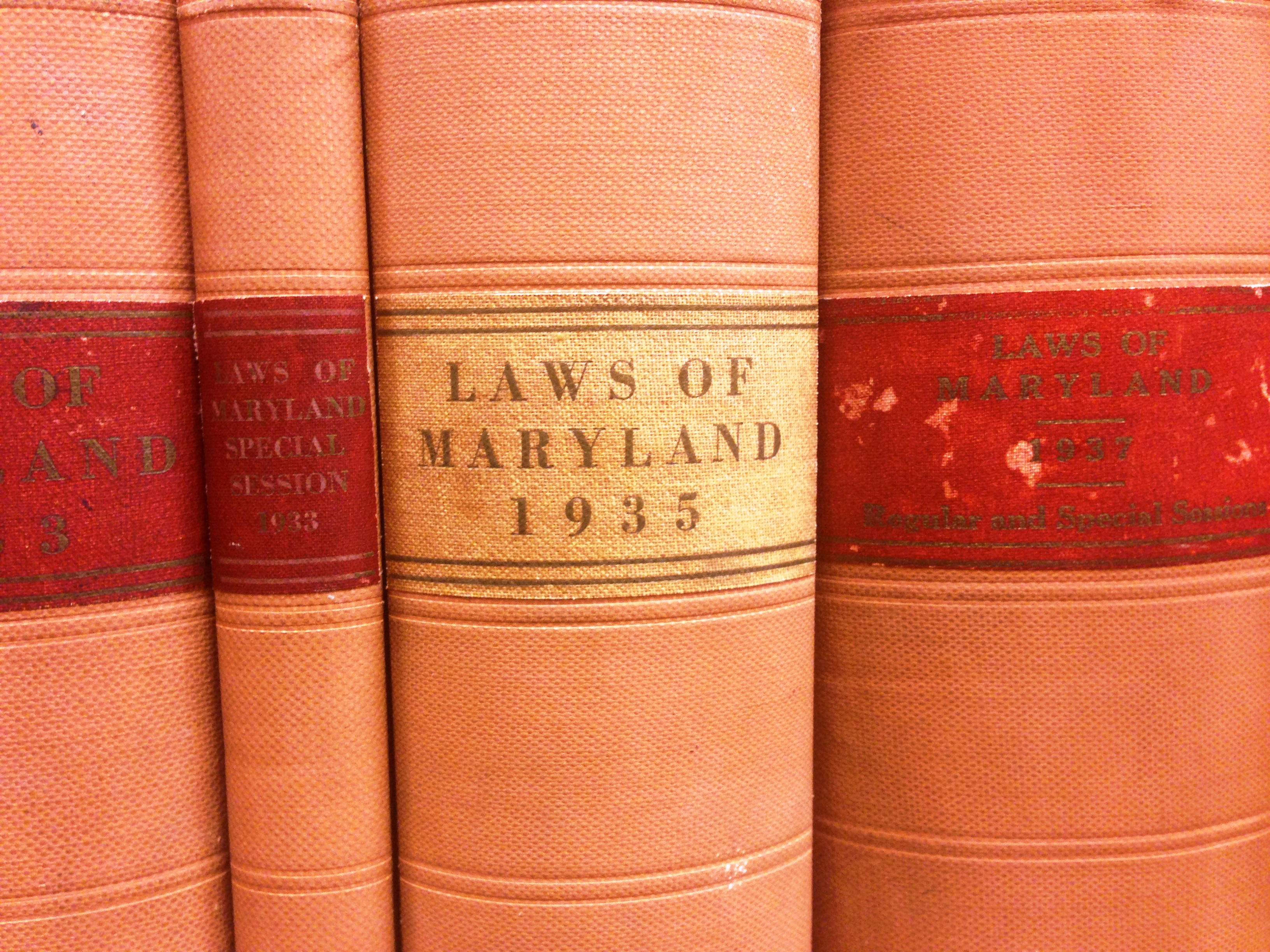
The Law Library’s print collection includes current and superseded copies of the Anne Arundel County Code and the Code of the City of Annapolis. In addition, the Law Library’s collection includes copies of the Anne Arundel County Council’s Proposed Bills, Final Bills, Resolutions and Schedules.
Stay tuned for the next post in our Law Day Series, which will provide an overview of the Maryland Office of Administrative Hearings.
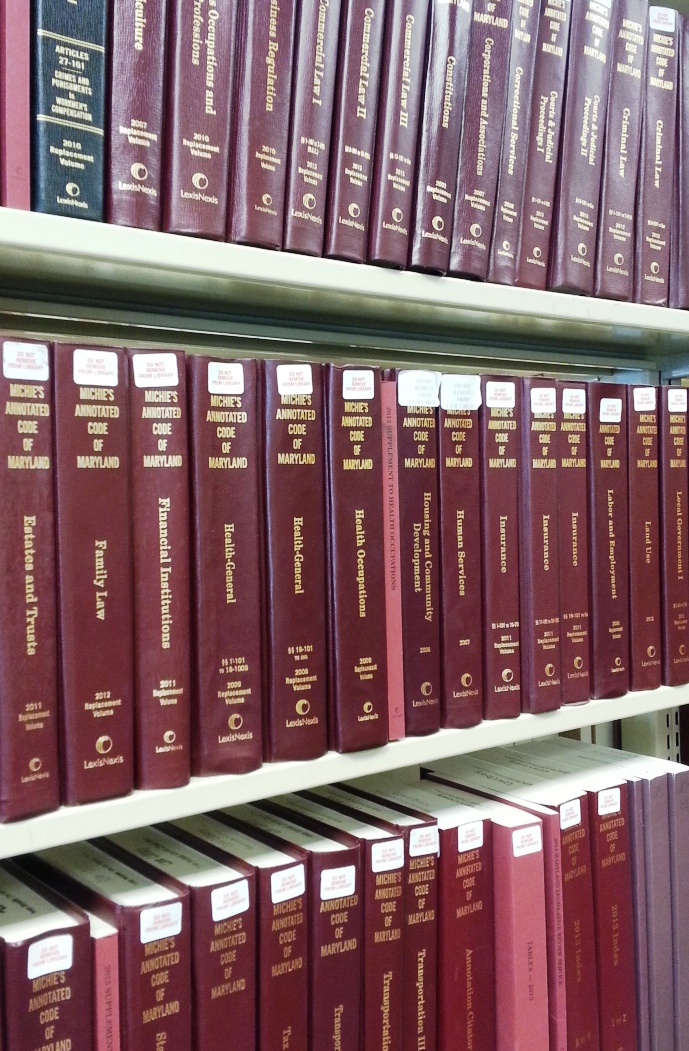
Here are print copies of the Annotated Code of Maryland.
In connection with the Law Library’s celebration of Law Day, we will be publishing a series of eight posts that focus on the basics of the Maryland court system and legal research.
For the Law Library’s legal researchers, the main goal is to find the “law” that will solve his or her legal problem or answer a specific legal question. The legal researchers are looking for relevant primary authorities, which are the binding laws for their case. These primary authorities come from several different sources, and you must read all of the primary sources of law together in reaching your legal conclusion.
Before we start discussing primary legal sources, a research tip is to start with secondary legal resources because these secondary resources have already done a lot of the work for you by reviewing and summarizing the relevant primary legal sources. These secondary legal resources, such as books, articles, formbooks and websites, are often more user-friendly than primary legal sources and can provide summaries of the law, explanations of the law and, most importantly, citations to the relevant primary sources.
Returning to primary legal sources, the main sources of primary law are statutes, regulations, and case law, which this post will briefly describe below.
Statutes. Most people probably think of statutes when they are thinking about the “law”. Statutes are the laws passed by legislatures (for example, the Maryland General Assembly and the United States Congress). Statutes are generally organized by subject in a set called a “code”. For example, you can find the statutes relating to divorce in the Family Law Article of the Maryland Code.
The Law Library’s collection includes The United States Code Annotated, Michie’s Annotated Code of Maryland and West’s Annotated Code of Maryland. You can also access these statutes and statutes from other jurisdictions through our online legal databases.
Regulations. Regulations are perhaps the least well-known of primary legal sources. Regulations are made by executive agencies (for example, the Federal Aviation Agency in the United States Executive Branch and the Maryland Department of Transportation). These agencies derive their rule-making power from statutes passed by the appropriate legislature, granting them those powers. These statutes set forth the subjects and limits of the agency’s rule making powers. So, it is important to read the regulations in conjunction with the relevant authorizing statutes. In Maryland, regulations are printed in the Code of Maryland Administrative Regulations (COMAR). Federal regulations are printed in the Code of Federal Regulations (CFR).
The Law Library’s collection includes COMAR as well as a subscription to the Maryland Register (the Maryland Register is the supplement service for COMAR that is published every two weeks). In addition, the Law Library’s collection also includes the Code of Federal Regulations and Federal Register. Drop by the Law Library, and we will show you how to use these resources!
Case Law. Case law is the law made by judges (usually at the appellate level). Judges write opinions, which are written explanations that justify a court’s decision and usually includes a statement of facts and the law. Navigating case law is a bit more difficult than navigating statutes and regulations, but equally important because case law can be binding legal authority. Stay tuned because this blog will be posting an article later this month on the topic of case law and opinions.
In the Law Library, you can find case law in print and electronic formats. In print, the cases are published in serials called reporters, which publish the cases in rough chronological order. The Law Library’s collection include Maryland Reports (cases from Maryland Court of Appeals) and Maryland Appellate Reports (cases from the Maryland Court of Special Appeals) as well as certain regional and federal reporters. You can also access the cases online through the Law Library’s subscriptions to online legal databases.
In addition, don’t forget Court Rules, which set out the procedures that you will need to follow. These procedures will vary from court to court and govern things like time limits, service, formats before, during and after a trial.
The Law Library’s collection includes the Annotated Maryland Rules and the Maryland Rules Commentary as well as resources related to the Federal Rules of Procedure.
This post is intended to provided a brief overview only. For additional information, the Maryland People’s Law Library is a great resource for learning more about legal research and how to get started in the Maryland court system. Check out these articles on the Maryland People’s Law Library.
The Basics of Finding the Law – This article provides an overview of where to find the “law”. Read the article about Understanding Legal Research first.
Finding and Using Secondary Sources – Secondary sources, such as articles, encyclopedia, and form books can be very helpful and, for most legal researchers, reading secondary sources is the best place to start. This article provides guidance in locating useful secondary resources.
Research Guides – The Maryland People’s Law Library research guides based on subject area (for example, Adoption, Bankruptcy, Divorce, Immigration, Workplace Safety)
Evaluating Legal Websites – There is a lot of information available online, but not everything is trustworthy. This article provides some helpful tips to help you decide whether you should rely on what you found on a website. In addition, you can always contact us here at the Law Library.
Getting Help from Law Librarians – The Law Library is always happy to assist you with your legal research, but the process can be very complicated, and there are certain things that the librarians cannot do, such as provide legal advice (because we are not attorneys). This article will help you get the most out of your relationship and interactions with the law librarian.
Stay tuned for the next post in our Law Day Series, which will provide an overview of case law research in Maryland.
On October 1, 2015, several changes to Maryland divorce law will go into effect. These changes were passed in the 2015 Regular Session of the General Assembly of Maryland and approved by the Governor of Maryland.
Grounds for Divorce – Mutual Consent – Senate Bill 472 / House Bill 165(Chapter 353) is, perhaps, the most sweeping of the new changes to Maryland’s divorce law because it provides for an absolute divorce on the grounds of mutual consent if certain conditions are met. These conditions include a requirement that the parties do not have any minor children in common and that the parties submit a written settlement agreement to the court that resolves certain specific issues, such as property and financial issues.
Grounds for Limited Divorce – House Bill 0165 (Chapter 0226) affects the conditions to determine separation for purposes of granting a limited divorce on a specific ground by repealing certain requirements dealing with the voluntary nature of the separation and reconciliation. Additional information, including the Fiscal and Policy Note, is available on the General Assembly’s website.
Residency Requirement –House Bill 1185 (Chapter 473) provides that, under certain circumstances, the period of time that an applicant for divorce must reside in the State of Maryland will be reduced from one year to six months. Additional information, including the Fiscal and Policy Note, is available on the General Assembly’s website.
If you are looking for more information about divorce and other family law matters, available resources include the following.
The Family Law Self Help Center provides self-represented litigants with legal information and forms for family law matters such as divorce, custody, visitation, child support and name changes. Located at the Law Library, the Family Law Self Help Center has walk-in hours and telephone hours (410-280-5374).
The Law Library’s wiki site includes pages dedicated to Family Law Resources, including referrals, forms and reference materials.
The Circuit Court of Anne Arundel County’s website includes a “Learn About” page addressing Family Law Cases.
The Maryland Courts’ website includes information about Family Law Matters, such as adoption, child custody, child support, divorce, marriage and name change.
The Maryland People’s Law Library has a page dedicated to Family Law Articles.
For more information or help getting started with your research, contact the Law Library!
In a 5-4 decision, the U.S. Supreme Court has held that the personal income tax scheme in Maryland violates the dormant Commerce Clause. The Commerce Clause grants the U.S. Congress the power to regulate commerce among states. The dormant Commerce Clause is a derivative of the Commerce Clause and prevents states from “discriminat[ing] between transactions on the basis of some interstate element”. Basically, the Supreme Court found that Maryland’s personal income tax scheme violates the dormant Commerce Clause because Maryland’s personal income tax scheme does not offer, at the county-level, full credit for personal income taxes paid in other states.
For more information about this decision, check out these articles.
Today, the Senate Judicial Proceedings Committee will have a hearing on the Maryland Uniform Legal Materials Act (UELMA, “yoo-el-mah”). This proposed law would require legal materials that are only published in electronic form to be designated as “official”. The law would then require “official” materials to be capable of authentication, preserved, and permanently accessible to the public.
Why is UELMA so important? Many state governments have moved to online only publication of legal information. Consumers of this information, which include students, attorneys, legislators, and librarians are increasingly accessing this information online. It is critical that there is a way for everyone to know that the electronic information is accurate. UELMA provides Maryland’s citizens with this assurance and ensures that the law in the digital age will be accessible, authenticated, and preserved.
For more background information, check out our blog post from January here. If you have any questions about UELMA or navigating the Maryland General Assembly’s website, please contact us at the Law Library!
*The Maryland Uniform Legal Materials Act, sponsored by Delegates Vitale, Ghrist, Glass, McComas, McConkey, McMillan, Metzgar, Saab, and B. Wilson, was introduced to the House of Delegates and first read on January 28, 2015.* The proposed act, sponsored by Senator Astle, was introduced to the Senate on February 6, 2015. The text of Senate Bill 611 is available here, and the text of House Bill 162 is available here. For those of you interested in tracking the progress of the proposed act through the Maryland General Assembly, check out these summary pages here and here.
What is UELMA? UELMA (“yoo-el-mah”) is the Uniform Electronic Legal Material Act, a uniform law* that addresses the issues of trustworthiness and access raised by the increased electronic distribution of state primary legal materials through the provision of an “outcomes-based approach to the authentication and preservation of electronic legal material . . . to enable end-users to verify the trustworthiness of the legal material they are using and to provide a framework for states to preserve legal material in perpetuity in a manner that allows for permanent access.”** UELMA requires legal material that are only published in electronic form to be designated as official. Official information must then be (1) capable of authentication (i.e., the appointed government agency or official provides the user with a way to determine that the legal information is trustworthy as an accurate copy), (2) preserved (i.e., in print and/or electronic formats) and (3) permanently accessible to the public.
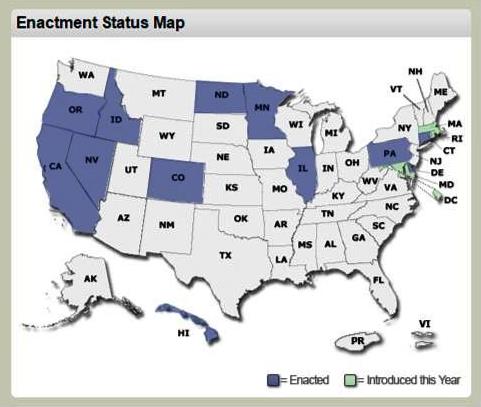
As of October 2014, the following twelve states have adopted the act: California, Colorado, Connecticut, Delaware, Hawaii, Idaho, Illinois, Minnesota, Nevada, North Dakota, Oregon and Pennsylvania. UELMA was introduced in the Maryland General Assembly in January 2014 (HB 46 / SB 275), but was withdrawn from further consideration in February 2014. The full text of UELMA is available at http://www.aallnet.org/Documents/Government-Relations/2011Oct-UniformElectronicLegalMaterialAct-Final.pdf. If you are interested in learning more about UELMA, check out the UELMA Resources page (http://www.aallnet.org/Documents/Government-Relations/UELMA), available on the American Association of Law Libraries’ website.
*In the United States, multiple legislative bodies may address the same area of law. The goal of uniform laws is to encourage uniformity throughout the United States by encouraging state legislatures to enact the same law. A uniform law is only a proposal until it is adopted by a legislative body.
**Prefatory Note of the Uniform Electronic Material Act.
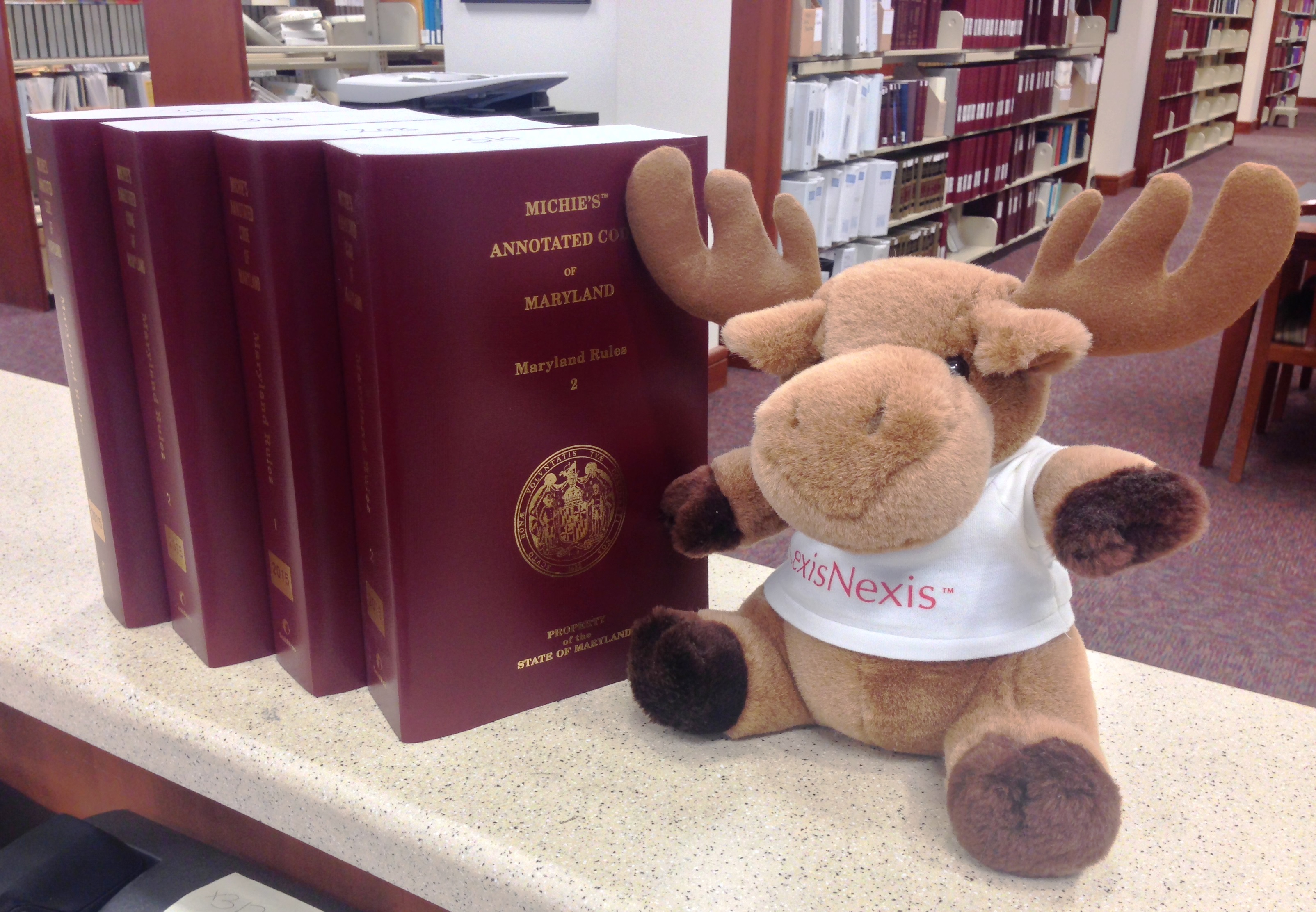
The 2015 Edition of Michie’s Maryland Court Rules is available at the Law Library! The 2015 edition includes amendments adopted through November 7, 2014. The Maryland Rules are the rules of practice and procedure followed by Maryland courts and apply to all Maryland courts unless noted otherwise. Annotation sources include Maryland case law, the Maryland Law Review, the University of Baltimore Law Review, the University of Baltimore Law Forum and Opinions of the Attorney General.
The current Maryland Code and Rules (without annotations) are available online, free of charge, through Lexis Nexis and Westlaw. In addition, you can access the annotated Maryland Code and Rules online in the Law Library’s computer room through the Law Library’s subscriptions to Lexis and Westlaw legal databases. If you are new to the Maryland Rules, the People’s Law Library has an online video tutorial on reading the Maryland Rules through Westlaw, which is available at http://www.screencast.com/t/My0FU44NZbwL.
The 2015 edition supersedes and replaces all previous editions and supplements. Note that the Law Library maintains copies of the superseded Maryland Rules in its collection, so if you ever need to reference the superseded rules, please drop by the Law Library’s service desk, and we can assist you in locating the appropriate rules.
 New Maryland laws take effect on October 1, 2015! We will be publishing a series of posts highlighting a few of the newly enacted laws. This series is just a small sampling of the new laws enacted by the 2015 Legislative Session. To read about more laws resulting from the 2015 session, see the 90 Day Report – A Review of the 2015 Session published by the Department of Legislative Services (DLS) of the General Assembly of Maryland. For a full listing of new laws effective October 1, 2015, check out this publication from DLS.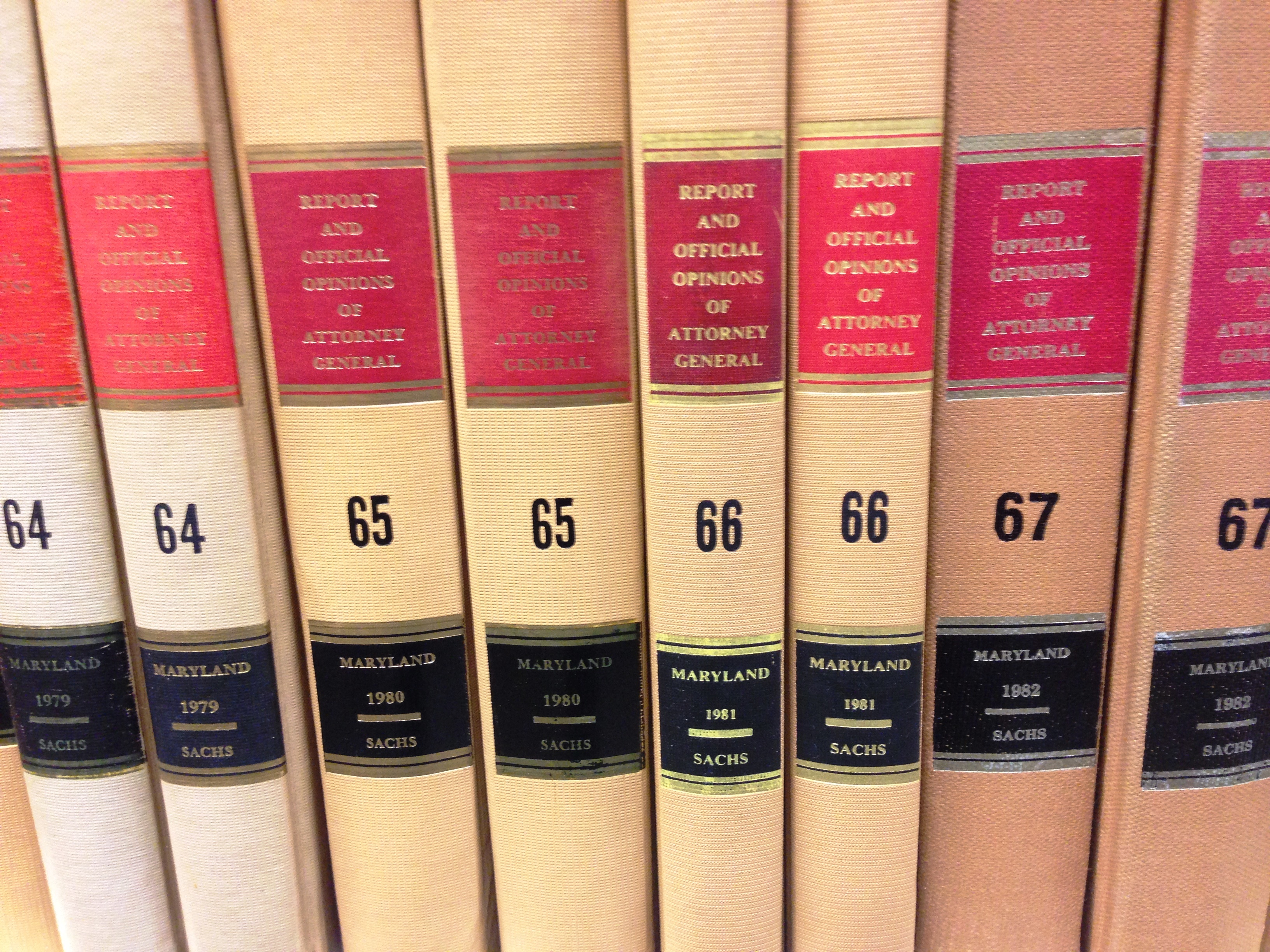


 AACPLL Blog: Law Library News