Categories
Legal Technology Maryland Law

Maryland Sentencing Guidelines Calculator

In the most recent edition of  the Guidelines E-News (Vol9 No2-June 2014)  the Maryland State Commission on Criminal Sentencing Policy announced the availability of an online Sentencing Guidelines Calculator Tool.

The Maryland Automated Guidelines System (MAGS) designed by the Commission is now in use in the Montgomery County Circuit Court and the Calvert County Circuit Court.  The calculator is now available to anyone who would like to use it.

The newsletter provides detailed instructions in its use.  Access is provided on the Commission’s website through the Quick Links list on the left-hand side of the page: http://msccsp.org/


Categories
lawlibrary

Newly Cataloged Materials-National Consumer Law Center (NCLC)

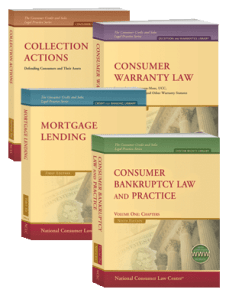
Recently, the Law Library cataloged a new set of valuable resources from the National Consumer Law Center (NCLC). The Center is described as the “nation’s consumer law expert,” assisting the general public, attorneys, advocates and public policy makers. Books that have been cataloged include Fair Credit Reporting, 8th Edition, Repossessions 8th Edition, Consumer Law Pleadings Website and Index Guide 2013, and Consumer Law on the Web December 2013.

In addition, to print resources NCLC comes with a companion website that patrons have access to. Also, NCLC website has free webinars, information on NCLC legal assistance programs, consulting services for attorneys and legislation/rulemakings on consumer topics.

Check out the website here: National Consumer Law Center (NCLC)

By: Julie Shenk, Law Library Intern

NCLC

Categories
EJC2014 lawlibrary Legal Technology Pro Bono Self Represented

EJC 2014: A Law Librarian’s Report

The ABA/NLADA Equal Justice Conference has ended and I am back at work.  The EJC is a joint effort of the ABA Standing Committee on Pro Bono and Public Service and the National Legal Aid & Defender Association (NLADA). The EJC provided a great forum in which to learn from  interesting programming and from getting to know others whose work involves providing legal services to those who cannot afford legal help. I hoped to be able to report on a daily basis but found little time to fit that in.  Here are some of the highlights.

Categories
EJC2014 lawlibrary Pro Bono Self Represented

Survey of Law Library Services to Self-Represented Litigants: Reporting from the Equal Justice Conference in Portland

I am the AALL Representative to the Self Represented Litigation Network or the SRLN.  Over the last year I have been working with other members of the SRLN Law Librarians’ Working Group,  analyzing the results of the “Survey of Law Library Programs for Self Represented Litigants, including Self-Help Centers.”  The survey task force, also members of AALL State, Court and County Law Library Special Interest Section,  included Marnie Warner, Sara Galligan, and Charley Dyer.

Today I  reported on the survey at the SRLN pre-conference workshop at the Equal Justice Conference in Portland.

Jessican Van Buren, chair of the SRLN  Law Librarians’ Working Group, has posted the report, survey results and other supporting documents at SelfHelpSupport:  http://www.selfhelpsupport.org/surveys/ .

The survey shows how law libraries of all types serve the needs of the self-represented litigants.  Law Libraries serve the SRL by providing the more traditional law library services of research assistance, use of online databases and referrals.  They also provide services designed especially for the SRL such as websites, publications and forms.  Law libraries also work with self-help centers but the results show that law libraries can also provide the self-help center in the library or house a self-help center managed by another organization.

The report can act as guide for those seeking to develop programs for service to the SRL.  We hope that the information will be of value to not only the law library community but to the courts, the bar, legal services providers, public libraries and access to justice organizations involved in service to the self-represented litigant.


Categories
lawlibrary Pro Bono Self Represented

Anne Arundel County Attorneys Volunteer at Annual Homeless Resource Day

The 7th Annual Anne Arundel County Homeless Resource Day was held on March 29 at Annapolis High School.

This slideshow requires JavaScript.

There were 19 attorneys who provided legal advice to 88 participants who had questions about 95 legal issues.  (For more detail see the Statistics page.)  As expected the number one issue was how to expunge a criminal record.  Three of the 35 who asked fit the criteria for filing and were able to complete expungement petitions that were mailed or filed with the courts on Monday. HPRP (Homeless Persons Representation Project) completed an expungement intake to follow-up on a more complicated case.  Having Antonia Fasanelli, Executive Director of HPRP,  and HPRP volunteer Mike Stone on hand for the day is really helpful to the volunteer attorneys assisting those with questions about their criminal records.  This year HPRP was also able to provide intakes for two who had benefits questions.

The Maryland Lawyers Volunteer Service (MVLS) not only sponsored the Anne Arundel pro bono participation in the event but was also there in person to screen for those eligible for MVLS services.  It was a great help to have Jessica Rich, Intake Paralegal, come with attorneys Joseph Franco, William Cooke and Cheri Wendt-Taczak.

Having attorneys from the Office of the Public Defender, William Cooke and Denis O’Connell, is helpful to those that need representation for current criminal cases.  This year they performed 4 OPD intakes.

Every year there is a large contingent from the Anne Arundel County office of  Maryland Legal Aid.  This year Anita Bailey, Margaret Leonard, Lisa Sarro, Jessica Quincosa, Amy Siegel, and Kathy Hughes were able to assist with many of the issues faced by the homeless.

Of course, legal services could not be provided without the the pro bono attorneys who practice solo or in small firms: Tasnima Apol, Kari Fawcett, Kurt Roper, Andrew DiBlasio, Scott MacMullan, Gene Brennan, Ginina Stevenson, and Angela Tonello.

Legal services are coordinated by me, Joan Bellistri, Director of the Anne Arundel County Public Law Library and Chair of the Local Pro Bono Committee.  As a law librarian I can provide backup reference and research services.  Bringing a printer is also helpful when working with criminal record research for the expungement cases.

We can only hope that someday the need for this program will be eliminated.  Until then the dedication of these volunteers is truly appreciated.

Categories
lawlibrary Pro Bono Self Represented

Anne Arundel County Pro Bono Volunteers Recognized

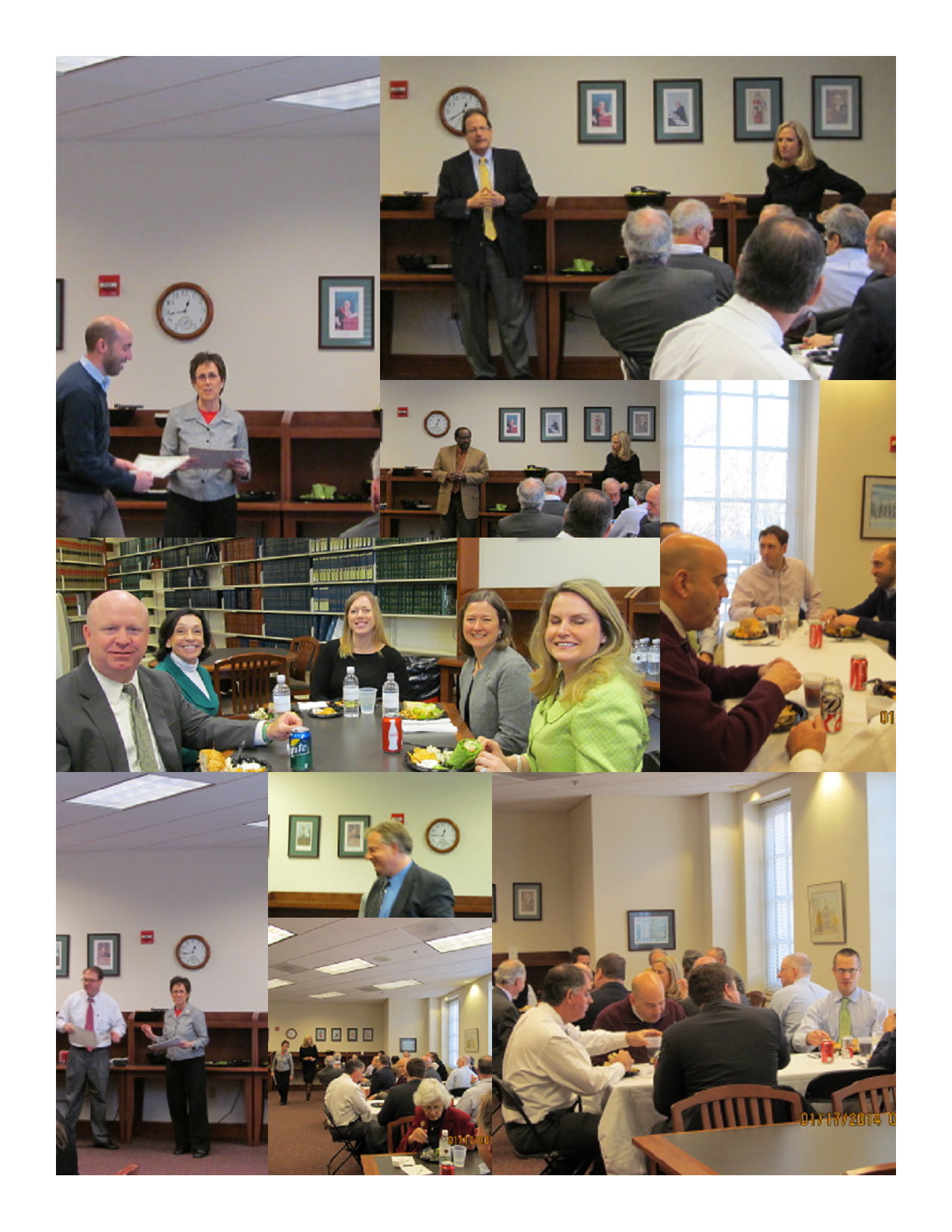
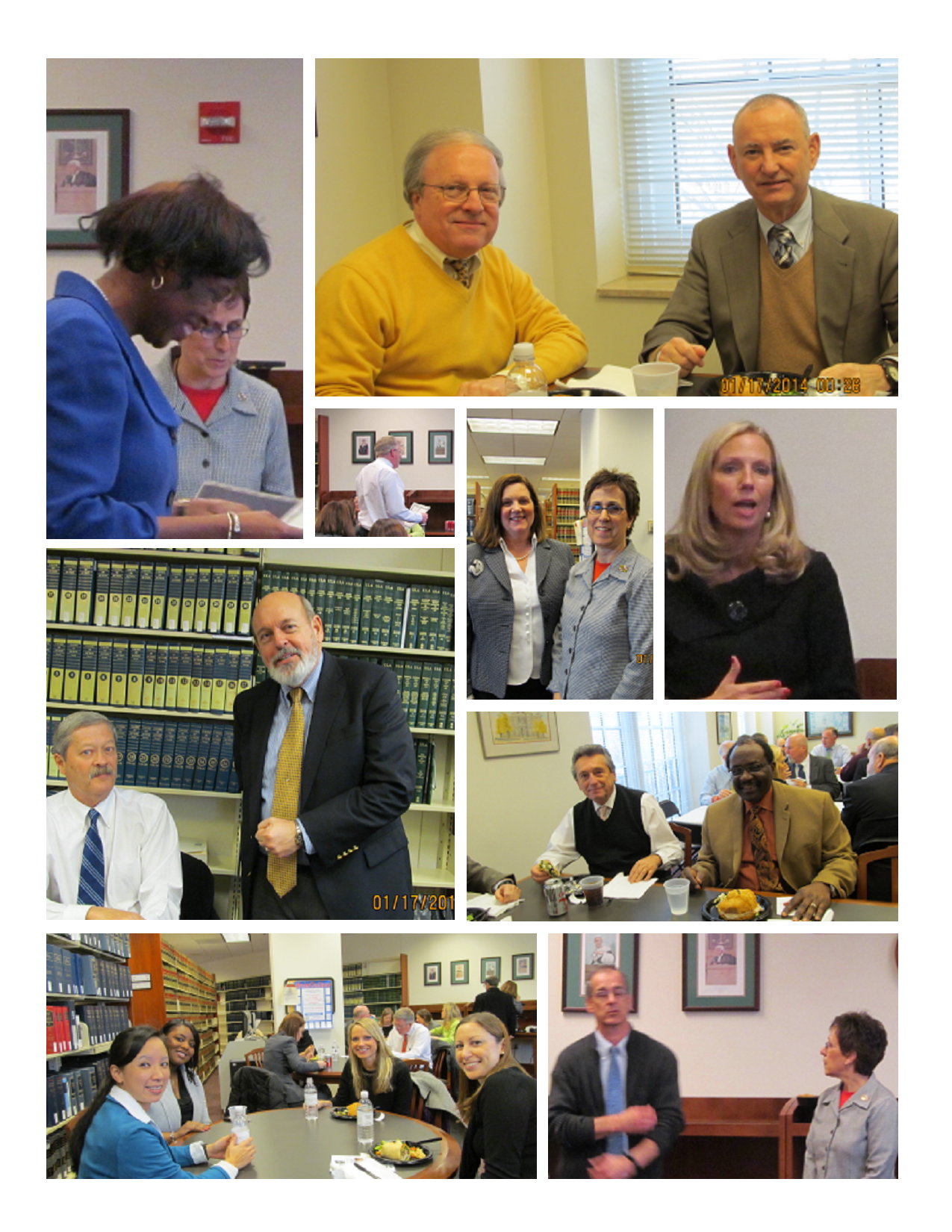
collage 1 collage firstThe Annual Pro Bono Recognition lunch was held on Friday, January 17.  It was the best turnout ever for the event with 45 attorneys, judges, and court staff filling the law library’s reading room. Attorneys who volunteer for the Lawyer in the Library programs and Homeless Resource Day as well as Court Facilitators and MVLS volunteers were honored for their pro bono service and provided lunch catered by the Main Ingredient.

All volunteers in attendance received a certificate thanking them for their service and the number of pro bono hours were also provided if an Ask a Lawyer volunteer.

The Local Pro Bono Committee was represented by Scott MacMullan, Michelle Moodispaw, Chris  Poulsen,  Anita Bailey, Lisa Sarro, Suzanne Vetter, Hon. Pamela North and  Joanie Bellistri, Chair.  New member, Lauren Wallace of the YWCA Domestic Violence Program made her first contact with the Committee at the lunch.

Hon. Ronald Silkworth, Hon. Paul  Harris, Hon. Michael  Wachs, Hon. William Mulford, Hon. Philip Caroom,  Hon Pamela North, Hon. Paul Hackner were able to come to the lunch as well as masters Muskin, Thurtle and Gunning.  In fact,  all of the Anne Arundel County Circuit Court bench who were in court on Friday were there.  It was especially nice that Anne Arundel County Appellate Court judges, Hon. Clayton Greene and Hon. Timothy Meredith, were able to come, too.  Having a judicial presence and the words of appreciation by Judge Hackner, the new Administrative Judge; Judge Greene, the author of Clearing a Path to Justice, a report detailing the needs of self-represented litigants;  and Judge North, the circuit court judicial committee member, will hopefully make a difference in encouraging the continued pro bono work by Anne Arundel attorneys.  Judge Caroom announced a plan for solicitation of AABA member pro bono stories for publication in the Barrister.

It was great that Patty Stephenson, President of the Inns of Court, could attend. The Inns of Court through the coordination of Patty and Judge Silkworth  has been helping to get the word on pro bono service out to  their members through Chambers Chats and time from Inns of Court programs to mention pro bono.

Fran Czajka, Executive Director of the Anne Arundel Bar Association, represented the Bar Association.  Doug Hofstedt and Nancy Faulkner of Court Administration and Kim Doan, Erin McCarthy, and Courtnee  Hill-Jones of the Office Case Management and Julie Shenk of the law library provided a good court contingency.

It is an unfortunate fact that Anne Arundel County ranked last in the state for reporting 50 or more hours of pro bono service for the year reported in November of 2012.  As of the November 2013 report Anne Arundel has moved back to fourth from the bottom.  An improvement but not a great improvement.  This fact brought about a number of conversations between the court and the bar at the lunch.  It is hoped that those conversations will continue and that there will be success in changing the culture of the Anne Arundel Bar in regard to pro bono service.

The service of the following is appreciated by the court and especially by those who received legal assistance:

Ask A Lawyer and Homeless Resource Day

Tasnima Apol
Judson Arnold
Anita Bailey
William Bainbridge
Chris Boucher
Jeff Bowman
Eugene Brennan
Andrew DiBlasio
Kari Fawcett
Alan Forman
Joseph Gormely
Kemp Hammond
Dallas Houston
Kathy Hughes
Jesse Iliff
Mary Jordan
Margaret Leonard
Scott MacMullan
Lisa Mannisi
Michael Marinello
DenisO’Connell
L. CliftonO’Connor
Allen J.Paltell Jr.
Michael J.Ragland Sr.
Richard Ronay
Kurt Roper
James Sauer
Amy Siegel
Ginina Stevenson
Michael J.Valadez
NathanVolke
Seth Zirkle

Court Facilitor and Foreclosure Programs

Marc Baer
Christina Bayne
Jennifer Baldwin
Christopher Beard
Todd Bennett
Leslie Billman
Raymond Carignan
Nicholas Capousis
Jeremiah Chiappelli
Tom Codd
Carol Craig
Penelope Dart
Tom Fleckenstein
Jonathan Gladstone
John Haislip
Susanne Henley
Maria Krapf
Stephen Krohn
Allen Kruger
Angela Magruder
Michael Malone
Ron Marryott
Susan Mays
Robert McFarland
Dawn Merino
Bill Mitchell
Todd Mohink
Chip Obrecht
Rick Obrecht
Donna Schaeffer
Kevin Schaeffer
Laura Shanley
David Simison
Susan Stauffer
Barbara Taylor
Robert Waldman
Harrison Wetherill
Mike Wilsman
Susan Wycoff
Kari Fawcett
Allen J. Paltell Jr.
James Sauer
Rebecca Bleecker
Scottie Reid

Maryland Volunteer Lawyers Service

Frank Campbell
Andrew Cooch
Chris Flohr
Garland Hall
Bernard Kennedy
Joseph Laumann
David Martino
Timothy Mummert
Stacey Rogan
Wendy Schieke
M. Clare Schuller
Robert Smith
Jim Vidmar
Marla Zide
Allen J. Paltell Jr.
James Sauer
Susan Mays
Jonathan Gladstone

Categories
lawlibrary

2013 in review

The WordPress.com stats helper monkeys prepared a 2013 annual report for this blog.  The AACPLL’s New Year’s resolution: more posts for 2014!

Here’s an excerpt:

A San Francisco cable car holds 60 people. This blog was viewed about 1,000 times in 2013. If it were a cable car, it would take about 17 trips to carry that many people.

Click here to see the complete report.

Categories
lawlibrary

ADR Collection Available in the Law Library

The following books were donated to the law library by the Office of Case Management so that they would be more accessible to those who might benefit from them.  They are shelved with the library’s self-help collection located in the aisle that leads to the Family Law Self-Help Center. They were purchased with support money from the Maryland Judiciary’s Mediation & Conflict Resolution Office. 

  • Principles of Alternative Dispute Resolution 2nd ed. / Stephen J. Ware (West, 2007).  (ADR KF 9084 .W7 2007)        
  • Renegotiating Family Relationships: Divorce, Child Custody, and Mediation 2nd ed. / Robert E. Emery (Guilford Press, 2012).  (ADR HQ 834 .E48 2012) 
  • Alternative Dispute Resolution: A Conflict Diagnosis Approach / Laurie S. Coltri (Prentice Hall, 2010).  (ADR K 2390 .C655 2010) 
  • Dispute Resolution: Negotiation, Mediation, Arbitration, and Other Processes 6th ed. / Stephen B. Goldberg &  Frank E.A. Sander (Wolters Kluwer Law & Business, 2012).  (ADR KF 9084 .G65 2012) 
  • Family Mediation: Contemporary Issues / Howard H. Irving & Michael Benjamin (Sage Publications, 1995).  (ADR HQ 10.5 .N7 I78 1995) 
  • A Guide to Divorce Mediation: How to Reach a Fair, Legal Settlement at a Fraction of the Cost / Gary J. Friedman & Jack Himmelstein (Workman Pub., 1993).  (ADR KF 535 .Z9 F68 1993)Mediation: Principles and Practice / Kimberlee K. Kovach (West, 2004).  (ADR KF 9084 .K68 2004)The Foreclosure Mediation Training Guide / Victoria Ring ( Graphico Pub., 2007).  (ADR KF 697 .F6 R56 2007) 
  • The Mediation Process: Practical Strategies for Resolving Conflict 3rd ed. / Christopher W. Moore (Jossey-Bass, 2003).  (ADR HM 1126 .M667 2003) 
  • The Handbook of Family Dispute Resolution: Mediation Theory and Practice / Alison Taylor (Jossey-Bass, 2002).  (ADR HQ 10 .T28 2002) 
  • Essentials of Alternative Dispute Resolution 2nd ed. / Susan R. Patterson & D. Grant Seabolt, Jr. (Pearson Publications Co., 2001).  (ADR KF 9084 .P47 2001) 
  • Stop Fighting Over the Kids : Resolving Day-To-Day Custody Conflict in Divorce Situations 1st ed. / Mike Mastracci (Saint Gabriel’s Press, 2009).  (ADR HQ 834 .M7 2009) 
  • The Practice of Mediation: A Video-Integrated Text 2nd ed. / Douglas N. Frenkel & James H. Stark (Wolters Kluwer Law & Business, 2012).  (ADR KF 9084 .F746 2012) 
  • Foreclosure Nation: Mortgaging the American Dream / Shari Olefson (Prometheus Books, 2009).  (ADR HD 255 .O44 2009) 
  • Help! I’m facing Foreclosure: What Are My Options? / William Tyler (PublishAmerica, 2009).  (ADR KF 697 .F6 .T4 2009)
  • Coping with the Foreclosure Crisis : State and Local Efforts to Combat Foreclosures in Prince George’s County, Maryland (Government Printing Office , 2009).  (ADR KF 697 .F6 .S6 2009) 

Other titles in the law library shelved with the general collection include:

  • Mediation: A Handbook for Maryland Lawyers / Honorable Daniel E. Klein, Honorable Kaye A. Allison & Perry F. Sekus, (MICPEL, 1999).  (KFM1760.3.K54 1999) 
  • How Arbitration Works 6th ed. / Alan Miles Ruben, ed. (American Bar Association, Committee on ADR in Labor & Employment Law, The Bureau of National Affairs, Inc., Washington, D.C., 2003).  (KF3424.E53 2003) 
  • How Arbitration Works 6th ed.: 2010 Cumulative Supplement / Kenneth May, ed. (American Bar Association, Committee on ADR in Labor & Employment Law, 2010).  (KF3424.E53 2010) 
  • The Alternative Dispute Resolution Practice Guide / Betty J. Roth & Randall W. Wulff (West, 1997.)  (KF9084.A93 1997) 
  • The Law of Alternative Dispute Resolution / Margaret Jasper (Dobbs Ferry, NY : Oceana 2000).  (KF9084.Z9 J37) 
  • Mediation in a Nut Shell 2nd ed. / Kimberlee K. Kovach (West, 2010).  (KF9084.K68 2010) 
  • Mediation: Law, Policy & Practice / Sarah R. Cole & Craig A. McEwen (West, 2012).  (KF9084.M44 2012) 

 There is also an AACPLL Wiki page, ADR -Alternative Dispute Resolution, with additionlal information.

Categories
lawlibrary

WestlawNext Patron Access

Have you tried WestlawNext Patron Access?

This new interface, WestlawNext, is now accessible in the law library’s computer room. WestlawNext is in addition to the “old” Westlaw, now referred to as Westlaw Classic, you may be accustomed to. One big difference that will be appreciated by library users is the ability to download and email results. These features are only available with Next, printing is the still the only option for the Classic version.

With WestlawNext you do not have to begin your research session by choosing a database to search. Instead, you need only type your search terms in the search box at the top of the page. This has a more Google like feel to it. However, you can still use the old Boolean terms and connectors in the search box and you can still select the database in which you would like to search. If you don’t though, your results will be presented to you in an organized manner. In the middle of the results screen will be the Overview. The Overview displays the results by document type displaying the most relevant within each category. Listed first will be cases, followed by statutes, regulations, secondary sources and more. On the left of the screen all of the categories will be listed with the number of results for each showing in parens. As you might guess, the number of results can be quite large, just like a Google search. This is where the ability to “filter” comes in. Once one of the categories of results or even “all results” is chosen, boxes will appear below the results on the left that allow the narrowing of the search. You could search within the results by typing in a search term such as “Maryland” or any combination of terms and connectors.

What if you just want to find a case or use Keycite, the citator? To search for a specific case, you would just enter the citation or case name in that same search box. A bar showing Keycite results will display automatically across the top of displayed documents once it is viewed.

Westlaw and WestlawNext Content

Both Westlaw Classic and WestlawNext have access to Maryland’s cases, code, regulation, Attorney General Opinions and some secondary sources such as the MLE and Maryland form books.

This is in addition to access to all state and federal cases and statutes, too. The general secondary sources include ALR, Black’s, the encyclopedias AmJur and CJS, and the Restatements and Principles of the Law. Titles of interest to litigators are the AmJur Proof of Facts, AmJur Trials and Causes of Action. The law library has a number of form books published by West. These sets along with many other titles not available in the library can be searched through the Form Finder on Westlaw and WestlawNext.

Next time you are in the law library, give WestlawNext a try at the computers labeled with a Westlaw sign. We will be happy to help you with your research using Next or the Westlaw Classic. You can also find out more through the online tutorials available on those Westlaw computers.

Categories
lawlibrary Maryland Law

New Maryland Laws Take Effect October 1, 2013

The two laws that have been in the news as October 1 approaches concern the sale of firearms and the use of cell phones while driving.

The Firearm Safety Act of 2013 (CH427) makes changes to current laws regulating the sale of certain firearms and ammunition, gun dealers and to

Senate Bill 339/House Bill 753 (CH638/CH637) makes violation of the law prohibiting cell phone use while driving a primary offense, that is one for which the driver can be stopped, and increases the fines and penalties,

Another road safety bill was Senate Bill 87 (CH 179) which requires the use of seat belts for passengers in the rear seat of a motor vehicle.

The “Slayers Rule” was codified in Maryland by SB489/HB1211 (CH485/CH486) which would disqualify “a person who feloniously and intentionally kills, conspires to kill, or procures the killing of the decedent is disqualified from inheriting, taking, enjoying, receiving, or otherwise benefitting from the death, probate estate, or nonprobate property of the decedent, or from receiving a general or special power of appointment conferred by the will or trust of the decedent, or from serving as a personal representative, guardian, or trustee of a trust created by the decedent ….”

The Task Force to Study Implementing a Civil Right to Counsel in Maryland was created by SB262 (CH35) to “study the current resources available to assist in providing counsel to low–income Marylanders compared to the depth of the unmet need, including the resulting burden on the court system and the stress on other public resources; study whether low–income Marylanders should have the right to counsel at public expense in basic human needs cases, such as those involving shelter, sustenance, safety, health, or child custody, including review and analysis of the Maryland Access to Justice Commission’s “Implementing a Civil Right to Counsel in Maryland” report and each other previous report by a task force, commission, or
workgroup on this issue; study alternatives regarding the currently underserved citizenry of the State and the operation of the court system; study how the right to counsel might be implemented in Maryland; study the costs to provide meaningful access to counsel and the savings to the court system and other public resources; study the possible revenue sources; and make recommendations regarding the matters …”

This is just a small sampling of new laws enacted by the 2013 session that will go into effect October 1, 2013. To read about more laws resulting from that session, see the 90 Day Report – A Review of the 2013 Session published by the Department of Legislative Services of the General Assembly of Maryland.